


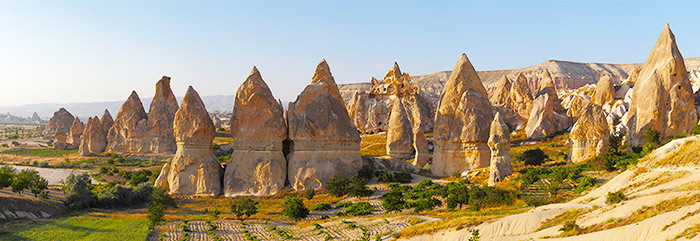
A land of radical disciples, families, and missionary monks
One of the first group of people from other nations to receive the Gospel and outpouring of the Holy Spirit at the beginning of the early church were the Cappadocians in Asia Minor (today located in central Turkey). Luke in his account of Pentecost in Acts chapter 2, list the residents of Cappdocia among the nations gathered in Jerusalem for the Feast (Acts 2:9). They witnessed the tongues of fire which appeared over the heads of the apostles and other disciples who had gathered in the upper room in prayer for the coming of the Holy Spirit. And to their utter amazement when they heard Peter and the other apostles speak to the crowds, each heard them in their own native language.
We know that the Gospel quickly spread to Cappadocia and throughout the region of Asia Minor. Peter’s First Letter specifically addressed the Christian communities in Pontus, Galatia, Cappadocia, Asia, and Bithynia – all Roman provinces in Asia Minor.
“Peter, an apostle of Jesus Christ, To those who are elect exiles of the Dispersion in Pontus, Galatia, Cappadocia, Asia, and Bithynia, according to the foreknowledge of God the Father, in the sanctification of the Spirit, for obedience to Jesus Christ and for sprinkling with his blood: May grace and peace be multiplied to you.”
1 Peter 1:1-2
When Peter wrote his letter, sometime before his execution in Rome between 64 – 67 AD, the majority of the Christians in Cappadocia and Asia Minor were Gentile converts. Peter addressed them as “elect exiles” living in “dispersion.” These were titles originally given to the Jews who were a nation chosen by God but now were dispersed among the Gentile nations after the Babylonian exiles. Peter wrote his letter during a time of persecution which affected the Christians living in the Roman provinces of Asia Minor. Peter wrote to affirm them in the faith and to encourage them to persevere with hope in the midst of severe trials and persecution.
Witness of heroic martyrs among the Christians of Cappadocia
A number of holy martyrs were honored as Christian heroes throughout Cappadocia, including St. George the Wonder Worker – a Roman officer under Diocletian in 303, Orestes the Physician in 304, the Forty Holy Martyrs of Sebaste in 320, the martyr Barbara of Nicomedia, and the martyr Catherine of Alexandria in 305. They were tortured and put to death for their bold witness of faith and loyalty to Jesus Christ. A number of the early rock cut cave churches and shrines in Cappadocia were dedicated to their honor.

The Martyr St. George of Cappadocia
The martyr George, whom Eastern Christians call the Victory-Bearer and Wonder Worker, was a native of Cappadocia, a Roman province in Asia Minor. He was raised in a deeply committed Christian family. His father was martyred for Christ when George was still a child. His mother was originally a Greek native from Lydda in the Roman province of Syria Palaestina. After his father’s death, George and his mother settled back in the Syrian province where she owned land.
When George came of age, he joined the Roman army. He was brave and valiant in battle, and he came to the notice of the emperor Diocletian (284-305) and joined the imperial guard with the rank of comites, or military commander.
As Christians increased in number and influence, Diocletian, who was pagan and anti-Christian, began to intensify his persecution against the Christians. Following the advice of the Senate at Nicomedia, Diocletian gave all his governors full freedom in their court proceedings against Christians, and he promised them his full support.
When George heard the decision of the emperor he decided to take a public stand against the empereor’s edict. George distributed all his wealth to the poor, freed his servants, and then appeared in the Senate. The brave soldier spoke out openly against the emperor’s designs. He confessed himself a Christian, and appealed to all to acknowledge Christ: “I am a servant of Christ, my God, and trusting in Him, I have come among you voluntarily, to bear witness concerning the Truth.”
“What is Truth?” one of the dignitaries asked, echoing the question of Pontius Pilate. The saint replied, “Christ Himself, Whom you persecuted, is Truth.”
Stunned by the bold speech of the valiant warrior, the emperor, who had loved and promoted George, attempted to persuade him not to throw away his youth and glory and honors, but rather to offer sacrifice to the gods as was the Roman custom. The confessor replied, “Nothing in this inconstant life can weaken my resolve to serve God.”
Then by order of the enraged emperor the armed guards led him off to prison and began to torment him there. The next day at the interrogation, powerless but firm of spirit, George again answered the emperor, “You will grow tired of tormenting me sooner than I will tire of being tormented by you.” George was severely tortured for days and then sentenced to death for refusing to recant his faith.
At the place of execution he prayed that the Lord would forgive the torturers who acted in ignorance, and that God would lead them to the knowledge of Truth. Calmly and bravely, George bent his neck beneath the sword, receiving the crown of martyrdom on April 23, 303.
The martyr George was widely honored among the Christians in Cappadocia for his bold witness of faith and perseverance in suffering for Jesus Christ. He is called St. George the Wonder Worker for many miracles that were attributed to him. The Cappadocian bishops in the 4th and 5th centuries included him in the annual feast day commemoration of martyrs, and a number of shrines and churches which were built to honor the martyrs included St. George among them.
The photo above features a wall frescoe painted in the cave church of St. Basil in Cappadocia, dating from the 5th century, which depicts St. George on his horse with a spear in his hand slaying the dragon – a biblical symbol of Satan and his kingdom of darkness and evil.
sources: Life and Society in Byzantine Cappadocia, by J. Eric Cooper, and George the Great Martyr

Martyrdom of the Forty Christian Soldiers of Sebaste in 320 AD
Gregory of Nyssa (330-395 AD) in his homily on the commemoration of the Forty Holy Martyrs of Sebaste, describes the martyrs as forty battle-tested and highly-decorated Roman soldiers, who were part of the Twelfth Legion “Fulminata” (Legio XII Fulminata) meaning “Armed with Lightning” stationed in Cappadocia. They were also very committed Christians who openly confessed their faith. During the persecution by the emperor Lucinius in 320 AD, they were interrogated and refused to recant their faith.
According to Basil the Great (329-379 AD), they were condemned by the pagan prefect to be exposed naked upon a frozen pond near Sebaste, (in southern Anatolia ) on a bitterly cold night, so that they might recant their Christian faith or freeze to death. Among the suffering soldiers, one weakened, and left his companions, seeking the warm bath house or banya near the lake which had been prepared for any who might waver in their faith. This one deserter, according to the Synaxarion, dropped dead as soon as he crossed the threshold to the bath house. One of the guards, who was appointed to keep watch over the martyrs, saw a supernatural light descending over them. Immediately he proclaimed himself a Christian, threw off his garments, and placed himself beside the thirty-nine soldiers of Christ. Thus the number “forty” remained complete.
At dawn, the stiffened bodies of the confessors, some of which still showed signs of life, were crushed with hammers, burned and then the charred bones were cast into a river so that Christians would not gather them up. Three days later the martyrs appeared in a dream to Peter, Bishop of Sebaste, and commanded him to recover and bury their remains. The bishop, together with several clergy, gathered up the relics of the glorious martyrs by night and buried them with honor. Later, their relics were recovered and distributed throughout many cities. In this way the commemoration of the Forty Martyrs became widespread, and numerous churches and shrines were erected in their honor.
Many Christians today commemorate their martyrdom on March 9th and March 10th.
Martyrdom of Orestes the Physician in 304 AD
The Martyr Orestes the Physician of Cappadocia lived at the end of the third century in the city of Tyana in Cappadocia in the time of the emperor Diocletian (284-305). He was a capable soldier, and from childhood a very committed Christian.
By order of the emperor, the military officer Maximinus was sent to Tyana to deal with Christianity, which then had spread widely throughout Cappadocia. Orestes was among the first brought to trial to Maximinus. He bravely and openly confessed his faith in the Crucified and Risen Lord, Jesus Christ. The prosecutor offered the saint riches, honors and renown to renounce God, but Saint Orestes was unyielding.
At the order of Maximinus, they took Orestes to a pagan temple and again demanded that he worship idols. When he refused, forty soldiers took turns one after the other, beating the Orestes with lashes and rods, and then they tormented him with fire. Orestes cried out to the Lord, “Establish with me a sign for good, let those who hate me see it and be put to shame” (Psalm 85/86:17). The Lord heard his servant. The earth began to tremble, and the idols fell down and were smashed. Everyone rushed out of the temple, and when Saint Orestes came out, the very temple tumbled down.
Infuriated, Maximinus ordered the holy martyr to be locked up in prison for seven days giving him neither food nor drink, and on the eighth day to continue with the torture. They hammered twenty nails into the martyr’s legs, and then tied him to a wild horse. Dragged over the stones, the holy martyr departed to the Lord in the year 304. His relics were thrown into the sea.
In 1685, when Saint Demetrius, later the Bishop of Rostov, was preparing the Life of Saint Orestes to be printed by the Kiev Caves Lavra, he became tired and fell asleep. The holy martyr Orestes appeared to him in a dream. He showed him the deep wound in his left side, his wounded and severed arms, and his legs which had been cut off. The holy martyr looked at Saint Demetrius and said, “You see, I suffered more torments for Christ than you have described.” The humble monk wondered whether this was Saint Orestes, one of the Five Martyrs of Sebaste. The martyr said, “I am not that Orestes, but he whose Life you have just finished writing.”
A distinguished family of holy women, monks, and bishops
Macrina of Caesarea: philosopher, monastic foundress, miracle worker
One distinguished holy woman from Cappadocia was Macrina (330-379 AD), a philosopher, miracle worker, and founder of a monastic community of women. Macrina was the eldest of 10 children in a well-off Christian family in Cappadocia. Along with Macrina, this family produced an extraordinary number of saints: the girl’s maternal grandmother (Macrina the elder), for whom she was named; her parents, Basil and Emmelia; and three of her brothers, all bishops – Peter of Sabaste, Gregory of Nyssa, and Basil of Caesaraea, and a fourth brother, Naucratius who became a renowned Christian jurist, and a sister (or sister-in-law), Blessed Theosebia the Deaconess.
Gregory of Nyssa wrote a 35-page narrative of his sister’s life around 380-383. In an introduction to The Life of Saint Macrina, scholar Kevin Corrigan calls Macrina the “spiritual guide” in her distinguished family and says that her “influence upon the major currents of her own time is evident on almost every page of the [Life], an influence that goes to the very heart of Christianity.”
According to the Life, the holy woman rejected “a great swarm of suitors,” preferring a life of Christian asceticism. She persuaded her mother to give up their “rather ostentatious lifestyle,” treat her maids as “sisters and equals instead of slaves and servants” and turn their home into a monastery for women.
Peter founded a men’s monastery near Macrina’s community on the banks of the river Isis. Basil became the father of a monastic tradition that still forms the basis for much Orthodox monasticism today. But it seems he wasn’t always inclined toward renunciation. Gregory relates that when “the great Basil” returned from school as a young man, “he was monstrously conceited about his skill in rhetoric” until Macrina gave him a talk. “So swiftly did she win him to the ideal of philosophy that he renounced worldly appearance” to follow his life of poverty and virtue.
Gregory heard her last philosophical discourse on a visit he made to his sister at the end of her life. (“I kept wishing that the day could be lengthened so that she might not cease to delight our hearing,” he wrote.) He was with the many women at Macrina’s bedside when she died in 379. News of her death “spread like wildfire,” and crowds of people poured in for the funeral procession, many telling Gregory about miracles “the great Macrina” had performed while she was alive.
source by Erin Ryan
A new domestic asceticism
“The fourth century marks the beginning of a golden age of monasticism in the church, and in the forefront of our minds here are the great founders and fathers of Christian asceticism. We think, rightly, of Antony the Great (d. 356), about whom several lives were written, though Athanasius’s became the most famous. We think of Pachomius (d. 346), whom we regard as the founder of coenobitic monasticism and who wrote the first rule to guide the common life for communities of both male and female ascetics. We think of Rufinus (d. 410) and Jerome (d. 420). The pioneering female ascetics should not be forgotten: Marcellina (d. 398), Demetrias (after 440), Melania the Elder (d. 410) and the Younger (d. 439). And, of course there are our Basil and Macrina (d. 379).
“We do well to recognize, however, that this golden age is not limited to the institutionalized forms of asceticism but also embraces the less organized and more inchoate movement, from which some of the more organized forms grew.⁴ At least two factors spurred the growth of this movement, as they did of organized asceticism: persecution before Constantine’s conversion and the secularization of the church that followed it. While persecution must have affected individual families differently, Gregory of Nazianzus indicates how it affected Basil’s paternal grandparents.⁵ During the reign of Maximinus, he tells us, Basil’s ancestors steered the virtuous mean between cowardice and foolhardiness in the face of persecution (Or. 43.5–6). They fled to the mountains of Pontus as a small company without servants and stayed there for around seven years. “Their mode of life,” Gregory relates, “delicately nurtured as they were, was straitened and unusual, as may be imagined, with the discomfort of its exposure to frost and heat and rain, and the wilderness allowed no fellowship or converse with friends” (Or. 43.6; 397).
“Gregory describes here a sort of forced ascetic life. The wilderness forced on Basil’s grandparents not only the bodily discomfort turned asceticism brought on by the elements but also ascetic isolation, a sort of social abstinence. As a very famous and later example of the former, we can call to mind Augustine’s dear friend Alypius, who “tamed his body to a tough discipline by asceticism of extraordinary boldness: he went barefoot on the icy soil of Italy” (Conf. 9.6.14; 163).
“Basil’s grandparents and their companions, Gregory tells us, did not grumble as did the Israelites in the desert. Rather, in piety and faith they cast themselves upon the mercy and bounty of God, who provided them wild game for food. These animals were not hunted or chased with dogs but with prayers, at which “their quarry lay before them, with food come of its own accord, a complete banquet prepared without effort, stags appearing all at once from some place in the hills” (Or. 43.7; 397). Persecution became the occasion for prayer and ascetic struggle, and Basil’s grandparents took advantage of it. Indeed, Gregory wonders at these wild animals presenting themselves as food to Basil’s relatives, not hunted by them but “caught by [their] mere will to do so” (Or. 43.8; 397). He sees this both as a foretaste of heaven and a reward for the “struggle” (athlēsin) in which they had been engaged (Or. 43.8).
“With the conversion of Constantine, mediocrity and sometimes corruption replaced persecution as a spurring influence on both formal and domestic asceticism, for Constantine’s beneficence to the church was a mixed blessing. It meant the production of Bibles, the building of churches, the restoration of property, tax breaks and some civil powers for clergy, and so on, but it also meant lukewarm half-converts from paganism and unscrupulous men seeking ecclesial office for worldly reasons. We will see later that one of the moving forces behind Basil’s ascetic thought was his conviction that the church of his time experienced so many difficulties and internal divisions because Christians, especially Christian leaders, had abandoned the commandments of Jesus and the order and peace that flow from keeping them (On Judg. 1–2).
“Anna Silvas describes well the household asceticism that resulted from Christian families devoting themselves to living the gospel: The values of the Graeco-Roman civic politeia gradually yielded to more explicitly Christian virtues. The cultural shift is seen especially in the fostering at home of the Scriptures and church traditions, in the practice of hospitality, personal frugality, and a Gospel charity in which the ruling idea is no longer philanthropy with a view to civic kudos, but self-effacing succour of the poor in imitation of Christ. (Silvas, 68)
“We see a shift to from the ascetic practices of Basil’s grand-parents to those of his parents. There was a movement from the forced and prayerful austerity of living in the woods to avoid persecution to the “community of virtue” notable “for generosity to the poor, for hospitality, for purity of soul as the result of self- discipline, [and] for the dedication to God of a portion of their property” (Or. 43.9; 398). This is not quite the shift that Silvas describes above, but, of course, the one type of shift is not exclusive of the other, and we will see in Basil himself as in his family a gradual abandonment of the trappings and values of the secular culture in which they lived as they ever more thoroughly embraced the gospel and its social implications.”
Excerpt from Basil of Caesarea, by Stephen M. Hildebrand, (c) 2014, published by Baker Academic
Basil of Caeserea
Basil the Great reformed the monastic movement in Cappadocia by instructing his brother monks to live together in monastic communities so they could fulfill the commandment to “love your neighbor as yourself.” The monks also were at the service of the local population, providing spiritual help, education, and charitable works for the disadvantaged.
The first monastic communities were small structures built to provide the Christian monks with solitude and a place for meditation. They were located near sources of water. Daily worship took place under the supervision of a member of the clergy. Everything was shared, the sick were tended, and there were no differences that would cause a rupture with the local Christian population
Basil created a “new city” of charitable works for the disadvantaged
When famine struck Cappadocia in 369 AD, Basil and his fellow monks began a daily service of providing food for the poor. Basil’s brother Gregory of Nyssa describes how he daily gathered together the poor to “set before them basins of soup and meat.” Basil’s soup kitchen served as an impetus for Basil to appeal to the wealthy to join him in financing and creating a “new city” devoted to charitable works on behalf of the disadvantaged.
Basil’s vision included a complex of hospitals for lepers and invalids, an orphanage and place to care for the elderly, and a training center for the unskilled, and a hospice for travelers. Basil staffed the hospitals with competent doctors. Monks, nuns, and laypeople served as caregivers. His “new city” of charitable works inspired other bishops and communities to build similar facilities in their cities, such as Constantinople and Alexandria.
When Basil the Great died in 379, he close friend, Bishop Gregory Nazianzen, during the funeral oration reminded his audience of Basil’s charity towards the poor:
Go forth a little way from the city, and behold the new city, the storehouse of piety, the common treasury of the wealthy… where disease is regarded in a religious light, and disaster is thought a blessing, and sympathy is put to the test…
My subject is the most wonderful of all, the short road to salvation, the easiest ascent to heaven. There is no longer before our eyes that terrible and piteous spectacle of men who are living corpses, the greater part of whose limbs have mortified, driven away from their cities and homes and public places and fountains, aye, and from their own dearest ones, recognizable by their names rather than by their features… no longer the objects of hatred, instead of pity on account of their disease…
[Basil] took the lead in pressing upon those who were men, that they ought not to despise their fellowmen… Others have had their cooks, and splendid tables, and the devices and dainties of confectioners, and exquisite carriages, and soft, flowing robes; Basil’s care was for the sick, and the relief of their wounds, and the imitation of Christ, by cleansing leprosy, not by a word, but in deed.
This article is excerpted from Early Christian Communities, Cave Churches, and Underground Cities in Cappadocia – A Land of Martyrs, Monks, and Holy Families by Don Schwager, 164 pages. An online PDF copy of the book is available to read or download at Academia.edu.
Image credits: (1) Top photo, by Benh Lieu Song, of a rock formation, near Gorëme in Cappadocia, central Turkey. Image source from Wikimedia Commons. Free to use under the license CC BY-SA 3.0.

2) Second image is an icon depicting the Forty Holy Martyrs of Sebaste. Image source is from Wikimedia Commons. Image in the Public Domain.

(3) Third image depicts a wall fresco painting of Saint George of Cappadocia, located in the rock cut cave church of St. Basil, in Goreme, Cappadocia. Photo © by David Lyons / Alamy Stock. Used with permission.
Don Schwager is the editor of Living Bulwark and author of the Daily Scripture Reading and Meditation website. He is a lay religious brother and life-time member of the Servants of the Word.