


I can’t think. I can hardly pray. But I can trust and love.
My first big clue that something was very wrong came in February 2009. I was on a Christian mission trip to Costa Rica, meeting with a small group of women. Suddenly I couldn’t understand a word they were saying.
I didn’t let on, but I was totally at a loss. All I could do was make a comment every now and then and hope it was all right. I got some puzzled looks, but somehow I made it through the next hour. Afterwards, I reverted to normal.
Things weren’t normal, though, when I got back home. I cried all the time without knowing why. In my job as a high-level statistician, I found myself struggling to analyze data and needing to delegate my work to other analysts.
“Could be menopause,” a friend suggested. I was fifty-six and had already gone through that stage, so it didn’t seem likely. “Stress,” thought someone else. I took a month off from work, but things only got worse.
A nurse practitioner urged me to see a doctor, and so began two years of medical tests. Early on, after a psychological test revealed “significant” mental impairments, one specialist noted: “probably Alzheimer’s disease.” If I ever read his comment, I dismissed it right away.
That diagnosis wasn’t confirmed until May 2011. By that time, because of my increasing confusion and forgetfulness, I had left the job I loved. And I was wrestling with God in a very serious way.
But I’m your bride!
For most of my adult life, I’ve lived “single for the Lord” as part of an ecumenical group of women who have chosen not to marry in order to dedicate ourselves to a life of prayer and Christian service. And so, though we work at various professions and don’t take religious vows, I see myself as a bride of Christ, deeply loved and deeply in love with Jesus.
Every day before work, I used to get up to spend an hour with him. I loved it. I’d praise and worship God – singing, reading Scripture, reflecting, and writing down things that struck me. But as I felt myself declining, I became very angry with the Lord.
“Is this the way you treat your bride?” I’d ask him. But he was silent.
Deep down, I knew that if I refused to choose “your way, not mine,” I was the one who was going to be the loser. Still, for nearly two years I fought and struggled. I denied what was happening, tried to cover up, refused to discuss it. With all my heart I wanted to believe that my problem was sleep deprivation, stress, or even depression – anything but Alzheimer’s.
This wrestling went on and on, but at least I kept talking to the Lord. Then one day, during my prayer time, he gave me an unexpected grace. I suddenly realized that I could really trust him with my future. “I accept this,” I told Jesus very simply.
The peace I felt got me through the final medical consultation, which left no doubt that I have progressive dementia: Alzheimer’s disease, according to one last test. Sherry, a close friend who is also single for the Lord, was with me as I got the bad news
“Myriam, you’re too quiet,” she said, when we were back in the car. “What are you thinking?”
“I’m okay. I worked it out with God last night. And I told him it’s okay, whatever it is.”
Sherry couldn’t believe what she was hearing. I could hardly believe it myself. It was pure grace – and so freeing to be able to admit what was happening and to talk about it.
Loved and loving
After a couple of weeks, I felt like the Lord was asking something more: Thank me. Again I wrestled. Accepting my situation had been hard enough. Did I really have to do this too? It was hard, very hard, but again there came the grace to say yes.
Months later, I realized that I was truly grateful for some of the changes I saw in myself. “I’m relating to people differently, in a softer, more loving way. Thank you, Jesus, for this opportunity.” And as I prayed, I sensed a call to go deeper – not just to accept and give thanks, but to embrace the journey with trust in God’s love and wisdom. This time my response came easily: I embraced it like a gift from heaven.
This may sound strange, but even as I’m losing my abilities, I’m seeing the “gift” side of what’s happening. More and more, all I can do is love and be loved. And I feel so much love from so many people! They’re praying for me, telling me what I mean to them, thanking me for ways I’ve helped them.
And God is still using me to speak words that people need to hear. When women I’ve counseled over the years call and ask my advice, I usually know what to say. I say it more directly, too, because along with Alzheimer’s comes a lessening of inhibitions! I noticed this recently, when a woman in my Zumba exercise class said how worried she was that her husband might have dementia. Not only did I tell her how to get medical help, but right there, with other people listening in, I prayed with her. “I feel so much better now,” she said afterwards.
Suffering servants
Don’t get me wrong, though. Embracing this journey isn’t the same as embracing the disease. I’m doing all I can to stay fit and slow my decline – speech therapy, exercise, social contacts, a good diet. If God chooses to heal me, I’ll be ecstatic.
And although I’ve arrived at a basic peace, there are still struggles and tears.
I loved being a statistician, being savvy and capable. Now I can’t even count. I can’t tell time without a lot of effort. If people talk fast, I can’t understand what they say. I have a hard time focusing to pray. It’s hard to accept help, too, hard to let go.
An experience I had at the airport last year drove home this sense of loss and helplessness. I was traveling with Sherry, but she went through security just ahead of me and couldn’t help when I got confused at the guards’ directions. I couldn’t understand where they wanted me to place my luggage. I didn’t know which hand they wanted me to raise. “Don’t you know one from the other?” one guard jeered.
I stumbled out of the checkpoint crying. I felt so humiliated. “This is what’s coming,” I was thinking. “This is the way I’m going to be – all the time.” Explaining it to Sherry later, I could only say I’d had a taste of what it was like for Jesus, when he was stripped of everything and people were mocking him. I take comfort in the fact that I am being conformed to him. As I wrote in my journal: “As time goes on and I lose all I have – the ability to communicate, my memory, being able to do my daily functions – I see that all this is making me more like Jesus, the suffering servant.”
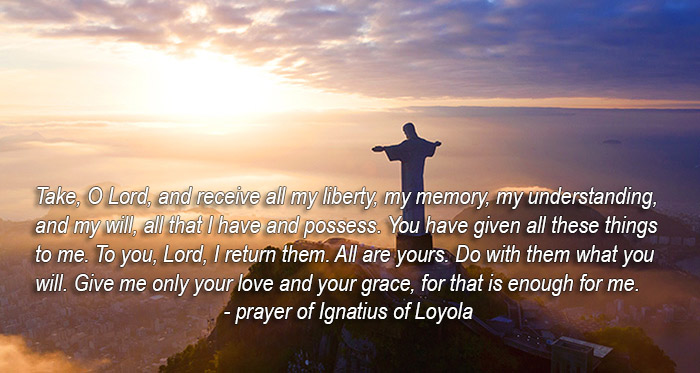
St. Ignatius Loyola put it more eloquently in words that I now pray from the heart:
Take, O Lord, and receive all my liberty,
my memory, my understanding, and my will,
all that I have and possess.
You have given all these things to me.
To you, Lord, I return them.
All are yours. Do with them what you will.
Give me only your love and your grace,
for that is enough for me.
This article was previously published in the April/May 2013 issue of Living Bulwark.
- See related article. Quotes to Live By – Compiled by Myriam Torres
Top image credit: Photo of Christ the Redeemer statue in Rio de Janeiro, Brazil, aerial photo by © Peter Adams, source Shutterstock.com, ID: 652195627. Used with permission. Quote from Ignatius of Loyola added.
Myriam Torres died peacefully on August 1, 2018, after a ten-year battle with early-onset Alzheimer’s disease. When faced with her diagnosis, she chose to accept it with grace and dignity. Myriam was born in New York City and returned with her parents to Puerto Rico when she was ten. She graduated Summa Cum Laude from the University of Puerto Rico with a Bachelors degree in Statistics. Her hard work won her the only ITT post graduate grant award in 1975 at the age of twenty-two, and gave her the opportunity to attend the University of Michigan where she completed her Masters degree in the same field. For most of her career Myriam worked as a Research Associate for the Institute of Social Research at the University of Michigan.
Although Myriam loved her work and did it with diligence, advancing her career was never her priority. She chose to work less hours in order to dedicate her life to sharing her Christian faith and helping others come to know the love of God. Myriam lived a life of simplicity and consecrated celibacy in order to serve others. She was a faithful parishioner at Christ the King Catholic Church in Ann Arbor. She was a member of Word of Life Community, an ecumenical Christian community based in Ann Arbor, Michigan, USA and a member of Bethany Association, an international, ecumenical association of women living single for the Lord in various communities of the Sword of the Spirit. Myriam served Christian communities around the world (Central America, Mexico, Spain, Lebanon, and the USA) with a focus on helping young women grow in their love for God and their capacity to navigate their professional and personal lives with faith and joy.