


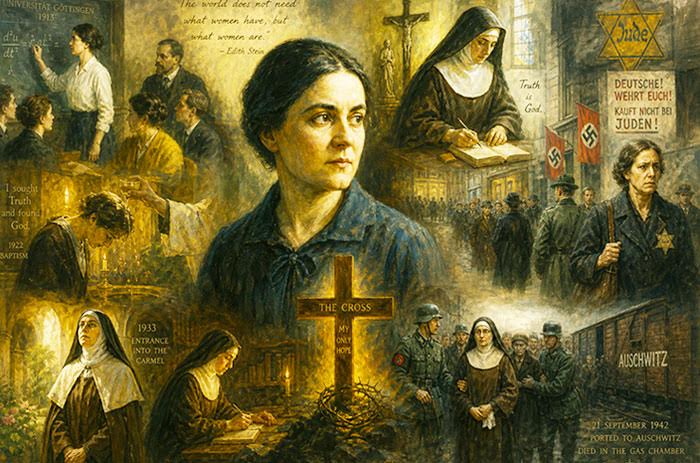
The Heroic Life of Edith Stein in Nazi Germany
A biographical reflection by Jeanne Kun
A young woman in search of the truth
“I keep having to think of Queen Esther who was taken from among her people precisely that she might represent them before the king,” Sister Teresa Benedicta wrote to an Ursuline religious sister late in 1938. “I am a very poor and powerless little Esther, but the King who chose me is infinitely great and merciful. That is such a great comfort.”
Edith Stein was born into a prominent Jewish family in Breslau, Germany (present-day Wroclaw, Poland), on Yom Kippur, the Jewish Day of Atonement, in 1891. As a teenager she abandoned Judaism and became a self-proclaimed atheist.
She attended the university in Breslau and, later, in Göttingen, where she sought intellectual truth in the study of philosophy and became a protégé of the famed philosopher Edmund Husserl. She earned her doctorate of philosophy in 1916, but her search for truth remained unfulfilled.
The following year Edith was impressed by the calm faith that sustained a Christian friend at the death of her husband. “It was my first encounter with the cross and the divine power that it bestows on those who carry it.”
Edith later wrote.
“For the first time, I was seeing with my very eyes the church, born from its Redeemer’s sufferings, triumphant over the sting of death. That was the moment my unbelief collapsed and Christ shone forth – in the mystery of the cross.”
Taking up the cross of Christ
Edith chose her religious name, Sister Teresa Benedicta of the Cross, anticipating that she would share in the Lord’s sufferings. “By the cross I understood the destiny of God’s people which, even at that time, began to announce itself,” she later explained to a friend. “I thought that those who recognized it as the cross of Christ had to take it upon themselves in the name of all.”
As the situation worsened for Jews in Germany, Sister Teresa Benedicta knew she was not safe in the Cologne monastery and also believed that her presence there put all the nuns in danger. On the night of December 31, 1938, she crossed into the Netherlands where she was received at the Carmel monastery in Echt. Her sister Rosa, who had also become a Catholic, later followed her and served as a lay portress at the monastery. However, the Nazis occupied the Netherlands in 1940 and Jews, even those who were converts to Christianity, were no longer safe there either.
A martyr through the silent working of divine grace
Sister Teresa Benedicta and Rosa were arrested on August 2, 1942, as part of Hitler’s orders to deport and liquidate all non-Aryan Catholics. This was in retaliation for a pastoral letter issued by the Dutch bishops that protested Nazi policies. As the two were taken from the convent, Sr. Teresa was heard to say to her sister: “Come, Rosa, let us go for our people.” Their lives ended a week later in the gas chamber at Auschwitz.
Like Queen Esther, Edith Stein identified with her fellow Jews in their grave danger and interceded for them. When she was formally declared blessed in 1987 by the Catholic Church, a selection from the Old Testament’s Book of Esther was read at her beatification ceremony.
When she was formally declared a saint on October 11, 1998, Pope John Paul II noted:
“A young woman in the search of the truth has become a saint and martyr through the silent working of divine grace: Teresa Benedicta of the Cross, who from heaven repeats to us today all the words that marked her life: ‘Far be it from me to glory except in the Cross of our Lord Jesus Christ.’”
Now alongside Teresa of Avila and Thérèse of Lisieux, another Teresa takes her place among the hosts of saints who do honor to the Carmelite Order.”
Life in a Jewish Family from the writings of Edith Stein
The highest of all the Jewish festivals is the Day of Atonement, the day on which the High Priest used to enter the Holy of Holies to offer the sacrifice of atonement for himself and for the people; afterwards, the “scapegoat” upon whose head, symbolically, the sins of all the people had been laid was driven out into the desert.
All of this ritual has come to an end. But even at present the day is observed with prayer and fasting, and whoever preserves but a trace of Judaism goes to the “Temple” on this day.
Although I did not in any way scorn the delicacies served on the other holidays, I was especially attracted to the ritual of this particular holy day when one refrained from taking any food or drink for twenty-four hours or more, and I loved it more than any of the others. . .
For me the day had an additional significance: I was born on the Day of Atonement, and my mother always considered it my real birthday, although celebrations and gifts were always forthcoming on October 12. (She herself celebrated her birthday according to the Jewish calendar, on the Feast of Tabernacles; but she no longer insisted on this custom for her children.) She laid great stress on my being born on the Day of Atonement, and I believe this contributed more than anything else to her youngest’s being especially dear to her.
[Excerpt from Edith Stein’s autobiography, Life in a Jewish Family, written in 1933, translated by Josephine Koeppel, 1986.]
This article by © Jeanne Kun is excerpted from the book, Even Unto Death: Wisdom from Modern Martyrs, first published by The Word Among Us Press, 2002. Used with permission.
- See related article, The Prayer of the Ever-Living Christ by Edith Stein (1891-1942)
Top image credit: AI enhanced digital artwork depicting the heroic life of Edith Stein in Nazi Germany. Image source from artstyles.com. Used with permission.
Jeanne Kun is a noted author, and a member of Bethany Association, an international, ecumenical association of women living single for the Lord in various communities of The Sword of the Spirit, and a senior woman leader in the Word of Life Community, Ann Arbor, Michigan, USA.