


The Letter to the Ephesians begins with a prayer of blessings:
“Blessed be the God and Father of our Lord Jesus Christ, who has blessed us in Christ with every spiritual blessing in the heavenly places …”
Ephesians 1:3
In this prayer, what God has done for us in Christ is described with the phrase “every spiritual blessing in the heavenly places”. Christ brings us the fullness of such blessing, although that blessing was foreshadowed, predicted, and prepared for in the old covenant.
Earthly blessing of the old covenant
The blessings of the covenant of Sinai are, to all appearances, blessings of this world. The people of Israel were given a physical land to live in. They farmed that land which was flowing with milk and honey, and it provided them with good things to eat and drink.
As they lived in that land, they increased and multiplied, becoming numerous and strong. Enemies, pagan nations who worshipped false gods, surrounded them, but God protected them from those nations, gave them victory in battle, and freed them from enemy oppression.
They went up regularly to the temple in Jerusalem, where God was present, and worshipped him, acknowledging him as their king, receiving instruction in his law, and thanking him for the blessings he gave them. As long as they were faithful to his covenant and kept his commandments, these blessings were theirs.
The blessings of the people of Israel were real and worthwhile, but they are not well described as every spiritual blessing in the heavenly places. They prefigured and foreshadowed those spiritual blessings, but they were earthly, not heavenly blessings, natural or physical, not spiritual (1 Corinthians 15:46–47). The blessings in Christ are different.
The spiritual, heavenly blessings of Christ
The prayer in Ephesians 1:3 describes the blessings given through Christ as “spiritual.” “Spiritual” here as in other places does not mean “immaterial,” but “of or in the Spirit.” The blessings in Christ are given to us by the agency of the Holy Spirit. They do not make us or our lives immaterial or non-human. Rather, they spiritualize us and our lives, filling us with the power and presence of God, allowing us to live in a higher, godlier way.
The prayer also describes these blessings as being given in heavenly places. First Corinthians 15:47–49 says the blessing given to us makes or will make us “of heaven” rather than “of earth.” The heavenly character of our call or blessing does not mean that we leave the earth or cease to function on earth. Rather, it means that we come into a new relationship with God with a freer access to his presence which is “in heaven,” his throne room. With such blessings, our life is lived more for God and more from his presence and his power, even while we are still living this present life on earth.
Christ gives us a new life in God
The spiritual, heavenly blessing Christ gives us is a new life in God, the life of the kingdom of God, the life of the Spirit. The primary content of this blessing is a better relationship with God—our sins are forgiven, the Holy Spirit is poured out upon us, we are allowed into the presence of God in a new way, we have the relationship of sonship with God, he dwells inside of us. To live in such a relationship is a higher life, a spiritual or heavenly one.
At the same time we are changed. The gift of the Spirit gives us new power to live the new life; the character of God is formed in us; we are freed from the oppression of evil spirits; we experience charismatic gifts working through us. This is life on earth “spiritualized” and made “heavenly.”
Finally, we also have a share in the kingdom to come. When the kingdom comes fully or when we ourselves “go to heaven,” we will experience the blessing of God in a full way, including the blessing of having all our material needs and desires satisfied. As a result, we look forward to the time when God will fully reign and we will live with him “face to face.” This future orientation likewise makes our life heavenly.
We will look at the full coming of the kingdom in the next chapter.
Special Exegetical Discussion: The Sociological Stages of God’s People
A major issue that regularly surfaces is how various provisions in the Scripture are to be applied in the life of the Christian people, especially in relationship to those outside the Christian community, but also often in relationship to Christians who belong to other Churches and Christian communities. The discussion is often very confused, in large part because of the failure to make distinctions between the various sociological situations in which the Christians have found themselves. The discussion that follows here makes the main distinctions.
For instance, we can read discussions about Christian engagement in warfare in the early church. They note that Christians did not very often seem to participate in the Roman army at first but later the Roman armies were made up mainly of Christians and commanded by Christians. Various reasons are given, but often the discussions omit the fundamental fact that, with the conversion of much of the Roman Empire, the Christian people had moved from a diaspora situation to being a nation among nations.
It is one thing, for instance, to think Christians should not engage in warfare when they lived in the pagan Roman Empire, whose legions protected them and their neighbors reasonably well. It is another thing to think that Christians who lived in a Christian Roman Empire should let the Huns pillage, plunder, and rape, burning churches and monasteries, and not fight to ward them off. They had to handle a new and different situation.
We have already observed that the sociological situation comes into play as well in understanding the differences in the stages of God’s plan. The Israelites had their own system of administering judgment and sometimes executed wrongdoers. The diaspora Jews and the Christians in the Roman Empire before the conversion of the Empire could not do that. They took a different approach, as we have seen in the earlier discussion in chapter 8 on the civil commandments.
Below is an empirical description (sociological) of the stages of the development of God’s people. The focus is on the relation of God’s people to others around them, and does not attempt to present all the important aspects of their development. Starting with stage 6, it is a sketch of the development of the Christian people/culture.
The Major Kinds of Relationship to Others
1. A nation among nations: God’s people governing themselves, living in their own territory, and subject to no other human government except perhaps in a tributary way.
2. A subject nation: God’s people governing themselves, living in their own territory, but under the active government of another nation or empire.
3. A diaspora: God’s people living in another nation’s (or other nations’) territory as resident aliens, with a limited government of their own, and subject to the government of the territory they are part of.
4. A nomad tribe: God’s people living as a nation without their own land, sometimes living in lands unclaimed by any other nation, and sometimes living as resident aliens in the territory of another nation but on a temporary basis.
5. A sect: a grouping of God’s people living within a larger grouping of God’s people, partly identifying with and participating with the larger grouping, but partly living a separate way of life, with a separate corporate identity under a separate government.
6. Secularized (partly assimilated) Christians: Christians living in a secularized society, unable to maintain the integrity of their way of life or a clear corporate identity.
This article by Steve Clark is excerpt from The Old Testament in the Light of the New; The Stages of God’s Plan, © Stephen B. Clark, (2017), Emmaus Road Publishing. Steubenville, Ohio, USA.
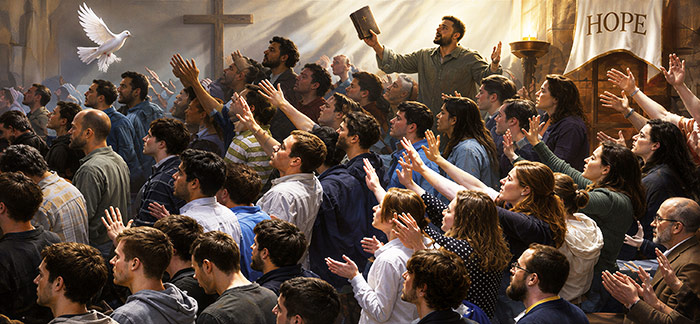
Top image credit: An Illustration of Christians worshipping together in community. Image created with digital paintbrush and AI enhanced artwork from © Artstyles.com. Used with permission.