


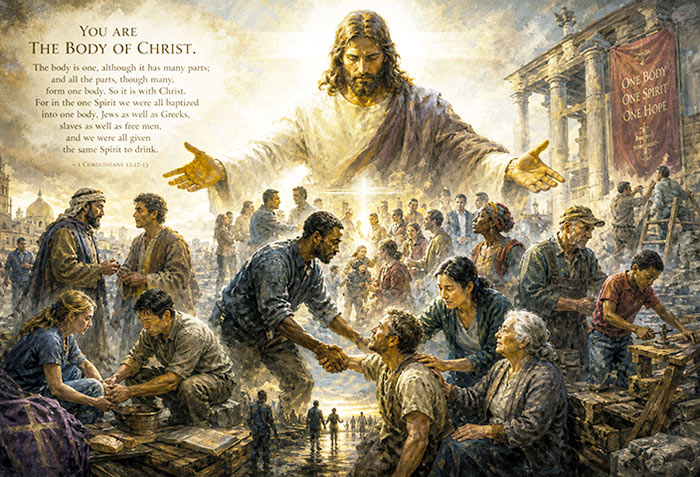
We are members of the body of Christ
The phrase “the body of Christ” is found in the letters of Paul. In Ephesians, one of his later letters, he uses the term to refer to the universal church. However, in his earlier letters he applies the term to a local Christian assembly. He tells the Christians in Corinth that they should function as a body because they are the body of Christ.
“Just as the [human] body is one and has many members, and all the members of the body, though many, are one body, so it is with Christ.”
1 Corinthians 12:12
The members of the Christian body have different gifts, but they are to function in unity.
“Now you are the body of Christ and individually members of it. And God has appointed in the church first apostles, second prophets, third teachers, then workers of miracles, then healers, helpers, administrators, speakers in various kinds of tongues… Are all teachers? Do all work miracles? Do all possess gifts of healing? Do all speak with tongues? Do all interpret?”
1 Corinthians 12:27-30
Being the body of Christ means much more than running orderly worship services or establishing proper procedures to make decisions and resolves disputes. It is a daily, living relationship that embraces our whole lives. We are members of the same body all the time. The relationship goes beyond the things we do in common. On the job, alone in a secular environment, we are still parts of the body of Christ. Together, we are Jesus in the world today because we are members of his body. Through us, his body, he proclaims the good news of salvation; he heals, feeds, teaches, and confronts men with the truth about God.
Interdependence
An important implication for the church and for all of us as individuals is that we must begin to give up our hard-won independence and become interdependent; we must become people who depend on each other. This does not mean becoming weak or less capable of doing things. We become interdependent in order to become stronger – to do even greater things than Jesus did.
Interdependence sounds nice. However, it is much easier to acknowledge our interdependence than it is to act as though our very lives hinge on others. We experience this as difficult largely because in our culture, growing to maturity means cutting the ties that bind us to others. We learn to make our own decisions and chart our own course. Acting as a member of an interdependent body involves unlearning the habits of a lifetime.
Only the body is whole
God’s plan for our maturity is not individualistic. The only complete Christian is the body of Christ. Jesus is the only individual who is complete in himself. Today he is present in the world in the body of believers. Only the body can be whole. Anyone who wants to be a complete Christian must realize that he or she is part of a body, dependent on others, and must begin to act accordingly.
This short reflection is excerpted from Mere Christian Community, © 1976 by Stephen B. Clark, first published in Pastoral Renewal Magazine 1, no. 4 (1976): 25–29, Ann Arbor, Michigan, USA.
See related articles:
- The Fruit of Unity – Living Together in Christ, by Bob Tedesco
- Being a Bulwark – A Community of Disciples on Mission, by Steve Clark
- “Why We live in Christian Community” – Personal Stories from Sword of the Spirit Members
Top image credit: AI enhanced digital artwork based on 1 Corinthians 12:12-30 passage which describes the Christian people as the Body of Christ. Image source from artstyles.com. Used with permission.
Steve Clark has been a founding leader, author, and teacher for the Catholic charismatic renewal since its inception in 1967. Steve is past president of the Sword of the Spirit, an international ecumenical association of charismatic covenant communities worldwide. He is the founder of the Servants of the Word, an ecumenical international missionary brotherhood of men living single for the Lord.
Steve Clark has authored a number of books, including Baptized in the Spirit and Spiritual Gifts, Finding New Life in the Spirit, Growing in Faith, and Knowing God’s Will, Building Christian Communities, Man and Woman in Christ, The Old Testament in Light of the New.
- See articles by Steve Clark in Living Bulwark Archives