


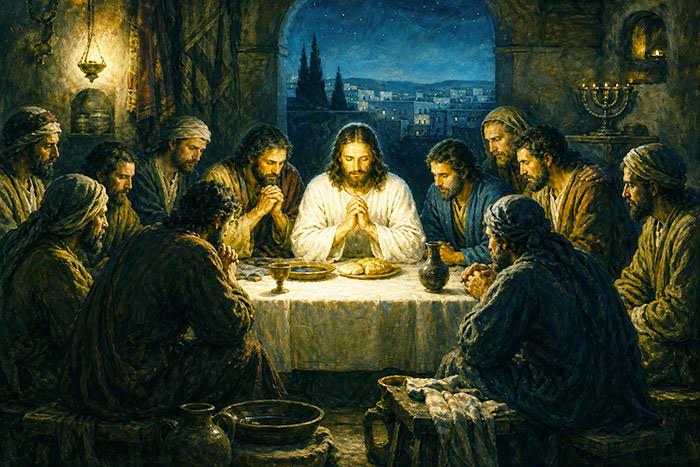
The prayer of the church is the prayer of the ever-living Christ. Its prototype is Christ’s prayer during his human life.
Jesus’ public prayer life
The Gospels tell us that Christ prayed the way a devout Jew faithful to the law prayed. Just as he made pilgrimages to Jerusalem at the prescribed times with his parents as a child, so he later journeyed to the temple there with his disciples to celebrate the high feasts.
Surely he sang with holy enthusiasm along with his people the exultant hymns in which the pilgrim’s joyous anticipation streamed forth:
“I rejoiced when I heard them say: Let us go to God’s house.”
Psalm 122:1
From his last supper with his disciples, we know that Jesus said the old blessings over bread, wine, and the fruits of the earth, as they are prayed to this day. So he fulfilled one of the most sacred religious duties: the ceremonial passover seder to commemorate deliverance from slavery in Egypt. And perhaps this very gathering gives us the profoundest glimpse into Christ’s prayer and the key to understanding the prayer of the church.
While they were at supper, he took bread, said the blessing, broke the bread, and gave it to his disciples, saying, “Take this, all of you, and eat it: this is my body which will be given up for you.”
In the same way, he took the cup, filled with wine. He gave you thanks, and giving the cup to his disciples, said, “Take this, all of you, and drink from it: this is the cup of my blood, the blood of the new and everlasting covenant. It will be shed for you and for all so that sins may be forgiven.”
Luke 22:19-20
Blessing and distributing bread and wine were part of the passover rite. But here both receive an entirely new meaning. This is where the life of the church begins. Only at Pentecost will it appear publicly as a Spirit-filled and visible community. But here at the passover meal the seeds of the vineyard are planted that make the outpouring of the Spirit possible.
In the mouth of Christ, the old blessings become life-giving words. The fruits of the earth become his body and blood, filled with his life. Visible creation, which he entered when he became a human being, is now united with him in a new, mysterious way. The things that serve to sustain human life are fundamentally transformed, and the people who partake of them in faith are transformed too, drawn into the unity of life with Christ and filled with his divine life.
The Word’s life-giving power is bound to the sacrifice. The Word became flesh in order to surrender the life he assumed, to offer himself and a creation redeemed by his sacrifice in praise to the Creator.
Through the Lord’s last supper, the passover meal of the Old Covenant is converted into the Easter meal of the New Covenant: into the sacrifice on the cross at Golgotha and those joyous meals between Easter and Ascension when the disciples recognized the Lord in the breaking of bread …
Jesus’ solitary prayer life
We saw that Christ took part in the public and prescribed worship services of his people, i.e., in what one usually calls “liturgy.” He brought the liturgy into the most intimate relationship with his sacrificial offering and so for the first time gave it its full and true meaning that of thankful homage of creation to its Creator. This is precisely how he transformed the liturgy of the Old Covenant into that of the New.
But Jesus did not merely participate in public and prescribed worship services. Perhaps even more often the Gospels tell of solitary prayer in the still of the night, on open mountain tops, in the wilderness far from people.
Jesus’ public ministry was preceded by forty days and forty nights of prayer. Before he chose and commissioned his twelve apostles, he withdrew into the isolation of the mountains.
By his hour on the Mount of Olives, he prepared himself for his road to Golgotha. A few short words tell us what he implored of his Father during this most difficult hour of his life, words that are given to us as guiding stars for our own hours on the Mount of Olives.
“Father, if you are willing, take this cup away from me. Nevertheless, let your will be done, not mine.”
Luke 22:42
Like lightning, these words for an instant illumine for us the innermost spiritual life of Jesus, the unfathomable mystery of his God-man existence and his dialogue with the Father. Surely, this dialogue was life-long and uninterrupted.
Christ prayed interiorly not only when he had withdrawn from the crowd, but also when he was among people. And once he allowed us to look extensively and deeply at this secret dialogue. It was not long before the hour of the Mount of Olives; in fact, it was immediately before they set out to go there at the end of the last supper, which we recognize as the actual hour of the birth
“Having loved his own … he loved them to the end.”
John 13:1
He knew that this was their last time together, and he wanted to give them as much as he in any way could. He had to restrain himself from saying more. But he surely knew that they could not bear any more, in fact, that they could not even grasp this little bit.
The Spirit of Truth had to come first to open their eyes for it. And after he had said and done everything that he could say and do, he lifted his eyes to heaven and spoke to the Father in their presence.
We call these words Jesus’ great high priestly prayer, for this talking alone with God also had its antecedent in the Old Covenant. Once a year on the greatest and most holy day of the year, on the Day of Atonement, the high priest stepped into the Holy of Holies before the face of the Lord “to pray for himself and his household and the whole congregation of Israel.”
He sprinkled the throne of grace with the blood of a young bull and a goat, which he had previously to slaughter, and in this way absolved himself and his house “of the impurities of the sons of Israel and of their transgressions and for all their sins.”
No person was to be in the tent (i.e., in the holy place that lay in front of the Holy of Holies) when the high priest stepped into God’s presence in this awesomely sacred place, this place where no one but he entered and he himself only at this hour. And even now he had to burn incense “so that a cloud of smoke… would veil the judgment throne … and he not die.” This solitary dialogue took place in deepest mystery.
Day of Atonement – Most Solemn Day of Prayer
The Day of Atonement is the Old Testament antecedent of Good Friday. The ram that is slaughtered for the sins of the people represents the spotless Lamb of God (so did, no doubt, that other chosen by lot and burdened with the sins of the people that was driven into the wilderness). And the high priest descended from Aaron foreshadows the eternal high priest.
Just as Christ anticipated his sacrificial death during the last supper, so he also anticipated the high priestly prayer. He did not have to bring for himself an offering for sin because he was without sin. He did not have to await the hour prescribed by the Law and nor to seek out the Holy of Holies in the temple.
He stands, always and everywhere, before the face of God; his own soul is the Holy of Holies. It is not only God’s dwelling, but is also essentially and indissolubly united to God.
He does not have to conceal himself from God by a protective cloud of incense. He gazes upon the uncovered face of the Eternal One and has nothing to fear. Looking at the Father will not kill him. And he unlocks the mystery of the high priest’s realm.
All who belong to him may hear how, in the Holy of Holies of his heart, he speaks to his Father; they are to experience what is going on and are to learn to speak to the Father in their own hearts.
This short meditation is excerpted from The Hidden Life: Essays, Meditations, Spiritual Text (The Collected Works of Edith Stein), © 1992 ICS Publications, Washington D.C. USA. English translation from the original German by Waltraut Stein, © Washington Province Discalced Carmelites, Inc. 1992, 2014.
Top image credit: AI enhanced digital artwork depicting Jesus praying with his disciples at his last supper meal. Image source from artstyles.com. Used with permission.
Edith Stein was born into a prominent Jewish family in Breslau, Germany (present-day Wroclaw, Poland), on Yom Kippur, the Jewish Day of Atonement, in 1891. As a teenager she abandoned Judaism and became a self-proclaimed atheist. She attended the university in Breslau and, later, in Göttingen, where she sought intellectual truth in the study of philosophy and became a protégé of the famed philosopher Edmund Husserl. She earned her doctorate of philosophy in 1916, but her search for truth remained unfulfilled.
The following year Edith was impressed by the calm faith that sustained a Christian friend at the death of her husband. “It was my first encounter with the cross and the divine power that it bestows on those who carry it,” Edith later wrote. “For the first time, I was seeing with my very eyes the church, born from its Redeemer’s sufferings, triumphant over the sting of death. That was the moment my unbelief collapsed and Christ shone forth—in the mystery of the cross.”
A few years later, Edith read St. Teresa of Avila’s Autobiography. In it she recognized the truth she had been yearning for, and was baptized on January 1, 1922. Soon after, she became a teacher at the Dominican school in Speyer. Widely respected in academic circles, she also lectured throughout Germany, Switzerland, and Austria on women’s role in society, Catholic education, and philosophy. A gifted writer, she published numerous books, lectures, reviews, and translations of some of the works of St. Thomas Aquinas and Cardinal John Henry Newman.
As Hitler rose to power, Edith was quick to perceive what this might cost her, her family, and her race. In the early 1930s, she wrote to Pope Pius XI of her concern for the Jewish people, hoping he might divert the catastrophe she sensed was threatening them. In 1932, she accepted a post at the Catholic Educational Institute in Münster, but was soon asked to resign because of growing anti-Semitism in Germany. Edith had long desired to become a nun and now that her professional effectiveness was severely limited, she felt that the way was open for her to enter the monastery. In 1933, when she was forty-two years old, she was received into the Carmelite community in Cologne.
Edith chose her religious name, Sister Teresa Benedicta of the Cross, anticipating that she would share in the Lord’s sufferings. “By the cross I understood the destiny of God’s people which, even at that time, began to announce itself,” she later explained to a friend. “I thought that those who recognized it as the cross of Christ had to take it upon themselves in the name of all.”
As the situation worsened for Jews in Germany, Sister Teresa Benedicta knew she was not safe in the Cologne monastery and also believed that her presence there put all the nuns in danger. On the night of December 31, 1938, she crossed into the Netherlands where she was received at the Carmel monastery in Echt. Her sister Rosa, who had also become a Catholic, later followed her and served as a lay portress at the monastery. However, the Nazis occupied the Netherlands in 1940 and Jews, even those who were converts to Christianity, were no longer safe there either.
Sister Teresa Benedicta and Rosa were arrested on August 2, 1942, as part of Hitler’s orders to deport and liquidate all non-Aryan Catholics. This was in retaliation for a pastoral letter issued by the Dutch bishops that protested Nazi policies. As the two were taken from the convent, Sr. Teresa was heard to say to her sister: “Come, Rosa, let us go for our people.” Their lives ended a week later in the gas chamber at Auschwitz.
Like Queen Esther, Edith Stein identified with her fellow Jews in their grave danger and interceded for them. When she was formally declared blessed in 1987 by the Catholic Church, a selection from the Old Testament’s Book of Esther was read at her beatification ceremony. When she was formally declared a saint on October 11, 1998, Pope John Paul II noted: “A young woman in the search of the truth has become a saint and martyr through the silent working of divine grace: Teresa Benedicta of the Cross, who from heaven repeats to us today all the words that marked her life: ‘Far be it from me to glory except in the Cross of our Lord Jesus Christ.’
[bio source: Blessed by the Cross: The Heroic Life of Edith Stein in Nazi Germany, by Jeanne Kun]