


“The hour has come for the Son of man to be glorified. Truly, truly, I say to you, unless a grain of wheat falls into the earth and dies, it remains alone; but if it dies, it bears much fruit.”
John 12:23-4
Toward the end of his earthly ministry, Christ led Peter, James, and John up onto Mount Tabor, the Mount of Transfiguration. By then the Jewish rulers and many of the people had clearly turned against him. Speaking on behalf of the disciples, Peter had just recognized Jesus as the Messiah, only to be told of his coming suffering and death. To Peter, such a thing should not happen. The Messiah predicted in Scripture was victorious, the King over the whole earth. For Peter and the Jewish teachers, success was the Messiah’s proof of identity. An executed messiah was a disproved messiah.
On Mount Tabor something happened to Christ. He was transfigured or metamorphosed. Without becoming a different person or a different type of being, he was transformed into someone so glorious as to be almost unrecognizable. He was then joined by Moses and Elijah, the representatives of the old covenant law and the prophets, themselves glorious as well. Anticipating the future, they “spoke of his exodus [RSV: departure], which he was to accomplish at Jerusalem” (Luke 9:31). Their presence indicated that what Christ would do would be the fulfillment of what they had worked for, taught, and prophesied. When Christ came down from the mountain, he reaffirmed that he would be put to death. He then began a journey, a passage from this world of bondage to sin to true spiritual freedom in the heavenly promised land. It was a personal exodus, one that involved his going through suffering to glory. Yet it was an exodus that he went through for our sakes.
Christ was a king, but he did not stay at home in the capital and send his generals off to war. He went into the battle as a captain. Nor did he direct his troops from behind. He himself led the way, and those who fought with him were to follow behind him. His name, Jesus, translated into Hebrew was Joshua (Yeshuah or Yehoshuah). Christ was the true Joshua, leading God’s people into the promised land by going first. His personal exodus followed a certain path. He went down to go up. He underwent the defeat of suffering and death to reach the victory. He died, but by that death he defeated death and rose in the glorious state he had briefly entered on Mount Tabor as an anticipation of what was to come. In this chapter we will look at the death of the Messiah from a different perspective than those of the previous chapters. We will look at that death as the transition to a new state, the glorified state. We will therefore see that death as the destruction of the old order, an order itself under the dominion of death, and the inauguration of the age to come.
The Victory Over Death
Death as an Enemy
For many people, Christ’s death would have been an even finer example of nobility if the story had ended there. He would then have been the tragic hero left dead on the battlefield, one who fought bravely to the end only to suffer personal defeat at the hands of a physically superior but morally inferior force. He would have left behind an example of unparalleled moral greatness that could itself have inspired a new human race. As a result of efforts that to him seemed like a failure, the kingdom of God could have been brought into existence.
Such a death would have been higher tragedy, no doubt, but it would not have been Christianity. Christianity is not tragedy, nor was Christ a tragic hero. No godly man can ultimately be a tragic hero. Christianity is based on hope, that confidence in God that gives assurance that even apparent earthly defeat is not final.
The story does not end with the grave, nor can it be understood apart from God. Earthly humiliation and defeat, if undergone in obedience to God, are the prelude to a success that lasts eternally. Christ’s death was not a tragic end but a transition to something better. “Was it not necessary that the Christ suffer these things and so enter his glory” (Luke 24:26)?
Christ’s death was the defeat not only of Satan and sin but also of death itself, because it forever altered the nature of human death. Sin and Satan were the source of our bondage, but death was as well. As Hebrews says, “he himself partook of [flesh and blood] that he might destroy him who has the power of death, that is, the devil, and deliver all those who through fear of death were subject to lifelong bondage” (Hebrews 2:15). Fear of death creates bondage because death, in its current reality, is an enemy.
There is a fear of death that comes from seeing death as annihilation. Many have recognized the desire for self-preservation to be the most basic and powerful of human desires, so instinctive that human beings almost invariably avoid danger to their life. The willingness to relinquish life by suicide or even to welcome the end through sickness or defeat in battle is a sign that someone has reached a very low ebb, almost dead already through psychological or physical suffering, or at least anticipating such suffering. Death, then, is the destruction of what human beings prize the most – life.
The recognition of an afterlife adds to this common fear of death. It does not usually take it away, as some think it should. It adds the fear of a future life that might be filled with misery or unknown terrors. Any recognition of God or of gods adds further to that fear because it raises the possibility of finding oneself facing divine or demonic beings that are unfriendly. Such a fear is much the same as the Christian fear of hell.
Fear of an unknown and unfortunate fate at the end of earthly life is common to the human race. It is even common among human beings in modern society where many profess to disbelieve in an afterlife – but who at the near approach of death discover that they are not so sure. There is much to be said for the view that all human beings somewhere inside do believe in an afterlife, and without an assurance of a good afterlife, approach death with a dread that is greater than the simple dread of annihilation. It is the dread of a destruction that takes away all that makes life worthwhile, but without the elimination of existence or consciousness. Most human beings are under the bondage of such a fear of death.
Christians recognize such a bondage as genuine rather than illusory, because the fear of death is well-grounded. Paul explains the danger presented by death when he cryptically says, “The sting of death is sin, and the power of sin is the law” (1 Corinthians 15:56). A sting causes pain, or harm if it is severe enough. Death has a sting because it inflicts harm by delivering people to hell and to Satan who is its ruler.
Sin is a sting because the sin of the human race leads to hell. The law gives sin such a power. Paul here seems to be thinking of the law as God’s decrees which penally condemn sin and legislate the punishment of sinners. Because human beings sin, they are under a just and lawful heavenly condemnation. Human beings who die in such a state face an existence that is objectively to be feared.
Many Christian writers, especially those in the Eastern tradition, have seen death and the fear of death as the source of many of the misfortunes that afflict the human race in this life as well — including sinfulness itself. Because of the fear of death human beings seek to preserve their lives, sometimes to the point of murder, stealing, and idolatry, actions that seem to them to promise a more secure life. The fear of death, then, produces in human beings a bondage to certain emotions or “passions” which control them and lead to sinful actions. It therefore provokes the very condemnation and destruction they fear.
Death, in short, is not just a normal, natural human condition. It is a moral disease because of the way it affects human beings. What may possibly have been intended by God as a natural transition to a better state, a life more fully in his presence, a sleep like the sleep of Adam (Gen 2:21), has become death as we know it. It is fearful without an assurance of God’s help in the face of an unknown and dangerous future. It produces sinful responses as people desperately attempt to avoid it.
Two Views of Christ.
To understand how Christ’s death was a victory over human mortality, we have to look at him in a different way than we have so far. Especially when we read the synoptic Gospels, we most naturally think of Christ as a person who is distinct from God and who relates to him in a somewhat external way. He looks up to heaven and speaks to his Father as someone spatially outside of him and in some sense above him. When he relates to human beings, he does so and ascends, he leaves the earthly Jerusalem and goes “up” to some location that is not in our spatio–temporal world but apparently still has some spatial relationship to it.
In such a view the relationship between Christ and God is somewhat external. It affects Christ “inside,” because any relationship of significance affects people internally. Yet the relationship between God and Christ remains external in much the same sense as any two human beings have an “external” relationship to one another.
There is another view of Christ in relationship to God that we also naturally take, especially when we read the Gospel of John or consider the way in which Christ acts on earth after his resurrection. We think of God as being in Christ. When we see Christ, we see God. When he acts, God acts. When he speaks, God speaks.
In such a view, Christ has divine power and wisdom, not so much as something made available to him from the outside, but as something inside of him. Even more, that divine power and wisdom is his own. He possesses it, has intrinsic title to dispose of it, and uses it at will. In fact, he can give human beings divine life, not just as a gift he gets God to give but as his own life that he is able to share with them.
When we take this second view of Christ in his human nature, we see him in relationship to God with a certain lack of separateness or externality. Because of the oneness of being of Father and Son and because of the incarnation of the Son, the relationship between God and Christ is interior to Christ’s being, something in him. In fact, the relationship between God and Christ is interior to his human nature.
The same two ways of seeing Christ’s relationship with God can also be found in our own relationship with God. We too look up to him, speak to him, and relate to him as a being external to ourselves. Yet as Christians, we experience God dwelling in us, giving us new life, and acting through us. Because he is a spirit, God can be inside of us and affect us internally in a way no merely human being can.
From our own experience, we know that the two aspects of our relationship with God are just two different ways of seeing the one relationship of personal union. God is both outside of us and in us. He is even, in a certain sense, a part of us because his presence in us enters into our ability to live and act as Christians.
To be sure, there is a notable difference between our relationship to God and Christ’s. The divinity Christ experienced inside of himself was his own. It belonged to him in a way God’s presence inside of us does not belong to us. To use the technical phrasing, Christ’s divinity belonged to him by nature, not by grace or by participation. Yet there is enough similarity between the two that our experience of God can help us intuitively understand that the two ways of viewing Christ’s relationship to God are not incompatible alternatives but go together.
So far, we have considered the sufferings and death of Christ mainly in terms of his external relationship with God. He offered the redemptive sacrifice for the sins of the world to his heavenly Father. We did consider his oneness with God when we looked at his obedience and his willingness to die for the sins of the world. Even so, it was still the external unity of two persons united in their aim and approach, what some Christian teachers have termed moral unity.
To understand Christ’s personal victory over death, we need to consider his relationship to God as a more internal unity. We need to consider the divine presence in the humanity of Christ, how God acts in and through Christ’s human nature to redeem the world. We need to understand more fully the scriptural truth that God was in Christ, “reconciling the world to himself” (2 Corinthians 5:19).
Dying to Defeat Death.
At Easter, Christians proclaim that Christ has defeated death. Most commonly if we speak about people defeating death, we mean that they came close to dying but did not, probably because they fought to stay alive. Christ, however, died. He defeated death in a more definitive way than by staying alive when his life was threatened. He defeated death by dying and coming back to life by his own power.
Christ did not just defeat death for himself, but he defeated death for other human beings as well. His death and resurrection make it possible for others not just to survive their own deaths but as a result of dying come into a life that is better than the one they had before. In this chapter we will consider how Christ himself overcame death, and in the last part of this book how he defeats death in the lives of others.
Freedom from a captor like Satan is freedom from an external oppressor. Freedom from death is freedom from an internal weakness. Death may originate from an outside cause like a blow or gunshot or fire. But death does not occur until the human organism loses the power to sustain life.
Life takes constant effort, as human beings discover when their lives are threatened by disease or injury and they find themselves in a “fight for their life”. Overcoming death, then, involves the strength to sustain life. Defeating death by dying and coming back to life involves a special strength, more than a normal human strength. This strength Christ had.
In the description Paul gives us of Christ’s redeeming work in Philippians 2, he tells us that Christ began his attack on death by lowering or humbling himself. “Though he was in the form of God, Christ Jesus did not count equality with God a thing to be grasped, but emptied himself, taking the form of a servant, being born in the likeness of men.” This description refers to what we now would call Christ’s incarnation. The first step, then, to defeat death was for Christ to enter into the human condition so that he could change it.
Paul then continues, “And being found in human form he humbled himself and became obedient unto death, even death on a cross. Therefore God has highly exalted him and bestowed on him the name which is above every name.” The self–lowering of Christ was not just a matter of his incarnation, because when he was exalted through his resurrection, he was still incarnate. Christ’s full self–lowering was not merely his taking on the condition of humanity, but his taking on a human condition in which he was deprived of something that would be present once he was raised from the dead and glorified. His full self–lowering, in other words, was his willingness to take upon himself humanity in its fallenness.
Exactly what he took on of our fallen human nature, when, as Paul said, he came “in the likeness of sinful flesh” (Rom 8:3), is a difficult question. He clearly became subject to human weakness (2 Corinthians 13:4), suffering, and death. But at the same time, he was able to remain without sin and in full union with God. However these two facts go together, Christ willingly entered into and personally took on something of the fallen, low state of humanity. Before his resurrection, there was something missing in him that could have been there without making him something other than human.
To understand more fully what was missing, we need to consider what happened to Christ in his exaltation or resurrection. After his resurrection, Christ was “glorified”. As we have seen, the scriptural word “glory” means greatness or power, even more than it does exterior radiance or splendor. Moreover, it can be used to indicate a greatness or power that things have in their own makeup, not just something conferred on them externally. “Glorification”, then, can refer to an inner strengthening or empowerment.
When Christ was glorified, he did not cease to be human nor did he become human to a lesser degree. Rather, his human nature was given a new power or capacity. He became capable of acting in ways he could not before. He could appear in rooms without opening doors. He could ascend to heaven by his own power. Even more importantly for what we are discussing, he was free from the power of death. “Christ being raised from the dead will never die again; death no longer has dominion over him” (Rom 6:9). When he was glorified, his human nature was transformed so that he had a greater or more glorious type of human life, one with fewer limitations. Most notably, his human nature had a greater power over its own life so it lacked the limitation of intrinsic mortality. It would no longer be true that he would be “appointed to die” (Hebrews 9:27).
Before his glorification, however, Christ did not lack all glory. He had a glory with his Father before the world was made (John 17:5, 24), and therefore a glory that was uncreated. That divine glory is in him now (2 Corinthians 3:18; 4:6), but it was in him on earth even before his resurrection. Because of the presence of that glory, those who see him can see God in him, at least if their eyes are not spiritually blinded (2 Corinthians 4:6; John 14:9).
Even though he took on the weakness of unfallen human nature, Christ had a power inside of himself capable of taking away that weakness. It was hidden or veiled to a certain extent, but it was there. Christ’s death and resurrection, then, was a transition from a state of humility or lowness that involved a divine glory present in a “weak human nature” to a state of exaltation, which involved a human nature transformed by that glory.
When the Scripture describes that transition, it most commonly says that God raised him from the dead (Acts 2:24, 32). The change is described as coming by an action from outside of Jesus, which rescues him from death. Yet Paul also describes that change as Jesus himself rising (1 Thessalonians 4:14). In the Gospel of John, Jesus asserts that “I have power to lay [my life] down, and I have power to take it again” (John 10:18). As the Son of God, Jesus could not only count on God’s power to raise him up. He could also count on that power as something in him, something he could employ even though dead.
These two types of statements are two ways of seeing the same truth. God did raise his Son but did so by acting through the divinity that was “in” Christ, which he and his Son shared. He had, as the Book of Hebrews said, “the power of an indestructible life” inside (Hebrews 7:16), and only divine life is truly indestructible. In a similar way, when God raises us from the dead, our resurrection will be due to his Spirit in us which will communicate life to us “from the inside” (Rom 8:11). For this reason, Jesus could say in the same discourse in the gospel of John that those who believe in him have (already) eternal life, and yet he will raise them up on the last day (John 6:40, 54).
The Son of God became human, took on humanity in its fallen state, in order to save us. He came to free us from our fallenness and to bring us to the full life for which we were intended. He was and is working for “our glorification” (1 Corinthians 2:7). But to glorify us, he had to first himself achieve glorification. The way for him to do that was, as it will be for us, death. He had to undergo death in order to “enter into his glory” (Luke 24:26), “glory” both in the sense of his reign as glorious king and also in the sense of his personal transformation or glorification.
Two main reasons have been given to explain why Christ had to die to overcome death and both probably have truth. The first is that it was not until Christ died that he offered his life for human sin and finished his work of satisfaction. That death atoned for the state of the human race, lifted the curse on Adam and his descendants, and took away the death sentence of condemnation that allowed Satan to have power over human beings. Now Christ was free to cast aside the limitations the fall had placed on humanity, including on himself as someone who was one with the human race.
The second reason is that Christ also had to die to overcome death because the old form of human nature was an obstacle to the new life coming through. It was oriented to staving off its own death and to warding off the fear of death. It was ordered in a way that was self–seeking, intent on preserving itself rather than trusting itself fully into God’s hands and allowing God’s life and power to permeate it completely.
Even Christ’s sinless human nature shared in that weakness, at least in the effects of that weakness, as was manifest at Gethsemane. In his determination to obey his Father, he could control it, but sometimes at the cost of a struggle. There was something to control. What was needed was a kind of death – not the death of annihilation, but the death that involves dissolution of the old. Once the old died, the glorious life within Christ could reconstitute his humanity on a new basis.
The death of Jesus, then, was a victory over death itself. The very act of dying was itself the way death was overcome. “He destroyed death by death” (Byzantine liturgy). Jesus underwent a human death and proved stronger because of the indestructible glory within. Thereafter those who belonged to him, the new human race, were no longer under the dominion of death.
The Great Change
Jesus in the Gospel of John described his death by using an image that sums up the truth we have been considering. He said,
“Truly, truly, I say to you, unless a grain of wheat falls into the earth and dies, it remains alone; but if it dies, it bears much fruit.”
John 12:24
A grain of wheat is a source of nourishment, ready to be made into bread. After it falls into the ground, it becomes dry and hard and is much like a little stone, lifeless. A change has happened that could be described as a death. The seed has died to its old mode of existence. In fact, it has become inert, much like a human corpse. That death, however, is not the end. When the conditions are right, something inside of the seed, something that was there all along, is released and begins to function in a new way. It transforms the seed into something greater, a plant capable not only of growing but of giving rise to other plants like itself. Death can be life–giving — depending on what is inside when the dying begins.
Inside Christ was divine glory. Once he died, the shell of his “weak” human nature began to crumble. Rather than leading to the complete dissolution of his existence, that crumbling led to freedom for what was inside to “come out”. The kernel of the seed– the glorious life inside – began to act not only in his human spirit and soul but also in his body. The bonds of death could not hold him (Acts 2:24). His “indestructible life” (Hebrews 7:16) manifested itself. Or as Melito of Sardis, a second century writer, put it more dramatically in his Paschal Discourse: “By his spirit, which was incapable of dying, he dealt man’s destroyer, death, a fatal blow.”
There is another way of describing what happened. On Mt. Tabor, as we have seen, Christ was changed in such a way that he even looked different. In the gospel of Mark it says he was “transfigured before them” (9:2). In Luke it says the disciples “saw his glory”. The two phrases are equivalent. He was, other words, glorified. As Cyril of Alexandria put it in his Commentary on the Gospel of John, he was glorified “by anticipation”. He was glorified at that point in his ministry because he had just predicted his death, and he was manifesting to his disciples what he would become as a result of what to them would seem defeat and destruction. Glorification can be described as “transfiguration”.
The English word “transfiguration” is a translation of a Greek word that transliterated is “metamorphosis”. We use that word, for instance, to describe what happens when a caterpillar turns into a butterfly. In the transfiguration and in the resurrection, Christ was metamorphosed into a new kind of human being.
When a caterpillar becomes a butterfly, the change is so striking that it is quite difficult to believe it is the same creature. Nonetheless, the similarities of structure and function are even greater than the changes. The butterfly remains the same species as the caterpillar. The change is not primarily a matter of adding or subtracting parts. Rather, the caterpillar is restructured and reshaped according to a new principle. As a result it becomes able to function very differently. In scriptural terms, we could say the butterfly has been “made new” or “raised to newness of life.”
This is what happened to Christ on Mt. Tabor in anticipation of what was to come after he rose from the dead. He was transfigured or glorified. He looked different and he shone with the radiant light or energy that was now being manifested because of the way in which it had transformed his outer nature. In his transfiguration and more importantly as a result of his resurrection, Christ became the kind of person who can live a new kind of existence, a heavenly existence. He did not become immaterial or lose his body, but his divine nature, permeating his human nature in “uncreated light”, transformed his physical existence in such a way that he could live and act in ways that we can hardly now imagine. He had a new life, a glorious life.
Scripture describes the transition from the life we live now to the life that God intends us to live in strong language. It involves a change of worlds or of ages and a death to our old mode of life. We simply cannot live in the age to come in our current condition. It would be too much for us. The “eternal weight of glory” (2 Corinthians 4:17) would crush us. “Flesh and blood cannot inherit the kingdom of God, nor does the perishable inherit the imperishable… This perishable nature must put on the imperishable, and this mortal nature must put on immortality” (1 Corinthians 15:50, 53). A transition has to occur at our death, so that we are fitted to live in the heavenly, eternal environment of the new world.
Christ himself had to make that same transition and made it so that we could as well. We do not fully understand the incarnation until we see that, sinless though he was, he entered into the condition of human fallenness. He came to lead the way out of that condition, across the Red Sea of human death to the promised land of true immortality where “what is mortal may be swallowed up by life” (2 Corinthians 5:4). In so doing, he had to himself overcome death.
When Jesus rose, he did not simply return to the state he was in before his sufferings. He rose in a glorified state, because the divine glory within replaced the weakness of his humanity with a more powerful ability to live and act. He himself had made the passage that we need to make after him in order to reach our heavenly inheritance.
This article is excerpted from chapter 9 of Steve Clark’s Book, Redeemer: Understanding the Meaning of the Life, Death, and Resurrection of Jesus Christ, copyright © 1992, 2013. Used with permission.
The book is available to read online or download in PDF format for personal use.
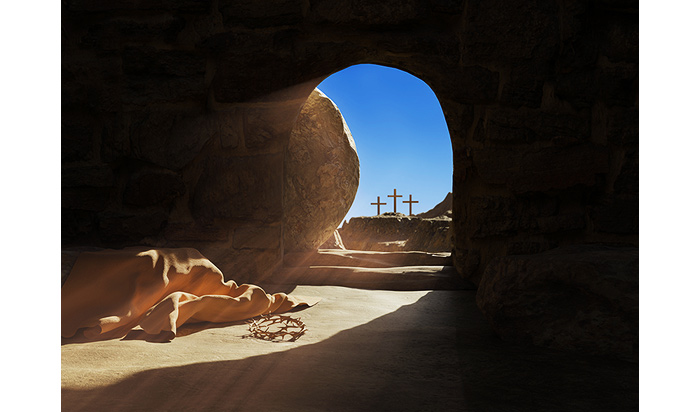
Top image credit: Illustration of Christ’s victory through his cross and resurrection, from Bigstock.com, © by K_E_N, stock photo ID: 450131183. Used with permission.
Steve Clark has been a founding leader, author, and teacher for the Catholic charismatic renewal since its inception in 1967. Steve is past president of the Sword of the Spirit, an international ecumenical association of charismatic covenant communities worldwide. He is the founder of the Servants of the Word, an ecumenical international missionary brotherhood of men living single for the Lord.
Steve Clark has authored a number of books, including Baptized in the Spirit and Spiritual Gifts, Finding New Life in the Spirit, Growing in Faith, and Knowing God’s Will, Building Christian Communities, Man and Woman in Christ, The Old Testament in Light of the New.
- See articles by Steve Clark in Living Bulwark Archives