


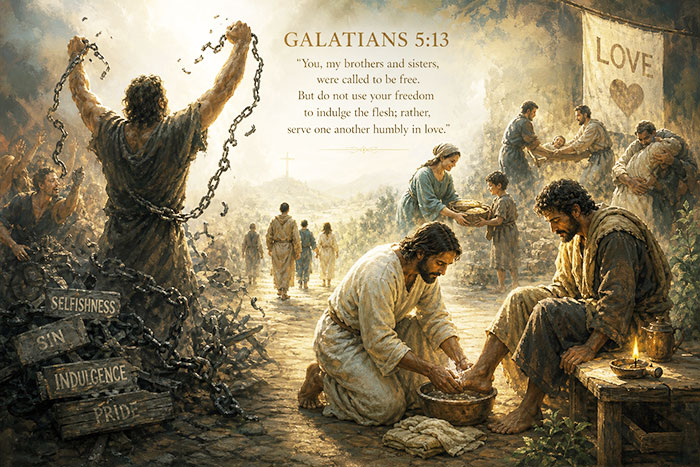
Selfism Versus Christian Servanthood
To summarize, when examined against the Christian standard of the two greatest commandments, the gospel of selfism utterly fails the test. It comes as no surprise, then, that it does no better with Jesus’ teaching on servanthood. Once again, it squares off against the basics of the Christian gospel. And wherever the spirit of the gospel of selfism prevails, the words of Jesus seem patently absurd, childishly naive, and very hard to take. “Humble yourself like a child.” “Become like a slave.” “Wash one another’s feet.” Jesus does not speak about being “self-actualized” or “fulfilled” in this life. In fact quite the opposite. He earnestly insists,
“If any one would come after me, let him deny himself and take up his cross daily and follow me. For whoever would save his life will lose it; and whoever loses his life for my sake, he will save it.”
Luke 9:23-24
When Jesus says, “deny yourself,” he isn’t merely speaking of some simple practices of “self denial.” Rather, “to deny” is a term that describes a relationship with someone. It means “to renounce a claim upon.” Jesus demands that any who would be his disciples must renounce their own claims upon their lives. “Stop acting like your life is yours, to do with as you please or as you find fulfilling. If you will follow me, your life is no longer yours, but mine.”
Often, Jesus’ words seem hard to fathom and difficult to apply. At first hearing, worldly wisdom carries a ring of truth. It is certainly fair to say that in our world the philosophy of the survival of the fittest, and even of “doing unto others before they can do unto us,” seems to make good sense. Many of these attitudes and approaches to life have long characterized the human population (ever since the Fall!). We can hardly expect much better from our own society.
But we can and should expect something quite different from God’s people. Though here, sadly, we are often disappointed. Many Christians today have written off Jesus’ “hard-to-handle” words and have swallowed the contemporary gospel of selfism. Sometimes they propagate selfist doctrines as enthusiastically and vigorously as any of the secular advocates. They seem oblivious to the fact that the gospel of selfism fundamentally opposes Jesus’ own teaching. This development among modem Christians is extremely unfortunate because Jesus’ words on the matter are dear, forceful, and uncompromising.
Remember Jesus’ words, “He who exalts himself shall be humbled.” Here is a dear, stem warning for all Christians. God does not want his people to put themselves, their interests, or their personal fulfilment first. He is not pleased that large numbers of his flock follow the seductive voice of another master. Jesus tells us plainly that those who put themselves first will be cut down to size. Then he goes on: “He who humbles himself will be exalted.” God himself will honour and exalt those who put their trust in him when in a lowly position as well as those who purposely take on an attitude and a posture of lowliness in obedience to his instructions. This paradoxical pattern has always characterized God’s way of working with his people. As Paul puts it:
“God chose what is foolish in the world to shame the wise, God chose what is weak in the world to shame the strong, God chose what is low and despised in the world, even things that are not, to bring to nothing things that are, so that no human being might boast in the presence of God.”
1 Corinthians 1:27-29
This was God’s way with Abraham, the simple and obedient man whose faith found favour in God’s sight. As he humbled himself in obedience before God, God exalted him to wealth and prosperity, and to everlasting greatness as the “father of many nations.”
The humble trust of the righteous in their God was a vital lesson taught to the Israelites as they became a nation. God humbled the proud and haughty Egyptian oppressors by his own power, and lifted up the children of Israel to a unique status among all the nations on earth: to be a royal priesthood, God’s own people.
Again and again, God dealt with his people in this way, and taught them this lesson through the prophets (see Isaiah 29:19-20) and other writings of the Old Testament. The psalms take up this theme and repeat it often.
“You save the humble but bring low those whose eyes are haughty.”
Psalm 18:27
“Love the Lord, all you his saints! The Lord preserves the faithful, but abundantly requites him who acts haughtily.”
Psalm 31:23
“For though the Lord is high, he regards the lowly; but the haughty he knows from afar.”
Psalm 138:6
The New Testament continues the message of this “great reversal” even more strongly than in the Old Testament. At the revelation of God’s plan of salvation, Mary proclaims in the Magnificat:
“He has scattered the proud in the imagination of their hearts, he has put down the mighty from their thrones, and exalted those of low degree; he has filled the hungry with good things, and the rich he has sent empty away.”
Luke 1:51-53
In the coming of Jesus, God has once again turned the tables, bringing down the stiff-necked and proud and exalting those who humbly trust in him. The New Testament teaches that Christians should model themselves after Jesus, who humbled himself as a slave and was exalted by his Father (Philippians 2:5-11).
“Humble yourselves before the Lord and he will exalt you.”
James 4:10
“Humble yourselves therefore under the mighty hand of God, that in due time he may exalt you.”
1 Peter 5:6
The Beatitudes
This lesson is stated most clearly and powerfully by Jesus himself in the Sermon on the Mount, particularly in the Beatitudes. The Beatitudes are Jesus’ first words in the Sermon on the Mount. Although spoken in the presence of the crowd, they are intended by Jesus as instruction for his disciples. Each Beatitude begins with “Blessed are . . .” (or to put it another way, “How truly fortunate are …“). Then it goes on to describe a certain spiritual condition that the disciples should have and the results that will flow from that condition. There are eight main Beatitudes (the ninth is an elaboration of the eighth). The first four have a certain relationship to one another, and to the second four. A good look at the first and third Beatitudes will reveal how God’s “great reversal” appears at the center of Jesus’ teaching.
The first four Beatitudes address the disciples’ relationship with God. Each of them describes an attitude or a posture before God that involves voluntary personal deprivation, expressing love for God and trust in him. The first Beatitude says, “Blessed [or “How fortunate”] are the poor in spirit, for theirs is the kingdom of heaven.” Jesus is not speaking primarily of those without material wealth, for many who are materially poor are far from being “fortunate.” He is speaking rather of his disciples, who do not rely simply upon themselves for what they need. They are to live in a state of trust and reliance upon God, looking to him to provide for them. As they do so, they will receive everything they need-the fullness of his kingdom. His teaching echoes a theme often found in the psalms, where the righteous who trust in the Lord are referred to as the “poor.” The spiritual condition that Jesus calls for in his disciples is one of deep and abiding faith in God. It is a condition that causes one to rely on God’s grace. Such trust should not be confused with irresponsibility or passivity.
The third Beatitude is closely related to the first. “Blessed are the meek, for they shall inherit the earth.” Jesus’ words state succinctly the same lesson he is to give his disciples on the road to Jerusalem. “How fortunate,” says Jesus, flare those who take on an attitude of lowliness, the posture of a servant, for they will receive from God their promised inheritance.” Here again, Jesus is teaching directly from the Psalms. In. this case, he quotes Psalm 37:11. “But the meek shall possess the land, and delight themselves in abundant prosperity.”
Psalm 37 is the prayer of the righteous who are not themselves in a position to overcome the power of the wicked, but who trust in God to provide for them and to deal with their enemies. Its message is expressed well in verses 3-6:
Trust in the Lord, and do good;
so you will dwell in the land, and enjoy security
Take delight in the Lord,
and he will give you the desires of your heart.
Commit your way to the Lord;
trust in him, and he will act.
He will bring forth your vindication as the light,
and your right as the noonday.
The spirit of the first and the third Beatitudes is very similar. In the first, Jesus exhorts his disciples not to depend upon their own resources alone, but to look to God to provide for them. In the third, the issue is one of power and position. The disciples are not to grasp for these things, but are to depend upon God for their power. Jesus assures them that as they put their faith in God and rely upon his grace, they will be fully provided for. Theirs will be the kingdom of heaven; to them will be given the promised inheritance for which they long. Their posture of lowliness and humility before God in reliance upon him opens the way for a special relationship with him, in which God himself can be their all.
Jesus has given his disciples an ideal that was beyond their imagination and understanding. To fallen human nature, especially within the context of the gospel of selfism, this ideal sounds naive and absurd-both impossible and undesirable. But as Paul says (in a different context), “the depth of the riches and wisdom and knowledge of God! How unsearchable are his judgments and how inscrutable his ways!” (Romans 11:33). The “great reversal” is an inscrutable piece of divine wisdom, which the worldly mind can neither comprehend nor accept; yet blessed are those who understand its message, believe it-and obey.
See related articles by John Keating:
- Overcoming the “Gospel of Selfism” – Part 1
- The Paradoxical Greatness of Christ-like Humility and Servanthood
- Brokenness and the Grace of Yielding to God
- Strength Under Control: Meekness and Zeal in the Christian Life, by John Keating Available online for free download from the Sword of the Spirit website.
Top image credit: AI enhanced digital artwork based on Galatians 5:13 passage “serve one another humbly in love.” Image source from artstyles.com. Used with permission.
John Keating is currently the head of the International Community Building Committee for the Sword of the Spirit. He is an elder in the Servants of the Word and leads the Servants of the Word household in Beirut, Lebanon.