


Far from abstract theory, the fact Jesus is both God and man affects all of us directly and personally.
In the centuries that followed the end of the persecutions of Christians in the Roman empire, the church was torn by tremendous struggles over the nature of Christ. Christians emerged from this period with a clear conviction that Jesus Christ is both fully God and fully man. This is the orthodox Christian teaching. But for many Christians, it seems distant and abstract, a point that does not have much to do with their lives. Thus it is very helpful for us who are leading other Christians to give them a clear explanation of how this teaching connects with their lives.
The fact Jesus is both God and man affects all of us directly and personally. Usually our explanations focus on the redemption. Only if Jesus was God would he have been able to carry out the sin problem of the world.
But there is more to the picture. We human beings needed more than reconciliation with God; we needed restoration. We needed transformation. As the result of the transgression and failure of Adam something needed to happen in human beings for us to become what God intended us to be. Jesus came not only to restore us to a relationship with God, but to bring about this transformation in us.
One way that the Scriptures speak of this is by saying that Jesus is the last Adam (1 Corinthians 15:45; see also Romans 5:14). He came to do what the first Adam was supposed to have done but failed to do; he came to establish the human race again. Jesus filled this role, first of all, by being himself what we were meant to be – a human being made in the likeness of God, living on earth according to the character of God.
And, second, he fulfilled the role of the new Adam by making a fundamental change in us, making us able to be what God intended humans to be. He was able to do this for us because he was both the Word of God and truly a man.
He came to bring life
The New Testament repeatedly speaks of what Jesus has done for us in terms of giving us “life” or “new life.” For example, Jesus says,
“I came so that they might have life and have it more abundantly.”
John 10:10
It is worth thinking a little about what this “life” is. We all know it is good; we all know we want it. But what does it mean to have more of it?
There is obviously a close connection between life and activity. If we come across an animal we can tell it is alive when we see it moving. A dead animal does not move. One of the chief characteristics of life is movement, the ability to do things.
We sometimes talk about some creatures having a “higher” life than others. Humans have higher life than dogs a higher life than amoebas, because we can do things that they cannot—we can build, speak, think. Our range of activity is considerably greater. If an expanded range of activity means having a higher life, the highest life of all would involve knowing God, and being able to act like God in some way.
Because Jesus is the divine Word, he has life in himself.
“In him was life, and the life was the light of men.”
John 1:4
Human beings do not have life in themselves that they can pass on, except in a limited and secondary sense. But Jesus had life in himself, in the sense that he was able to create life.
A passage in 1 John makes the point even more strongly.
“That which was from the beginning, which we have heard, which we have seen with our eyes, which we have looked upon and touched with our hands, concerning the word of life; the life was made manifest, we saw and testify to it and proclaim to you the eternal life which with the Father and was made manifest to us.”
1 John 1:1-2
While this statement is familiar to us, it is nevertheless an unusual way to talk: “We saw the life.” John is obviously speaking about our Lord Jesus Christ. He is saying that Jesus has life in such a way that you can simply describe him as “the life.” When you see Jesus, you see life. You can touch life by touching him. He has divinity in him to such a great extent that you can even say he is life.
United with Him
The scripture says that we receive that life by becoming united with Christ.
“Jesus said to them, ‘I am the bread of life. He who comes to me shall not hunger. He who believes in me shall not thirst. . . As the living Father sent me and I live because of the Father, so he who eats me will live because of me.’”
John 6:35, 57
Jesus is saving, “If you believe in me, if you become connected to me, life will come into you, because of my relationship with the Father. The Father’s life is mine, and that is the life that I pass on to you.”
The same message is presented in another way in Jesus’ teaching on the vine and the branches (John 15). Jesus is saying, “I am the vine. You are the branches. If you are connected to me, you will have life. If that connection is broken, you will wither and die. Your union with me is what brings divine life into you.”
We might say that if we become connected to God, energy comes into us. Suppose I have not eaten in a long time. I am starving; my life is ebbing away. There is less and less that I can do. Then someone gives me bread. As I start eating, life comes back. The bread contains energy in a form that my body can make use of. This is what Jesus is saying about himself. “If you become connected to me in the right way, I will be a source of spiritual energy to you. I will make you capable of doing more. I will make you more.
A way of summarizing all this is to say that Jesus did not come primarily to tell us to do more; he came to make it possible for us to do more. He came to bring us spiritual energy, spiritual power, so that we could, in fact, live the way that we are supposed to live, and do the things that we are supposed to do; so that we could have a higher life.
Sharing the divine nature
Many of the early Greek Christian writers summed it up by saying that God became man in order to make man God, or in order to “divinize” man.
2 Peter 1:3-4 teaches us:
“His divine power has granted to us all things that pertain to life and godliness through the knowledge of him who calls us to his own glory and excellence, by which he has granted to us these precious and very great promises, that through these you may escape from the corruption that is in the world because of passion and become partakers of the divine nature.”
Thus, through our Lord Jesus Christ, we can share in the divine nature. We are raised above the level of what human beings normally have been thought capable of being and doing. We are brought to a higher level of life by sharing in the divine nature, through the Word of God. (See also Colossians 2:9-10.)
Our glorification
Scripture uses other terms in addition to “life” and “more life” to describe what God does in us through Jesus. Two expressions are “glorification” and “spiritualization.”
Paul writes in 1 Corinthians 2:7 that God has arranged everything “for our glorification.” Today we do not often talk about the work of salvation that way, but it is one of God’s purposes – to give us greater glory. God’s glory, in this sense, probably means God’s very being as it is manifested in his creation. God became man so that he could share with us more of what he himself is; so that he could make us more like him; so that we could know more of the things he knows and do more of the things he does.
“We all with unveiled faces beholding the glory of the Lord are being changed into his image from one degree of glory to another, for this comes from the Lord, who is the Spirit.”
2 Corinthians 3:18
God has revealed himself to us through the work of the Holy Spirit, and now we can see God’s glory, which is in the Lord Jesus Christ. Not only do we see God’s glory in Christ but when we are put in direct contact with Christ, his glory comes into us and changes us.
What Paul is describing can be compared to a candle. When we light a candle, it is not just the flame that shines, but the whole body of the candle glows. The wax glows because it is the kind of material that can receive the light and then give it off again. Paul is saying that when we come into union with the Lord, the light of Christ comes on us; he makes us different, and we begin to shine. He shares his glory with us.
The action of the Holy Spirit
One other way of saying what Jesus, the new Adam, does for us is “spiritualization.” Through Christ, who is God made man, we become spiritual beings in a way that we were not before.
As long as men and women are made in any sense in the image and likeness of God, it is true that we are part spirit. But when God’s Holy Spirit is given to us through our Lord Jesus Christ, we are changed and our spirits become alive. We become more capable of doing spiritual things, enabled to function in new ways.
In 1 Corinthians 15 Paul explains that Jesus came into the world as the new Adam not simply to restore the life of the old Adam but to give us what he calls a spiritual body. A spiritual body is not immaterial; it is really a body, but a spiritualized one. It is a transfigured body, which can do things that a human being could not do before.
After Jesus’ resurrection he had a spiritualized body, but it was nonetheless a real body. The disciples could touch him; he could eat, and the food did not fall on the ground. The fish actually went into his body, and he digested it. But he did some things that he did not do before with his human body. For instance, he walked into rooms without opening doors. He appeared and disappeared at will.
Paul tells us that we are going to receive spiritualized bodies after we die and are raised up, but that we are already beginning to receive some of that through the outpouring of the Holy Spirit. We are beginning to have spiritual life that is a first installment, or down payment, of the kingdom of God (Romans 8:23). Because God is giving his Holy Spirit to us, we already have spiritual power to do some things that we could not do before. We can know God. We can come into his presence and speak to him, and hear him speaking to us. We can have faith. We can respond to God. We can receive healing from God. We can live according to his image and likeness.
How many of us are able to give testimony to that! After we committed our lives to the Lord and opened our lives to the action of the Holy Spirit, we became different. We are not yet perfect; we are still aware of lacking power in various areas of our lives and in various things that we want to be able to do. But we know, that the result of the Holy Spirit in us is that we can do things that we could not do before, knowing God and living our human lives in a new way.
“We know that the whole creation has been groaning in travail together until now; and not only the creation but we ourselves, who have the first fruits of the Spirit, groan inwardly as we wait for adoption as sons, the redemption of our bodies.”
Romans 8:22-23
Already we experience some of the new creation, yet we long to have more.
Thus we see how important it is for each of us that the Word of God, who was fully God, became fully man. Because of it, we can receive the accomplishment of God’s purposes. God has sent his Son as the second Adam to restore the human race. When we come into union with Jesus the life of God, the power of God, the glory of God, the Spirit of God flow into us. We can live a higher life than we had before, the life of God himself.
This article © by Steve Clark was first published in Pastoral Renewal Magazine, Ann Arbor, Michigan, USA.
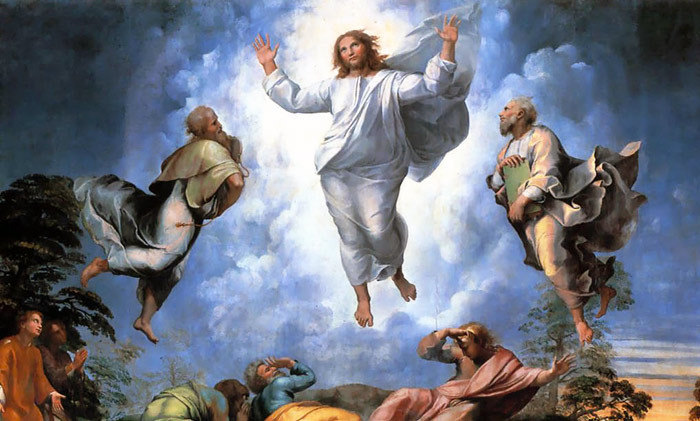
Top image credit: Christ transfigured in glory with Moses and Elijah (cropped), painting by Raphael, 1550, in the Vatican Museums, image from Wikipedia.org, in the Public Domain.

Steve Clark has been a founding leader, author, and teacher for the Catholic charismatic renewal since its inception in 1967. Steve is past president of the Sword of the Spirit, an international ecumenical association of charismatic covenant communities worldwide. He is the founder of the Servants of the Word, an ecumenical international missionary brotherhood of men living single for the Lord.
Steve Clark has authored a number of books, including Baptized in the Spirit and Spiritual Gifts, Finding New Life in the Spirit, Growing in Faith, and Knowing God’s Will, Building Christian Communities, Man and Woman in Christ, The Old Testament in Light of the New.
- See articles by Steve Clark in Living Bulwark Archives