


For those who are right-minded, God’s declaration is by itself sufficient – even in advance of any proof by His works – to show not only His providence but also His exceeding love toward us. For not only does He simply provide for us, but He loves us, and loves us exceedingly with an inconceivable love, a love which though impassible is also fervent, vigorous, genuine, indissoluble, and inextinguishable.
Wanting to demonstrate this, Holy Scripture presents images taken from among men, and it presents numerous examples of love, providential care, and solicitude. It does not want us to stop only as far as these examples go, but to go beyond them by reflection. They are not presented as being sufficient to show His love, but as well known to those who hear them and as able more than others to bring His love to light.
For example: Responding to some who are one day mourning and lamenting and saying: The Lord hath forsaken me and the God of Israel has forgotten me, the Prophet says: Will a woman forget her child, so as not to have compassion on the offspring of her womb? (Isaiah 49:14-15), meaning that just as a woman would not forget her own child, neither would God forget the race of men.
Then, in order that you understand that the Prophet presented this image, not because he intended to show that the magnitude of God’s love is comparable to that of a mother’s toward the offspring of her womb, but because he considered it to be well known that the magnitude of this love is more exceptional than others – though certainly the love of God is far greater than this – he added:
“But if a woman should even forget these, yet I will not forget thee, saith the Lord.”
Isaiah 49:15
Do you see how He has gone beyond the magnitude of a mother’s love? And so that you understand that His love far surpasses both the tender love of a mother and a father’s affection for his children, the Prophet says:
“Like as a father hath compassion upon his sons, so hath the Lord had compassion upon them that fear Him.”
Psalm 102:13
Once more, the Prophet also presents this image of love, knowing that it possesses something special in comparison to others.
The Master of the prophets and of all things reveals that God’s care far surpasses the magnitude of paternal love, and that as far as light is from darkness and wickedness is from goodness, so far is God’s kindness and providence from a father’s love. Listen to what He says:
“What man is there among you who, if his son ask for bread, will give him a stone? Or if he ask for a fish, will give him a serpent? If ye then, being evil, know how to give good gifts unto your children, how much more shall your Father Who is in heaven give good things to them that ask Him?”
Matthew7:9-11
By this He shows that by as much distance as there is between wickedness and goodness, so much higher is God’s goodness than the solicitude of fathers.
I have given these examples so that, when I cite other images of love, you will not restrain your mind at the level of the Prophets’ words but – having this standard – will by reason go beyond that level and perceive the unspeakable superiority of God’s love. God is not satisfied with natural proportions, but leaving them aside and surpassing them, He adds still further examples. This is how someone who loves is: in more and more ways he wants to show his love to the one he loves. God Himself does this by putting forth words regarding the magnitude of the distances between places – again, not so that you believe that His love is just like that, but because the magnitude of the distances stands out among others and is well known to His listeners.
Through the Prophet David He says: According to the height of heaven from the earth, the Lord hath made His mercy to prevail over them that fear Him (Psalm 102:11), and: As far as the east is from the west, so far hath He removed our iniquities from us (Psalm 102:12). And through Isaiah:
“For My counsels are not as your counsels, nor are My ways as your ways…. But as the heaven is distant from the earth, so is My way distant from your ways, and your thoughts from My mind.”
Isaiah 55:8-9
He said this after having spoken about the forgiveness of sins, saying: “I will abundantly pardon your transgressions” (cf. Isaiah 55:7).
Thus He indicated the magnitude of His forgiveness by providing this analogy. But not being satisfied with these comparisons alone, He descends to a more earthly image. In the book of Hosea He says: How shall I deal with thee, Ephraim? How shall I deal with thee, Israel? I will make thee as Adama and as Seboim.1 My heart is turned about; My repentance is utterly thrown into confusion (Hosea 11:8). What this means is that God says: “I could not even bear a threatening word.”
He speaks in a human way, not so that you will get an idea of something human-far from it-but so that on the basis of the earthly manner of speaking, you will conceive of a love which is genuine, everlasting, and worthy of God. Just as when one is madly in love with someone, he goes so far as to choose his words so as not to grieve his beloved, so the Lord says: Since I’ve just spoken and grieved you by My words, My heart is turned about (Hosea 11:8). He does not refrain from introducing highly powerful images in order to show His love, which is especially characteristic of one who loves.
And He does not stop there but again goes further and brings in another, more profound illustration, saying: As a bridegroom rejoices over a bride, so will the Lord rejoice over thee (Isaiah 62:5) – since lovers are particularly more fervent in the beginning. He speaks in such a way not in order that you get an idea of something human – I will not stop repeating this – but so that from this you will perceive the fervor, the genuineness, the strength, and the fire of His love.
Then, having said that He loves like a father and more than a father, like a mother and more than a mother, like a bridegroom and more than a bridegroom, as much as the distance from heaven to the earth and more than that, and as far as the east is from the west and more than that, He does not stop the comparisons there, but goes further and sets forth a much more humble analogy. After Jonah’s flight and God’s reconciliation with the Ninevites, Jonah was disconcerted that his threats had not been fulfilled; and feeling a human emotion, he was of a sad countenance. God ordered the rays of the sun to send forth greater heat. Then He commanded the earth to improvise a shelter out of a plant for Jonah, comforting him exceedingly and giving him rest. Then God distressed him by doing away with the shelter.
Listen to what God says to him, seeing him relieved on the one hand and ravaged on the other: Thou hadst pity on the gourd, for which thou hast not suffered, neither didst thou rear it; …and shall not I spare Nineveh, in which dwell more than twelve myriads of human beings, who do not know their right hand or their left hand? (Jonah 4:10-11).
What that means is this: “You were not given relief by the shade of the plant to the degree that I was gladdened by the salvation of the Ninevites; and the loss of it did not distress you to the extent that their ruin would Me. Thus their perdition was contrary to My will.” See how here too He goes farther than the illustration. He did not hot say: Thou hadst pity on the gourd, and then keep quiet, but added: for which thou hast not suffered, neither didst thou rear it.
Since gardeners especially love plants over which they have toiled a great deal, God wanted to show that He loves mankind with this kind of love. And He added: “If you cleave in this way to the work of another, much more so will I cleave to my own work, of which I am the Creator.”
Then He forestalls an accusation against them, saying that they do not know their right hand or their left hand, showing them forth as having gone wrong out out of lack of intelligence rather than out of wickedness-which is also indicated by their having repented.
In reproaching some others who were lamenting as though they had been abandoned, He spoke thus: Enquire of Me concerning My sons, and concerning the works of My hands command Me (Isaiah 45:11). What He means is this: “Who reminds a father of his child and entreats him to provide for his child? Or an artisan or craftsman not to let his work fall to pieces? And so, with men, nature and craftsmanship are sufficient for you as a proof of solicitude, but you think that I need to be entreated to succor My children and My works?”
He said this not in order that they not entreat Him, but so that they might know that, even before being entreated, God is doing that which pertains to Him. However, He wants to be entreated, because He knows that those who entreat Him receive great benefit from this.
Do you see how by these analogies the teaching regarding God’s unspeakable providence shines forth more clearly and more brightly than the sun?
Consider, then. He presented the father, the mother, the bridegroom, the interval between heaven and earth, the distance from east to west, the gardener who toils over his plants, the architect of things to come, the impetuous lover who is troubled if he grieves his beloved even by words. And He showed by all of these that the goodness of God exceeds all of these by as much as goodness exceeds wickedness.
This reflection by John Chrysostom is excerpted from his treatise On the Providence of God, Chapter 6. Translated from the Greek by Monk Moses (Worcester}. And edited by the St. Herman of Alaska Brotherhood, © 2015, 2021, Platina, California, USA.
Footnote:
1 Adama (Admah, Adamah) and Seboim (Zeboim): two cities that shared the fate of Sodom and Gomorrah. See Deuteronomy 29:23.
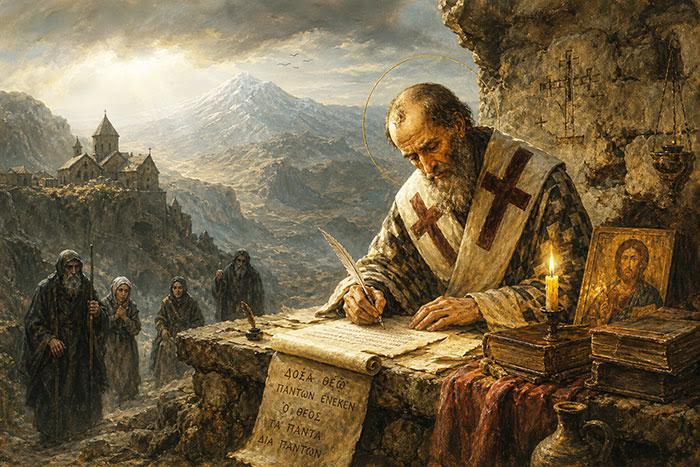
Top image credit: AI enhanced digital artwork depicting St. John Chrysostom, the “Golden-tongued Preacher” and Bishop of Constantinople, now exiled in the mountains of Armenia. Image source from artstyles.com. Used with permission.
John Chrysostom (c. 349-407) was an important early church father. He was born of noble parents in Antioch in 349. John acquired the skills for a career in rhetoric, as well as a love of the Greek language and literature. As he grew older he became more deeply committed to Christianity and went on to study theology. John became a hermit around 375. He was ordained a deacon in 381, and then ordained as a presbyter (priest) in 386 by Bishop Flavian I of Antioch.
Over the course of twelve years, he gained popularity because of the eloquence of his public speaking, especially his insightful expositions of Bible passages and moral teaching. Known as “the greatest preacher in the early church”, John’s sermons have been one of his greatest lasting legacies. The most valuable of his works from this period are his Homilies on various books of the Bible. He emphasised charitable giving and was concerned with the spiritual and temporal needs of the poor. He also spoke out against abuse of wealth and personal property. He founded a series of hospitals in Constantinople to care for the poor.
In 398, John was requested, against his will, to take the position of Archbishop of Constantinople. John was fearless when denouncing offences in high places. He was banished twice by the secular authorities. After his death, which occured in 407) he was named Chrysostom, which comes from the Greek word which means, “golden-mouthed.”