


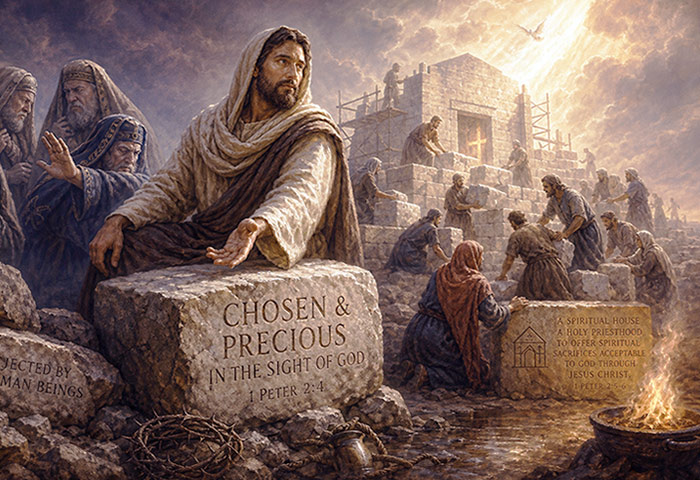
“You are living stones, built as a spiritual house in a holy priesthood, that you may offer spiritual sacrifices acceptable to God through Jesus Christ.”
1 Peter 2:4-6
So the Lord will repay his faithful followers who are so lovingly, so cheerfully, so devotedly carrying out these works, to the effect that he includes them in the construction of his own building, into which they hasten to fit as living stones (1 Peter 2:5), fashioned by faith, made solidly firm by hope, cemented together by charity.
This is the building in which that wise architect the apostle placed Christ Jesus as the foundation (1 Corinthians 3:10-11), also as the supreme cornerstone (Isaiah 28:16); one which, as Peter also reminds us from the prophetic scripture, was rejected indeed by men, but chosen and honored by God (1 Peter 2:4; Psalm 118:22).
By adhering to this stone we are joined peaceably together; by resting on it we are fixed firmly in place. You see, he is at one and the same time the foundation stone, because he is the one who regulates us, and the cornerstone, because it is he that joins us together.
He is the rock on which the wise man builds his house, and thus continues in utter security against all the trials and temptations of this world, neither collapsing when the rain pours down, nor being swept away when the river floods, nor overthrown when the winds blow.
[Sermons 337]
We Are Living Stones in the Household of God
by Origen of Alexandria
All of us who believe in Christ Jesus are said to be living stones, according to the words of Scripture: “But you are living stones, built as a spiritual house in a holy priesthood, that you may offer spiritual sacrifices acceptable to God through Jesus Christ” (1 Peter 2:4-6).
When we look at an earthly building, we can see that the larger and stronger stones are the first to be set in place as the foundation, so that the weight of the whole structure may rest on them securely. In the same way understand that some of the living stones become the foundation of the spiritual building. What are these living stones placed in the foundation? They are the apostles and prophets. That is what Paul says when he teaches:
“We have been built upon the foundation of the apostles and prophets, with our Lord Jesus Christ himself as the cornerstone.”
Ephesians 2:20
You, my hearers, must learn that Christ himself is also the foundation of the building we are now describing, so that you may prepare yourselves more eagerly for the construction of this building and become stones that lie closer to the foundation. As the apostle Paul says: “No foundation can be laid other than the one that has been laid already: I mean Christ Jesus” (1 Corinthians 3:11). Blessed are those, therefore, who build a religious and holy structure upon such a noble foundation.
In this building of the church, there must also be an altar. I think that if those of you, disposed and eager for prayer, offer petitions and prayers of supplication to God day and night, you will become the living stones for the altar which Jesus is building.
Consider what praise is ascribed to these stones which make up the altar. “The lawgiver Moses said that the altar was to be made of stones, uncovered by iron” (Deuteronomy 27:5). What are those stones? Perhaps those uncut and undefiled stones are the holy apostles, all making a single altar, because of their unity of mind and heart. For it was known that with one accord they all opened their lips to pray: “You, Lord, know the hearts of all” (Acts 1:24).
Therefore, these who were able to pray with one mind, one voice and one spirit, are perhaps worthy to form together one altar, where Jesus may offer his sacrifice to the Father. Let us strive to agree among ourselves and to have one mind and voice. May we never quarrel or act from vainglory. But may we remain united in belief and purpose. Then even we may hope to become stones fit for the altar.
[Source: Homilia 9, 1-2: SC 71, 244-246]
Top image credit: Illustration of Jesus laying the foundation stones with his apostles, and disciples joining in the building as living stones of God’s household. Image created with digital paintbrush and AI enhanced artwork from © Artstyles.com. Used with permission.