


“Confess your sins to one another.”
James 5:16
Those who remain alone with their evil are left utterly alone. It is possible that Christians may remain lonely in spite of daily worship together, prayer together, and all their community through service – that the final breakthrough to community does not occur precisely because they enjoy community with one another as pious believers, but not with one another as those lacking piety, as sinners. For the pious community permits no one to be a sinner. Hence all have to conceal their sins from themselves and from the community. We are not allowed to be sinners. Many Christians would be unimaginably horrified if a real sinner were suddenly to turn up among the pious. So we remain alone with our sin, trapped in lies and hypocrisy, for we are in fact sinners.
However, the grace of the Gospel, which is so hard for the pious to comprehend, confronts us with the truth. It says to us, you are a sinner, a great, unholy sinner. Now come, as the sinner that you are, to your God who loves you. For God wants you as you are, not desiring anything from you – a sacrifice, a good deed – but rather desiring you alone.
“My child, give me your heart.”
Proverbs 23:26
God has come to you to make the sinner blessed. Rejoice! This message is liberation through truth. You cannot hide from God.
The mask you wear in the presence of other people won’t get you anywhere in the presence of God. God wants to see you as you are, wants to be gracious to you. You do not have to go on lying to yourself and to other Christians as if you were without sin. You are allowed to be a sinner. Thank God for that; God loves the sinner but hates the sin.
Mercy and forgiveness in Christ
Christ became our brother in the flesh in order that we might believe in him. In Christ, the love of God came to the sinner. In the presence of Christ human beings were allowed to be sinners, and only in this way could they be helped. Every pretense came to an end in Christ’s presence. This was the truth of the Gospel in Jesus Christ: the misery of the sinner and the mercy of God. The community of faith in Christ was to live in this truth. That is why Jesus gave his followers the authority to hear the confession of sin and to forgive sin in Christ’s name.
“If you forgive the sins of any, they are forgiven them; if you retain the sins of any, they are retained.”
John 20:23
When he did that, Christ made us into the community of faith, and in that community Christ made the other Christian to be grace for us. Now each stands in Christ’s place. In the presence of another Christian I no longer need to pretend. In another Christian’s presence I am permitted to be the sinner that I am, for there alone in all the world the truth and mercy of Jesus Christ rule. Christ became our brother in order to help us; through Christ other Christians have become Christ for us in the power and authority of Christ’s commandment.
Other Christians stand before us as the sign of God’s truth and grace. They have been given to us to help us. Another Christian hears our confession of sin in Christ’s place, forgives our sins in Christ’s name. Another Christian keeps the secret of our confession as God keeps it. When I go to another believer to confess, I am going to God.
Thus the call within the Christian community to mutual confession and forgiveness goes out as a call to the great grace of God in the congregation.
Breakthrough to community
In confession there takes place a breakthrough to community. Sin wants to be alone with people. It takes them away from the community. The more lonely people become, the more destructive the power of sin over them. The more deeply they become entangled in it, the more unholy is their loneliness. Sin wants to remain unknown. It shuns the light. In the darkness of what is left unsaid sin poisons the whole being of a person. This can happen in the midst of a pious community. In confession the light of the Gospel breaks into the darkness and closed isolation of the heart.
Sin must be brought into the light. What is unspoken is said openly and confessed. All that is secret and hidden comes to light. It is a hard struggle until the sin crosses one’s lips in confession. But God breaks down gates of bronze and cuts through bars of iron (Psalm 107:16). Since the confession of sin is made in the presence of another Christian, the last stronghold of self-justification is abandoned. The sinner surrenders, giving up all evil, giving the sinner’s heart to God and finding the forgiveness of all one’s sin in the community of Jesus Christ and other Christians. Sin that has been spoken and confessed has lost all of its power. It has been revealed and judged as sin. It can no longer tear apart the community.
Now the community bears the sin of the individual believer, who is no longer alone with this evil but has “cast off” this sin by confessing it and handing it over to God. The sinner has been relieved of sin’s burden. Now the sinner stands in the community of sinners who live by the grace of God in the cross of Jesus Christ. Now one is allowed to be a sinner and still enjoy the grace of God. We can admit our sins and in this very act find community for the first time. The hidden sins separated the sinner from the community and made the sinner’s apparent community all a sham. The sins that were acknowledged helped the sinner to find true community with other believers in Jesus Christ.
In this connection, we are talking exclusively about confession between two Christians. A confession of sin in the presence of all the members of the congregation is not required to restore one to community with the entire congregation. In the one other Christian to whom I confess my sins and by whom my sins are declared forgiven, I meet the whole congregation. Community with the whole congregation is given to me in the community which I experience with this one other believer. For here it is not a matter of acting according to one’s own orders and authority, but according to the command of Jesus Christ, which is intended for the whole congregation, on whose behalf the individual is called merely to carry it out. So long as Christians are in such a community of confession of sins to one another, they are no longer alone anywhere.
The cross of Christ shatters all pride
In confession there occurs a breakthrough to the cross. The root of all sin is pride, superbia. I want to be for myself; I have a right to be myself, a right to my hatred and my desires, my life and my death. The spirit and flesh of human beings are inflamed by pride, for it is precisely in their wickedness that human beings want to be like God. Confession in the presence of another believer is the most profound kind of humiliation. It hurts, makes one feel small; it deals a terrible blow to one’s pride. To stand there before another Christian as a sinner is an almost unbearable disgrace.
By confessing actual sins the old self dies a painful, humiliating death before the eyes of another Christian. Because this humiliation is so difficult, we keep thinking we can avoid confessing to one another. Our eyes are so blinded that they no longer see the promise and the glory of such humiliation. It is none other than Jesus Christ who openly suffered the shameful death of a sinner in our place, who was not ashamed to be crucified for us as an evildoer. And it is nothing else but our community with Jesus Christ that leads us to the disgraceful dying that comes in confession, so that we may truly share in this cross.
The cross of Jesus Christ shatters all pride. We cannot find the cross of Jesus if we are afraid of going to the place where Jesus can be found, to the public death of the sinner. And we refuse to carry the cross when we are ashamed to take upon ourselves the shameful death of the sinner in confession. In confession we break through to the genuine community of the cross of Jesus Christ; in confession we affirm our cross. In the profound spiritual and physical pain of humiliation before another believer, which means before God, we experience the cross of Jesus as our deliverance and salvation. The old humanity dies, but God has triumphed over it. Now we share in the resurrection of Christ and eternal life.
Breakthrough to new life
In confession there occurs a breakthrough to new life. The break with the past is made when sin is hated, confessed, and forgiven. “Everything old has passed away.” But where there is a break with sin, there is conversion. Confession is conversion. “Everything has become new” (2 Corinthians 5:17). Christ has made a new beginning with us. As the first disciples left everything behind and followed Jesus’ call, so in confession the Christian gives up everything and follows. Confession is following after. Life with Jesus Christ and the community of faith has begun.
“No one who conceals transgressions will prosper, but one who confesses and forsakes them will obtain mercy.”
Proverbs 28:13
In confession, Christians begin to renounce their sins. The power of sin is broken. From now on, the Christian gains one victory after another. What happened to us in baptism is given to us anew in confession. We are delivered from darkness into the rule of Jesus Christ. That is joyful news. Confession is the renewal of the joy of baptism.
“Weeping may linger for the night, but joy comes with the morning.”
Psalm 30:6
This article is excerpted from Life Together, by Dietrich Bonhoeffer. Translated from German to English by Daniel Bloesch. New English-language edition translation with new supplementary material published by Fortress Press in 1996 as part of Dietrich Bonhoeffer Works. First published in English as Life Together copyright © 1954 Harper and Row Publishers, Inc. First published in German as Gemeinsames Leben by Chr. Kaiser Verlag in 1939.
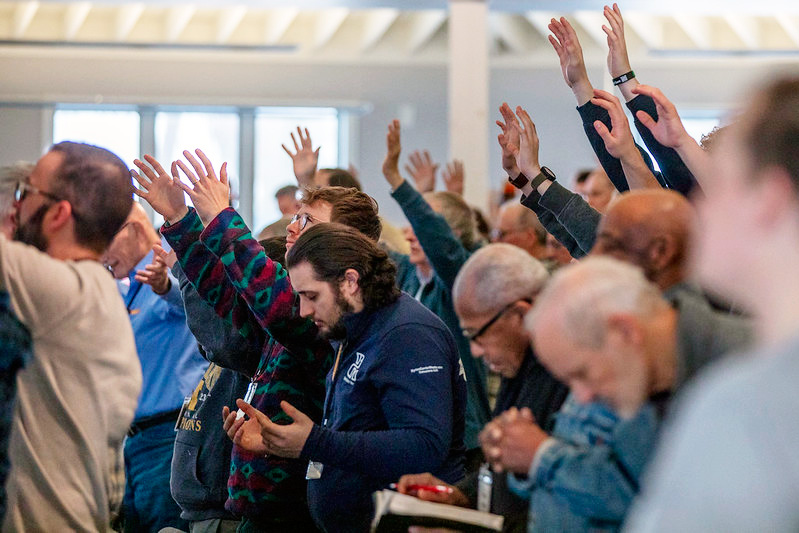
Top image credit: Sword of the Spirit All Michigan Men’s Retreat February 2026, photo © by Nico Angleys.
Dietrich Bonhoeffer (1906-1945) was a German Lutheran pastor and a founding member of the Confessing Church. He was the first of the German theologians to speak out clearly against the persecution of the Jews and the evils of the Nazi ideology. In spring of 1935 Dietrich Bonhoeffer was called by the Confessing Church in Germany to take charge of an “illegal,” underground seminary at Finkenwalde, Germany (now Poland). He served as pastor, administrator, and teacher there until the seminary was closed down by Hitler’s Gestapo in September,1937.
In the seminary at Finkenwalde Bonhoeffer taught the importance of shared life together as disciples of Christ. He was convinced that the renewal of the church would depend upon recovering the biblical understanding of the communal practices of Christian obedience and shared life. This is where true formation of discipleship could best flourish and mature.
Bonhoeffer’s teaching led to the formation of a community house for the seminarians to help them enter into and learn the practical disciplines of the Christian faith in community. In 1937 Bonhoeffer completed two books, Life Together and The Cost of Discipleship. They were first published in German in 1939. Both books encompass Bonhoeffer’s theological understanding of what it means to live as a Christian community in the Body of Christ.
He was arrested and imprisoned by the Gestapo in April 1943. On April 8, 1945 he was hanged as a traitor in the Flossenburg concentration camp. As he left his cell on his way to execution he said to his companion, “This is the end – but for me, the beginning of life.”