


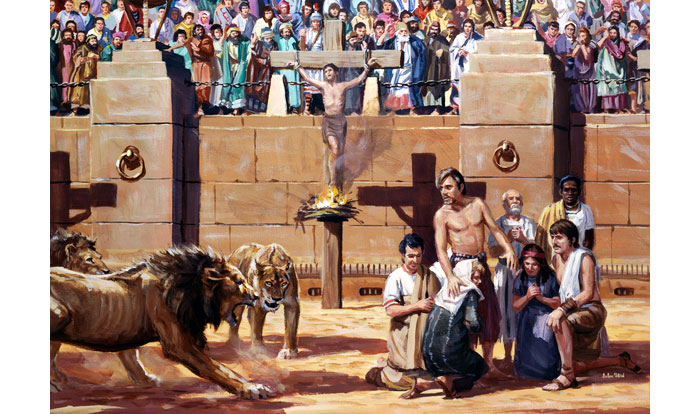
Heroes are not born but are made
What spurs men and women to risk their lives, as well as the lives of those under their command, in the face of great peril and death? Is it heroic courage against all odds or excessive confidence in their own strength or foolhardy recklessness?
It takes courage – some would say “guts” – to overcome obstacles that can inflict great pain and harm. Courage, however, can be exercised either foolishly or wisely, for a good cause or for evil, for selfish gain or for the benefit of others.
Heroes are not born but are made – through the lessons they learn and the habits they acquire in facing the challenges and difficulties of daily life. Big heroes have a lot of courage because they have learned how to conquer their fears and overcome their aversion to pain and difficulties – they have done this by meeting the little adversities and difficulties of daily life.
When the really big struggles and life-threatening difficulties arise, they are ready to face them. It is in such times that one’s true character and inner strength are revealed.
William Bennett, author of “The Book of Virtues,” distinguishes between courage and fear in facing challenges:
“We become brave by doing brave acts,” observed Aristotle. Dispositions of character, virtues and vices, are progressively fixed in us through practice. Thus, the Greek philosopher explained, “by being habituated to despise things that are terrible and to stand our ground against them we become brave, and it is when we have become so that we shall be most able to stand our ground against them.”
…Standing ground against threatening things is not to be confused with fearlessness, however. Being afraid is a perfectly appropriate emotion when confronted with fearful things.
The mere inclination to do the right thing is not in itself enough. We have to know what the right thing to do is. We need wisdom – often the wisdom of a wise leader – to give our courage determinate form, to give it intelligent direction. And we need the will, the motivating power that inspiring leaders can sometimes help us discover within ourselves even when we are unable to find it readily on our own.
If Aristotle is right, then courage is a settled disposition to feel appropriate degrees of fear and confidence in challenging situations (what is “appropriate” varying a good deal with the particular circumstances).
It is also a settled disposition to stand one’s ground, to advance or to retreat as wisdom dictates. Before such dispositions become settled, however, they need to be established in the first place. And that means practice, which in turn means facing fears and taking stands in advance of any settled disposition to do so: acting bravely when we don’t really feel brave.[i]
Courage is not the absence of fear, but the mastery of it. The Bible adds another key quality to courage – faith and trust in God. There are many examples in the Bible of ordinary men and women who became heroes by their faith and courage. David was only 17 years of age when he slew Goliath. He learned courage as a shepherd boy fighting lion and bear who preyed on his father’s sheep.
David said to Saul, “Your servant used to keep sheep for his father; and when there came a lion, or a bear, and took a lamb from the flock, I went after him and smote him and delivered it out of his mouth; and if he arose against me, I caught him by his beard, and smote him and killed him. Your servant has killed both lions and bears; and this uncircumcised Philistine shall be like one of them, seeing he has defied the armies of the living God.” And David said, “The LORD who delivered me from the paw of the lion and from the paw of the bear, will deliver me from the hand of this Philistine.”
1 Samuel 17:34-37
During the period when the Canaanites had oppressed the Israelites for 20 years, God raised up a woman, named Deborah, to be prophetess and judge for the people of Israel (Judges 4 and 5). The people came to her for counsel because she was wise and faithful to God’s word. She was not afraid to tell the people what God wanted them to do – to repent and return to him. She commissioned Barak to raise an army and overtake the Canaanites.
God called Gideon to be brave in the face of opposition
Another unlikely hero for the people of Israel was the young man Gideon (Judges 6, 7, and 8). After the Midianites had oppressed the Israelites for seven years and forced the men to flee to the mountains and caves, God called Gideon to stand and fight for his people. Gideon at first protested that he lacked experience and qualifications for such a task (Judges 6:15). When God directed Gideon to destroy the altar of Baal, Gideon obeyed, though he did it under cover of the night to avoid being seen. The next day Gideon had to face his own people who wanted to kill him for defying the false gods of the Midianites. Gideon did not retreat, but stood his ground and inspired many men to join and fight with him against the Midianites. God poured his Spirit upon Gideon to strengthen him for battle (Judges 6:34). Gideon grew in courage and boldness from that day forward as he routed the Midianites from the land.
God chose Esther to spare her people from disaster and death
Another unlikely hero whom God raised up in a time of peril for the Jewish people was a woman named Esther. The Book of Esther recounts the story of this young Jewish orphan who was deported to Babylon. She was adopted and raised by Mordecai, a Jew himself and a high official of the king (Esther 2:19-20). Mordecai introduced her to the service of the Persian king’s court where she soon found favor with Ahaseurus, King of Persia. When the king decided to make Esther his queen, Mordecai advised her to not reveal her Jewish identity.
When Haman, a chief in Ahaseurus’ court, commanded each servant to bow down before him, Mordecai refused. Haman sought revenge, not only on Mordecai, but on all the Jews in the land. The king sealed an edict with a handsome reward for anyone who would destroy all the Jews in his land. Queen Esther now faced the dilemma of saying nothing and thus sparing her own life, or exposing her true identity and risking all in the process, including her own death as well as that of her people. It was a weighty decision for a young woman in her circumstances.
Esther chose to stand and plead with the king to save her own people. After three days of prayer and fasting she made her bold plea before the king. The king followed her counsel against his own advisors and spared Esther and her people.
The courage of Christian martyrs
The early church grew rapidly and expanded despite widespread persecution through most of the first three centuries. One of the reasons for the rapid growth was the heroic witness of ordinary Christians in the face of stiff opposition and threats to their lives.
One notable example of faith and courage is the story of Perpetua at the turn of the 3rd century.[ii] She was a young well-educated Roman woman, married and with a nursing infant. In the year 203 AD, she decided to become a Christian against the advice of her father. She was also exposing herself to physical danger since the emperor had recently outlawed the Christian religion. Perpetua was arrested with four other recently converted Christians. Perpetua’s father pleaded with kisses and tears for Perpetua to give up her faith. She told him, “We rely not on our own power but on the power of God.” When she was taken before the judge he also tried to persuade her to give up her faith. After she refused, the judge sentenced her, along with the other four new Christians and Saturus their Christian teacher, to be thrown to the wild beasts in the arena.
While in prison Perpetua shared a vision she had received. She saw a ladder leading to heaven. At the bottom of the ladder was a serpent, attacking the Christians trying to climb the ladder to heaven. Perpetua understood that she would have to fight Satan rather than just the beasts of the arena. The Lord assured her that she would not be defeated in overcoming Satan. This gave her great confidence and courage. On the day of the games, the three men and two women were led into the amphitheatre. At the demand of the crowd they were first scourged. Then a boar, a bear, and a leopard were set on the men, and a wild cow on the women. Wounded by the wild animals, they gave each other the kiss of peace and were then put to the sword.
Perpetua’s last words to her brother were: “Stand fast in the faith and love one another and do not be tempted to do anything wrong because of our sufferings.” An eyewitness account describes the death of Perpetua: “But Perpetua, that she might experience pain more deeply, rejoiced over her broken body and guided the shaking hand of the inexperienced gladiator to her throat. Such a woman – one before whom the unclean spirit trembled – could not perhaps have been killed, had she herself not willed it.”[iii]
Courage for daily living
Courage helps us meet a variety of challenges and struggles we are likely to face in our daily life. And in handling them with the determination to do what is right, we grow in maturity and virtue. If I feel lazy or sleepy in the morning, will I sleep in or force myself to get up in time to avoid being late for school or work? When it comes time to study and prepare for my exams, will I put the media and other interests aside, and make the effort needed to prepare well? Or will I choose to cut corners by cheating or bluffing my way through the exams?
When I am asked to take on difficult assignments or an unpleasant task, do I try to make excuses? Will I go the extra mile when a co-worker or fellow student needs help in catching up? Difficult tasks often require sustained effort to keep at them, especially when we encounter setbacks or other difficulties. Stubborn problems require us to diligently search for solutions, resisting the urge to give up. Repairing damaged relationships, mending offensive remarks, and forgiving repeat offenders, often require the courage to forbear, forgive, and let go of resentments.
It is easy to blow off steam and react when offended, but harder to “turn the other cheek” with meekness (Matthew 5:39). It often takes courage to choose the more difficult path that leads to growth and maturity rather than the painless road to comfort and ease.
Courage helps us to do more than we would naturally be inclined to do, to go the extra mile when needed, to push through to the finish line even when we feel tired or exhausted, to endure the suffering, deprivation, and hardship that come our way. Courage is an inner strength because it keeps our mind resolute and our heart steady when we feel fainthearted, weak, or weary. It keeps us from giving up and running away when we need to stay the course.
There are different types of courage – such as the physical courage to climb a treacherous mountain or to defuse a land mine, the intellectual courage to persist in searching for a cure to fight a terminal illness, the heroic courage to lay down one’s life to save others, like the soldier who throws himself on top of a live grenade, or the person on a sinking ship who gives his life jacket to the person who doesn’t have one, and the moral courage to stand for the truth and to resist evil in the face of opposition and threats to one’s life.
Moral courage is a virtue precisely because it consistently (habitually) chooses to do what is morally right and good in the face of difficulty and to resist what is morally wrong despite the pressure to conform or succumb.
Need for heroes today
The world today needs heroes who are courageous, loyal, and ready to witness their Christian convictions even to the point of shedding their blood for Christ. When Hitler rose to power and began to promote his Nazi ideology, many Christians at first mistook it for social and economic progress. Those who listened more carefully and followed the moral convictions of their conscience began to speak up and point out the errors of Nazism and its uncompromising anti-Christian ideology. Martin Borman, a prominent Nazi official, said: “Priests will be paid by us and, as a result, they will preach what we want. If we find a priest acting otherwise, short work is to be made of him. The task of the priest consists in keeping the Poles quiet, stupid, and dull-witted.” Many lay people and clergy who refused accommodation and stood up for what was right were silenced, imprisoned, or sent to concentration camps. Dieterich Bonhoeffer, Alfred Delp, Sophie Sholl, Edith Stein, and many others are recognized today as true German Christian heroes and martyrs who risked their lives by openly defending the gospel against the false claims of Nazism.
Distortions of heroism
Our present age, unfortunately, promotes distorted models of courage and heroism. The flawed hero and the antihero are very popular in the media. Video games and comic books are devoted to serializing antihero characters and villains who have little or no morals or scruples. They cheat, steal, maim, and kill in epic fashion. They are great con artists, daredevils, rebels, and reckless adventurers who stop at nothing. Traditional heroes by contrast are often seen these days as old-fashioned, intolerant moralizers who are trying to turn the clock back to the good old days when heroes were seen as guardians of society who strove to root out evil in the land and make neighborhoods and schools safe for kids.
Can modern society survive without true heroes and upholders of moral values? Charles Colson, in his book, Against the Night, writes:
Societies are tragically vulnerable when the men and women who compose them lack character. A nation or a culture cannot endure for long unless it is undergirded by common values such as valor, public-spiritedness, respect for others and for the law; it cannot stand unless it is populated by people who will act on motives superior to their own immediate interest. Keeping the law, respecting human life and property, loving one’s family, fighting to defend national goals, helping the unfortunate, paying taxes – all these depend on the individual virtues of courage, loyalty, charity, compassion, civility, and duty.[iv]
There can be no decent society without them. And sound character can only be won through courage and perseverance in the pursuit of what is good. The ancient Greeks and Romans took great pride in upholding their noble ideals and in honoring their heroes who bravely died defending those ideals. Ancient Greek and Roman civilizations both eventually lost these ideals and collapsed through moral decay and excess. Our modern society will continue to decline and eventually collapse in the same way unless its leaders and teachers courageously choose to pursue the truth and restore moral order and virtue to their proper foundational role.
Moral truth and courage
What role should Christians play in restoring moral truth to society, community, and family life? First we need to cultivate courage in our own lives, to embrace the truth courageously, live it, defend it, and teach it to others, especially our children. God has revealed his truth to us so that we can live well and not become slaves to fear, doubt, and sin. It takes courage to pursue the truth of God’s word, believe it, and submit our lives to it. The second step is to reject whatever is contrary to the truth and to expose what is false. And the third step is to promote and imitate good role models – men and women who have lived virtuous lives, who were honest, just, and compassionate.
True courage, or the more traditional word “fortitude,” has two opposites: recklessness or false courage on the one hand and escapism on the other. This latter is often fueled by sloth or fear. We usually think of fear as the key obstacle to courage. Sloth, however, opposes courage more strongly than fear because it drives away any incentive to be courageous in the first place.
False courage
False courage is foolhardy risk-taking, audacious bragging, and false confidence. Reckless people often take unnecessary risks with excessive confidence in the face of danger or peril. They “dive in head first” without thinking. Some are “dare-devils,” engaging in reckless and indiscriminate courting of danger for the thrill of it. False confidence, especially in physical strength, and a sense of fearlessness based upon a false appraisal and evaluation of reality are other forms of false courage. It makes us think we are stronger than we really are.
Sloth
Sloth is also an enemy of courage. It literally means “not caring” or “apathy.” Sloth is a kind of sadness in the face of some good that requires effort and choice – through searching, seeking, and achieving. And sloth drives out the joy of pursuing what is truly good – God and his kingdom of peace and righteousness (Romans 14:17). Sloth weighs upon the mind and makes a person listless (wanting to do nothing) in the face of the need to do good, especially what is morally and spiritually good – such as loving God and neighbor, doing God’s will, overcoming vice with virtue.
Sloth makes us look for joy in the wrong places. Pascal describes sloth as diversions and distractions we fill our lives and minds with to avoid facing the truth about who we are and are called to be in relationship with God.[v] Sloth can spring from laziness (not wanting to put in the effort in pursuing and doing what is good) or timidity (fearful of how difficult or painful it might be to do what is good). Sloth leads to indifference – a “don’t care” attitude – and to restless escapism (excessive busyness, diversions, and distractions), and a refusal to work at our heavenly task (to seek first the kingdom of God).
Peter Kreeft, a prolific Christian writer and professor of philosophy, describes sloth as the chief modern sin holding us back from pursuing God and his kingdom.
There is a deep spiritual sorrow at the heart of modern civilization because it is the first civilization in all of history that does not know who it is or why it is, that cannot answer the three great questions: Where did I come from? Why am I here? and Where am I going?
This is the most terrifying thing of all to us, because our primary need is denied, our need for meaning. This tenor is so great that it must be pushed down far into the unconscious by sloth, or we would go insane. So we cover it up with a thousand busynesses. Thus, paradoxically, it is our very sloth that produces our frantic activism (Back to Virtue).[vi]
Fear
Another obstacle to courage is fear, especially the fear of suffering that makes us shy away from living according to our convictions, standing up for the truth, and doing what is right in the face of difficulty. Fear makes us run away. It hinders us from taking decisive action. Unreasoning timidity and being too affected by the opinions of others can be debilitating because they keep us from holding to our convictions and standing for what is right.
Courage, on the other hand, empowers us to take on what is hard and to persevere through the difficulties. It fortifies a spirit of strength and self-control (2 Timothy 1:7). Courage both allows us to overcome fear and restrains excessive boldness as well. Often fear can keep us from acting, but there are circumstances when the bravest and most difficult thing to do is wait patiently and endure. Courage steers a middle course between cowardliness on the one side and foolhardiness on the other.
Courage – fortitude
The English word courage comes from the French word coeur and the Latin word cor which both mean “heart,” or “to have heart” which is another way of saying “to be brave.” Another Latin word for courage is fortitude which comes from the root word fortis which means “strength.”
Both courage and fortitude were used interchangeably until recent times. The virtue of fortitude is more than “gutsy courage” or taking daring risks. Courage (fortitude) is the trait of pursuing or persisting in what is good or right in the face of difficulty (danger of harm or loss, of toil or suffering). Christian fortitude is a strength of mind and heart, the readiness to undergo suffering or risk danger for the sake of doing God’s will and overcoming evil with good.
Josef Pieper (1904-1997), a German Christian philosopher, has written extensively on the seven cardinal virtues (faith, hope, love, prudence, justice, fortitude, and temperance). He describes fortitude as one of the key virtues every person needs for living a morally good life.
Fortitude presupposes vulnerability; without vulnerability there is no possibility of fortitude. An angel cannot be brave, because he is not vulnerable. To be brave actually means to be able to suffer injury. Because man is by nature vulnerable, he can be brave.
By injury we understand every assault upon our natural inviolability, every violation of our inner peace; everything that happens to us or is done with us against our will; that everything in any way negative, everything painful and harmful, everything frightening and oppressive.
The ultimate injury, the deepest injury, is death. And even those injuries which are not fatal are pre-figurations of death; this extreme violation, this final negation, is reflected and effective in every lesser injury.
Thus, all fortitude has reference to death. All fortitude stands in the presence of death. Fortitude is basically readiness to die, or more accurately, readiness to fall, to die, in battle (The Four Cardinal Virtues).[vii]
Along with overcoming fear, courage inspires one to do great things. Magnanimity is also related to courage. Magnanimity is the virtue of being great of mind and heart. It encompasses a willingness to face danger and trouble with tranquility and firmness; it raises a person above revenge and makes him delight in acts of benevolence. It makes him disdain injustice and meanness, and prompts him to sacrifice personal ease, interest, and safety for the accomplishment of useful and noble purposes. Such a person is self-possessed and is unaffected by the opinion of others. That person takes delight in helping others, and is generous with his resources, especially in the service of the gospel and the Lord’s people.
Patience is also connected to courage. Patience enables us to bear affliction without anxiety or discouragement. Patience is courage borne out over time (James 1:2-4; Luke 21:19). Courage also requires that we be ready to die for the sake of what is right. We must be willing to die rather than sin. The martyrs, by laying down their lives for the Lord Jesus Christ and the spread of the gospel, make the supreme act of courage.
Distinguishing True Courage from Its Two Extreme Opposites
| Recklessness (false courage) | Fortitude (true courage) | Escapism (sloth and fear) |
|---|---|---|
| Being reckless or oblivious to danger is not courage. Reckless people take unnecessary risks and have excessive confidence in the face of danger or peril. | The courageous person strikes a balance between foolhardy recklessness and irrational fear and avoidance of pain and suffering. | The escapist doesn’t want to face the truth nor pursue what is morally right and good, especially if it will require personal sacrifice, struggle, pain, and suffering. |
| Excessive fear can keep us from acting, but there are circumstances when the bravest and most difficult thing to do is wait patiently and endure | Christian fortitude is the ability and readiness to undergo suffering, make sacrifices, and risk danger for the sake of doing God’s will and for protecting others from physical and moral danger and harm. | A coward lacks the moral courage to face the truth and to do what is right and good, either out of timidity (fear of pain and suffering) or out of sorrow (lack of desire or interest in pursuing what is good). |
| False confidence, especially in physical strength, and a sense of fearlessness, is based upon a false evaluation of reality. | True fortitude does not trust itself, but is subordinate to justice and prudence. “Fortitude without justice is a lever of evil” (St. Ambrose of Milan). Fortitude grows with the dogged effort to study, to finish a task, render a service, or overcome laziness or some other fault. | Sloth is excessive sorrow which weighs upon the mind and makes one listless (wanting to do nothing) in the face of good, especially in the pursuit of what is morally and spiritually good for us – such as loving God and neighbor, doing God’s will, overcoming vice with virtue. |
How do we grow in the virtue of fortitude?
Courage (fortitude) cannot simply be taught in a textbook or in a course. Learning courage requires role models – men and women who live it and who show others, especially their children, how they have learned to break bad habits and vices and how they have learned to acquire good habits and virtues. The Lord Jesus taught by precept and by example (Luke 10:37, John 13:15). Both go hand in hand. Bad example reinforces bad behavior and good example reinforces good behavior. Proverbs says, “Train a child in the way he should go, and when he is old he will not depart from it” (Proverbs 22:6). There is no short path to growth in character and moral maturity.
Servais Pinckaers (1925-2008), a noted Christian moral teacher, taught that courage calls for wise educators – parents, teachers, and pastoral workers – who can lead by example as much as by precept and training.
The development of courage (fortitude) is progressive. It is acquired far more through small victories of self-conquest, repeated day after day, than through dreams of great actions. It grows with the dogged effort to study, to finish a task, render a service, or overcome laziness or some other fault. There will also be battles to fight, trials to encounter, small and great sufferings to endure, reaching their pitch in the illness and death of loved ones.
There is no course in courage, likes courses in music or the other arts. Its best school is the family, where we learn from our parent’s example, wise discipline, and the encouragement we receive to make personal efforts and persevere in them. Courage, like any virtue, calls for educators rather than professors.
Courage, which the Romans considered as the highest of virtues, is a characteristic of the morally mature person. It is indispensable for complete moral freedom (The Sources of Christian Ethics).[i]
The greatest of all teachers is the Lord Jesus himself who calls us to walk in his way of love, truth, and courage. Through the gift of the Holy Spirit he gives us the help, wisdom, and strength we need to overcome whatever obstacles and challenges we may have to face. Nothing can shake our faith or separate us from God’s love if we root our lives in Jesus Christ and trust in his word.
“Who shall separate us from the love of Christ? Shall tribulation, or distress, or persecution, or famine, or nakedness, or danger, or sword? As it is written, “For your sake we are being killed all the day long; we are regarded as sheep to be slaughtered.” No, in all these things we are more than conquerors through him who loved us. For I am sure that neither death nor life, nor angels nor rulers, nor things present nor things to come, nor powers, nor height nor depth, nor anything else in all creation, will be able to separate us from the love of God in Christ Jesus our Lord.”
Romans 8:35-39
This article by Don Schwager is excerpted from the book, Training in Excellence How godly character forms strong mature men and women and strengthens the building of communities for generations to come, © 2013 Don Schwager, published by Kairos Publications www.kairos-eme.org.
An online PDF copy of the book and related articles are available to read or download at Academia.edu.
Top image credit: Depiction of early 3rd century Christian martyrs in the Roman coliseum as they bravely endure torture and bloody death by wild beasts, sword, and crucifixion for their their faith and loyalty to the Lord Jesus Christ. Image from GoodSalt.com, © illustration by Pacific Press. Used with permission.
Notes:
[i] The Sources of Christian Ethics, by Servais Pinckaers (The Catholic University of America, 1995), pg. 356
[i] The Book of Virtues, by William Bennett (Simon and Schuster, 1993), pg. 441,442.
[ii] For a firsthand account of the martyrdom of Perpetua see, The Acts of the Christian Marytrs, texts and translation by Herbert Musurillo, 1972 Oxford University Press. See an online excerpt from Pepetua’s testimony at http://www.pbs.org/wgbh/pages/frontline/shows/religion/maps/primary/perpetua.html
[iii] This excerpt is taken from The Martyrdom of Perpetua. It is based on the first-person accounts of Perpetua and Saturus, which took place under the persecution of Septimius Severus in 202-3 AD. The popularity of the account spread rapidly in the third and fourth centuries.
[iv] Charles Colson, Against the Night: Living in the New Dark Ages (Servant Publications, Ann Arbor, MI, 1989), chapter 6, pg. 67.
[v] Blaise Pascal, Pensees, “We run heedlessly into the abyss after putting something in front of us to keep from seeing the precipice.” See also, Pascal: The First Modern Christian, by Edward T. Oakes, First Things, August/September 1999 [http://www.firstthings.com/article/2007/01/pascal-the-first-modern-christian-49]
[vi] Back to Virtue: Traditional Moral Wisdom for Modern Moral Confusion, by Peter Kreeft (Ignatius Press, 1992), chapter 11, ps. 156.
[vii] The Four Cardinal Virtues, by Josef Pieper (University of Notre Dame Press, 1996), pg. 117.
Don Schwager is the editor of Living Bulwark and author of the Daily Scripture Reading and Meditation website. He is a lay religious brother and life-time member of the Servants of the Word.