


Many years ago, while serving in the Navy in the Mediterranean, three of us found ourselves in a place we had not intended to be, we had driven into the West Bank which was restricted to us. Driving through these hills, we descended into a narrow valley and stopped near a small white structure. It turned out to be Joseph’s tomb, so we went inside, to see the tomb.
It was a tense moment – an unfamiliar place, a realization that we should probably leave quickly. But with the passing of years, and especially when reading the Gospel of the Samaritan woman, that brief moment has taken on deeper meaning. Because the valley we had stepped into is not just another place in the Middle East. It is one of the most spiritually charged landscapes in the Bible.
That valley is the ancient site of Shechem, lying between Mount Gerizim and Mount Ebal. (Mt. Gerizim is where the Samaritans worshiped God) In that very place Abraham first built an altar after entering the promised land. Jacob later purchased land there. Joseph – sold into slavery by his brothers, later becomes instrument of their salvation from starvation. His bones were carried there, when the Israelites returned from Egypt, and it is here that he buried. It is here that Joshua gathered the tribes in that valley and challenged them to choose whom they would serve: “As for me and my house, we will serve the Lord.”
It was, in other words, a place of covenant – yet also a place of division.
By the time of Jesus, the region had become one of the fault lines of the ancient world. Jews and Samaritans lived side by side but carried centuries of distrust and resentment. Many Jews avoided the region entirely when traveling between Judea and Galilee. It was safer to cross the Jordan and take a longer road than to pass through Samaria.
Yet the Gospel of John tells us that Jesus “had to pass through Samaria.” While we entered this unsafe area, simply because we were lost, Jesus goes there on purpose.
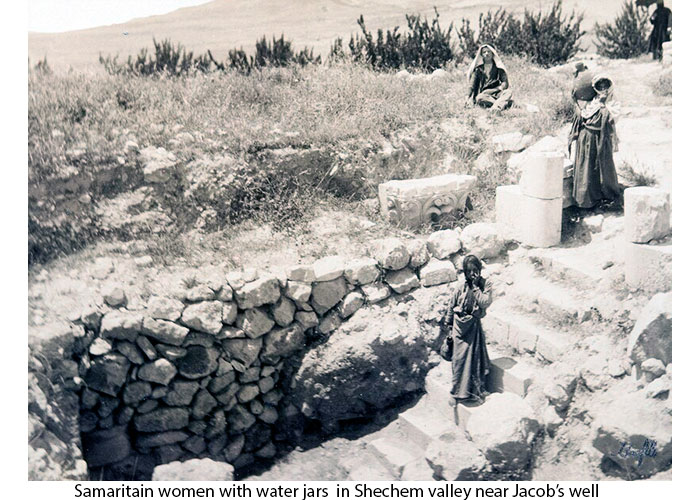
He came to Jacob’s Well in the same valley where those ancient covenants had been made, and there He did something remarkable. He spoke with a Samaritan woman – crossing boundaries of ethnicity, religion, and social custom. In that conversation He revealed Himself as the Messiah and offered her “living water.”
In a place marked by centuries of division, the first fruits of reconciliation appear. Through that woman’s witness, many Samaritans from that town came to believe in Him. What armies and politics have failed to accomplish for generations begins here with a simple conversation beside a well.
Today, when we see the violence and destruction that still afflict Gaza, the West Bank, and Lebanon, it is hard not to feel the weight of history pressing down on that land. The same hills that witnessed Abraham’s faith, Joseph’s burial, Joshua’s covenant, and Jesus’ offer of living water continue to echo with conflict.
Yet perhaps that is why today’s Gospel story matters.
Jesus did not avoid the dangerous places. He entered them. He stepped into the fault lines of history and spoke words of reconciliation and truth. His kingdom was not established by force but by transforming hearts – one person at a time.
Looking back, it strikes me that my brief and accidental visit to that valley mirrors something of that larger story. I entered a restricted place without fully understanding where I was. Only later did the meaning begin to unfold. Standing there, at Joseph’s tomb, even for a moment, placed me in the very landscape where God had been patiently working through generations of human struggle and division.
Perhaps that is one of the quiet lessons I am just beginning to grasp of that place.
God’s work often unfolds slowly, across centuries, in lands and lives marked by conflict. The valley of Shechem has seen betrayal, reconciliation, covenant, and redemption. It has witnessed the brokenness of human history – and the persistent effort of God to heal it.
And in the midst of that long story, a weary traveler once sat beside a well, at the hottest part of the day, and offered living water to a stranger. She in turn proclaimed the answer to life’s woes, going into the village convincing the people that Jesus the Messiah was in their midst.
That offer for Living Water still stands. Come Lord Jesus Come!
- See related article, The Good Samaritan(s) by Brian Murray
Top image credit: A photo of Samaritan women with water jars near Jacob’s well in the valley of Shechem, by Fran Jakobs Källa, a 19th century French photographer. Digital image of the photo at Wikimedia Commons. Is in the public domain. Original source of the photo is from the Hallwyl Museum in Stockholm, Sweden.
Brian Murray is a coordinator in the People of Hope, in Newark, New Jersey, USA.