


The Same
‘Jesus Christ is the same yesterday and today and forever.”
Hebrews 13:8
For most of us, this verse is reassuring: Jesus does not change with the sands of time; the cultural trends and whimsies have no impact on his character. He is reliable and unwavering in his love for us.
What about his Father?
“I and the Father are one.”
John 10:30
What if we compare the Old Testament with the New Testament? Many of today’s Christians have embraced the modern notion that the Old Testament is not very relevant; the stories and lessons being part of an ancient, uninformed civilization. God was almost “different” in those days, and now he is more like us: educated, compassionate, forgiving and wise.
I don’t think God has changed… I think WE have changed and, in fact, seem to be frequently changing with the trends, movements, politics, etc. To be sure, the New Covenant and the life, death, and resurrection of Jesus have drawn us into a deep and growing relationship with the Lord and with new revelation.
‘Truly, I say to you, many prophets and righteous men longed to see what you see, and did not see it, and to hear what you hear, and did not hear it.”
Matthew 13:17
So we DO see, experience, and know certain things differently from most Old Testament people. God has a plan, and things for us keep getting better, but that’s not a sign that he is changing but that we are getting to know him better, individually and corporately.
This article will focus on a few important elements of similarity, but I suspect we may have much more in common with Old Testament people than we think.
Prophets
“There was a rich man, who was clothed in purple and fine linen and who feasted sumptuously every day. And at his gate lay a poor man named Lazarus, full of sores, who desired to be fed with what fell from the rich man’s table; moreover, the dogs came and licked his sores. The poor man died and was carried by the angels to Abraham’s bosom.
The rich man also died and was buried; and in Hades, being in torment, he lifted his eyes and saw Abraham far off and Lazarus in his bosom. And he called out, ‘Father Abraham, have mercy upon me, and send Lazarus to dip the end of his finger in water and cool my tongue; for I am in anguish in this flame. But Abraham said, ‘Son, remember that you in your lifetime received your good things, and Lazarus in like manner evil things; but now he is comforted here, and you are in anguish. And besides all this, between us and you a great chasm has been fixed, in order that those who would pass from here to you may not be able, and none may cross from there to us.’
And he said, ‘Then I beg you, father, to send him to my father’s house, for I have five brothers, so that he may warn them, lest they also come into this place of torment.’ But Abraham said, ‘They have Moses and the prophets; let them hear them.’ And he said, ‘No, Father Abraham; but if someone goes to them from the dead, they will repent.’ He said to him, ‘If they do not hear Moses and the prophets, neither will they be convinced if someone should rise from the dead.’”
Luke 16:19-31
This is a classic “rich-man, poor-man” story, which teaches us a number of things: our behavior in this life matters; mistreatment of the poor is dangerous; comfort in this life is no guarantee of comfort in the next life, selfishness is despicable, etc.
I want to zero in on verse 31: “…if they do not hear Moses and the prophets, neither will they be convinced if someone should rise from the dead.” Jesus has risen from the dead and the world is still not heeding the warnings of the word of God.
“But Peter, standing with the eleven, lifted his voice and addressed them, ‘Men of Judea and all who dwell in Jerusalem, let this be known to you, and give ear to my words. For these men are not drunk, as you suppose, since it is only the third hour of the day;but this is what was spoken by the prophet Joel:
Acts 2:14-18‘And in the last days it shall be, God declares,
that I will pour out my Spirit upon all flesh,
and your sons and your daughters shall prophesy,
and your young men shall see visions,
and your old men shall dream dreams;
yea, and on my menservants and my maidservants in those days
I will pour out my Spirit; and they shall prophesy.’”
Here, we consider both a similarity and a difference between the Old and New Covenants: the rich man of the Old Testament had Moses and the prophets, and in the New Testament, prophecy will be given to common people with the outpouring of the Holy Spirit. “Your sons and daughters shall prophesy” (verse 17).
I like to think of the Old Testament prophets as prophets with a capital “P”. It’s a similarity that the Old Testament and the New Testament both have prophets, but there is a difference between the Old Testament and the New Testament as to the widespread outpouring of the gift.” In the Old Testament there were major prophets in various ages (Isaiah, Jeremiah, Elijah, Elisha) who brought the word of the Lord to the people. In the New Testament times, we also have major prophets, but they are complemented by the many folks (prophets with a lower case “p”) who have experienced Pentecost. This has many implications for everyday life.
Cousin Mary
In the rough-and-tumble family of my childhood, there was one woman who stood out: cousin Mary. She was the “odd duck” who was often saying spiritual things in family gatherings where cussing was as common as “pass the pasta”. I now believe that Mary was a prophet with a small “p” to our family; she spoke the Lord’s word to us. More than that, I now believe that many families have a “cousin Mary” who speaks for the Lord.
Risky Business
While you may not get tossed into a cistern, as was Joseph by his brothers, speaking for the Lord can be risky business and often results in ridicule (at least). I went to a parochial school where we were taught that taking the Lord’s name in vain was a serious offense. Our local church even had a men’s group called “The Holy Name Society”. Uncle Al, (Mary’s father) was a member, but Uncle Al took the Lord’s name in vain more than the entire rest of the family. He was also the meanest of my many uncles and had the worst temper.
Expecting to be boiled in oil or thrown into the lions’ den, I decided to call him on it: “It seems to me that as a member of the Holy Name Society, you take the Lord’s name in vain more than anybody!” I was in the seventh or eighth grade and I was supposed to be seen and not heard. I don’t remember his exact response (I may have blacked out!), but I think it went well. The older one gets, the less likely such comments will be well received!
Father Bob
I worked at Westinghouse Research Lab and somehow was nicknamed Father Bob. I took it as a compliment, especially when the nick-namer’s mother became seriously ill and he came to me for prayer. He later was baptized in the Spirit and joined our community.
My two older brothers called my family “the God Squad”. Again, I took it as a compliment; my kids not so much. Eventually, my older brother came back to church when he began to fear that the end of the world was near.
These were mild examples of ridicule, but it can get much worse as most Christian leaders know.
Speaking for the Lord is risky business.
Does God Still Perform Miracles?
So, prophecy has not diminished from the Old Testament to the New Testament. We could easily argue that it has multiplied with the outpouring of the Holy Spirit on all flesh, young men, young women, old men, etc. But what about miracles?
“Truly, truly, I say to you, he who believes in me will also do the works that I do; and greater works than these will he do, because I go to the Father.”
John 14:12
In the New Testament miracles are widespread, even worldwide. Since the early 1900s, most Christian churches have been experiencing a “New Pentecost”, and many common folks have been growing in the spiritual life. Signs and wonders have multiplied with the preaching of the Gospel.
One time, in the early 1970s, I was invited to a convent to share about the “Jesus Movement”, which began on the United States’ west coast and had worked its way eastward. After attesting to the great signs and wonders that the Lord was working among students and “hippies”, one of the older nuns asked, “You mean to tell me that after giving my life in service to the Lord, that these signs are happening to these young people?” The irony was not lost on me, nor was the irony of a young engineer giving any sort of spiritual talk to a group of sisters who have embraced the religious life. This irony is also reflected in a parable given by Jesus.
“For the kingdom of heaven is like a householder who went out early in the morning to hire laborers for his vineyard. After agreeing with the laborers for a denarius a day, he sent them into his vineyard. And going out about the third hour he saw others standing idle in the market place; and to them he said, ‘You go into the vineyard too, and whatever is right I will give you.’ So they went. Going out again about the sixth hour and the ninth hour, he did the same. And about the eleventh hour he went out and found others standing; and he said to them, ‘Why do you stand here idle all day?’ They said to him, ‘Because no one has hired us.’ He said to them, ‘You go into the vineyard too.’ And when evening came, the owner of the vineyard said to his steward, ‘Call the laborers and pay them their wages, beginning with the last, up to the first.’ And when those hired about the eleventh hour came, each of them received a denarius. Now when the first came, they thought they would receive more; but each of them also received a denarius. And on receiving it they grumbled at the householder, saying, ‘These last worked only one hour, and you have made them equal to us who have borne the burden of the day and the scorching heat.’ But he replied to one of them, ‘Friend, I am doing you no wrong; did you not agree with me for a denarius? Take what belongs to you, and go; I choose to give to this last as I give to you. Am I not allowed to do what I choose with what belongs to me? Or do you begrudge my generosity?’ So the last will be first, and the first last.”
Matthew 20:1-16
In this new Pentecost, the Lord is pouring out his Spirit on those who seemingly “don’t deserve it”; those who have not earned it… This is a difference from the Old Testament: The prophets with a small “p” far outnumber those with a capital “P”. Common, everyday folks sprinkled across denominational lines, in families and in wider institutions, are speaking up for the Lord.
So, under new covenant miracles, prophecy and other supernatural phenomena are widespread as the Holy Spirit has been poured out and into his people all across the world.
Does the Lord Still Discipline?
A good part of my motivation for this article came from a teaching by a Christian leader which basically said, “God will never hurt you or do anything to cause you pain.” To me, this kind of thinking presents a good example of how cultural influence and ideas can shape our theology and behavior. I also found it personally insulting since I am a father to many children and I have attempted to raise them up in “the discipline and instruction of the Lord.” Every father, every coach, every teacher, every drill instructor causes some pain as a part of the process.
And have you forgotten the exhortation which addresses you as sons?
“My son, do not regard lightly the discipline of the Lord,
nor lose courage when you are punished by him.
For the Lord disciplines him whom he loves,
and chastises every son whom he receives.”“It is for discipline that you have to endure. God is treating you as sons; for what son is there whom his father does not discipline? If you are left without discipline, in which all have participated, then you are illegitimate children and not sons. Besides this, we have had earthly fathers to discipline us and we respected them. Shall we not much more be subject to the Father of spirits and live? For they disciplined us for a short time at their pleasure, but he disciplines us for our good, that we may share his holiness. For the moment all discipline seems painful rather than pleasant; later it yields the peaceful fruit of righteousness to those who have been trained by it.”
Hebrews 12:5-11
Today’s approach, where every child gets a trophy, and training never involves discipline or pain, is leaving our children unprepared for adult life and unprepared for discipleship. I think many, many more children are more trainable than our experience in church or a restaurant might suggest. Much of this bad behavior is the result of the steep decline of the role of the father in modern family life. Masculinity has been under attack for decades, and the decline of the fathers’ role is the worst result. Empathy is at toxic levels, and the consequences of behavior are no longer being adequately enforced. I know that there are or can be disturbed children, but that reality is small and most children can be trained. If I pass my responsibility as a father to teachers, employers, or police, have I done any favors for my children? Is that empathy or is that a lazy dad? Or is that a modern trend replacing biblical and Christian traditional wisdom?
Psychology, sociology, modernism and feminism can all become a religion that usurps the Christian/Biblical worldview. We won’t be able to blame a self-help book for shirking our responsibility as parents.
“Fathers, do not provoke your children to anger, but bring them up in the discipline and instruction of the Lord.”
Ephesians 6:4
Eras
I grew up in the “God is justice” era, where the Lord was presented as just waiting to get me for wrongdoing. Fear was the motivator for good behavior. I’m sure there have been different eras throughout the ages, and I think they have one thing in common: they tend to focus on one of the aspects of God’s nature. For example: God’s mysterious or hidden nature has been exaggerated to say that he isn’t really interested, or he is taking a “hands off” approach to see how we do.
Over the centuries there probably have been many eras of embracing a characteristic of God’s nature… often so that we can justify any form of behavior or lifestyle.
Mercy
I believe that we are in a present era of mercy; where God’s just nature is never mentioned and fear of the Lord is nowhere to be found. This provides cover for all sorts of perversions and even grooming of little children with drag queens performing in their classrooms sanctioned by the school administration.
One of the most covered sins of this new era is fornication. The practice is so common that no one notices that it is expressly forbidden in both Old and New Testaments. Speak against it and you’ll discover the “risky business” side of speaking for the Lord.
Has God embraced the toxic empathy of the 21st century? Is he one of the new helicopter parents? Is he now like a “smothering” mother whose goal in life is to protect us from all pain and to guarantee our success with every venture? Is he the one turning men into women by his coddling nature that excuses every misstep? Is he inspiring books about toxic masculinity? Or is this the description that we have given God so that we can do what we want to do?
There is an old saying, “If God seems far away, who moved?” There now is a new saying, “If God seems to be radically different, who changed?”
God in the Old Testament was just; and he was also merciful.
God in this New Testament is exceedingly merciful; and he is also just.
Conclusion
The Old Testament: We can learn about the nature of God by embracing and studying the old covenant. The additional depth of wisdom about life is almost unmeasurable.
The New Testament: We can learn about Jesus and experience him and the new covenant by reading, studying, and embracing the Gospels and the whole New Testament.
Pentecost: We can learn about the Holy Spirit by embracing the New Pentecost, being baptized in the Spirit and by living under his guidance and inspiration.
God is the same: yesterday, today and forever!
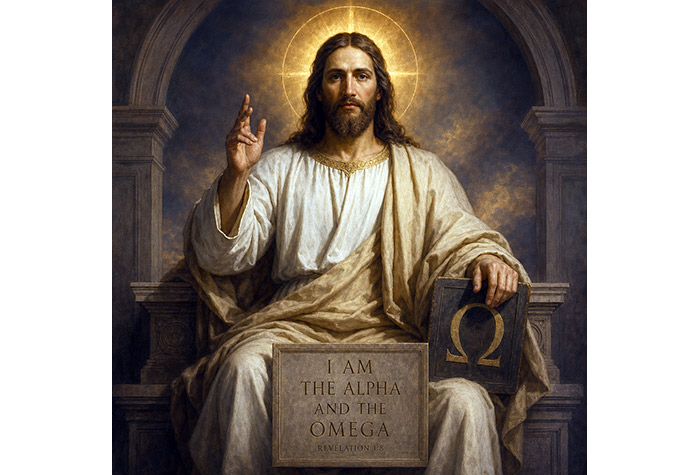
Top image credit: Digital artwork depicting Christ on the throne declaring, “’I am the Alpha and the Omega,” says the Lord God, who is and who was and who is to come, the Almighty” (Revelation 1:8). Image from artstyles.com. Used with permission.
Bob Tedesco is a profound teacher and prolific writer on building Christian family life and community in the light of Christian truth, Biblical wisdom, and the call to live and grow as disciples of Jesus Christ. Check out his previous articles and books in the Living Bulwark archives.
Bob is also the author of three books, Essays on Christian Community, Choosing Discipleship, By God’s Design. and forty-two Christian life articles published in the Sword of the Spirit international online magazine, Living Bulwark. He has a BS in Aerospace Engineering from the University of Pittsburgh and worked as a consulting engineer for twenty years. He and his wife, Bobbie, have been married for sixty-five years (as of June 24, 2026). They currently have ten children, thirty-seven grandchildren, and thirty great-grandchildren. They reside in Coraopolis, Pennsylvania, USA.