


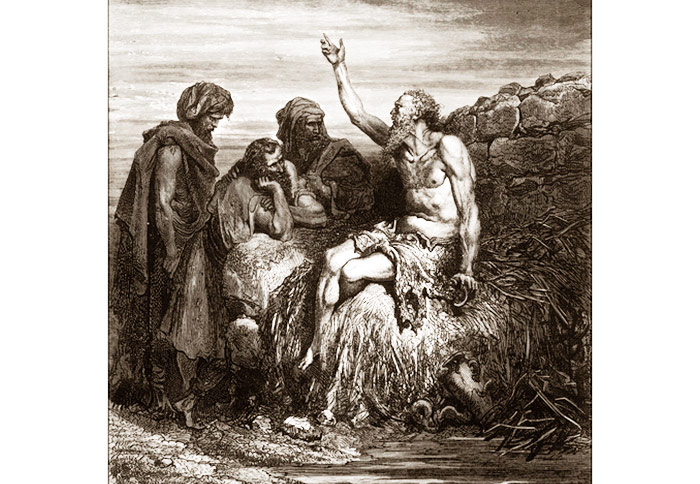
The following is a selection of a few verses from a forth-coming book, Job: The Poetry of Suffering. – ed.
Introduction
Old Testament poetry had certain characteristics. One of the most important was its “lyrical” nature. (Literally “of the lyre.”) Poetry was meant to be memorized and recited, or sung aloud accompanied by a stringed instrument. It wasn’t meant to be read silently to oneself.
Hebrew poetry often had three stressed syllables per lyrical line but it did not have a consistent meter. The total number of syllables per line could vary widely and the three stressed syllables could fall anywhere.
The poetry of Job employs another defining characteristic in its use of parallelism: two lines saying the same thing.
“O perish the day of my birth,
Job 3:3
The night which saw me conceived!”
Most of today’s bibles have the accurate translation of the Hebrew as a higher priority than the preservation of the poetic form. This makes sense, they are translations.
In my rendition of Job’s poetry, I maintain a meter with eight or nine syllables, of which, three are stressed.
Hebrew did not use a rhyme scheme. I have added one using the form ABCB.
I have not rendered the speeches of God nor Job’s friends. My goal was simply to manifest Job’s suffering in the form of modern poetry. I have tried to stay true to the meaning of the text line by line, but it was often better to reorder the words or verses to make the meter or rhyme scheme that I used work.
The Book of Job is about a wealthy and God–fearing man with a good life and family. God allows Satan to test Job by taking away his wealth and children, afflicting his body, and destroying his reputation.
In chapter three we move from hearing about Job’s fate to encountering Job face to face. He doesn’t just tell us about his anguish, he manifests the full force of it.
Job’s reflections occur separately over the course of several months. He covers many things from very different angles on different days.
O Perish the Day of My Birth
In what is probably the most eloquent curse ever written,
Job thoroughly denounces the day of his birth (3:3–16).
3:3- O perish the day of my birth;
The night, “It’s a boy!’ was proclaimed.
3:4- That day—shroud it over in darkness;
That night be bereft and defamed.
May God care nothing about it.
May light never shine there–upon.
3:5- May gloom and harsh darkness encase it –
Clouds howling in terror till dawn.
3:6- Overspread it with night through the day;
Overlay it in black still at noon.
Exclude it from days of the year;
Excise it from counts of the moon.
3:7- O suffer that eve to be barren.
No crying for joy let there be.
3:8- Let those, who would curse, curse that day
With monsters[1] aroused from the sea.
3:9- May the stars of its morning be dark;
May it hope for the light but see none;
May it open its eyelids in vain,
And see no awakening sun.
3:10- For it hid not my eyes from distress,
And shut not the doors of the womb.[2]
3:11- At birth, why did I not expire,
To be left all alone in a tomb?
3:12- O, why were there knees to receive me,
And breasts upon which I was nursed?
3:13- So, instead of sleeping in quiet;
I am living and living accursed.[3]
3:16-[4] I should have been hidden away,
a stillborn interred in the earth,
an infant who never survived,
nor saw light on the day of his birth.
3:14- The kings and the lords of the world
built halls that today lie destroyed.
3:15- Their houses held silver and gold,
But they rest now asleep in the void.
3:17- The wicked there cease having trouble;
And the weary have permanent rest.
3:18- The prisoners find ease together.
The taskmaster voices no test.
3:19- The small and the great are all equals,
The slave and the master cajole.
3:20- While light increases my misery,
And living embitters my soul.
3:21- I hunger for death but it comes not.
I seek it, an underground treasure.
3:22- It would fill me with joy and with gladness,
To lie in the grave at my pleasure.
3:23- No light shows a path that is hidden,
Whom God hedges in or keeps out.
3:24- Lamenting is my daily diet,
In rivers, my sighing pours out.
3:25- The thing that I feared comes upon me;
What befalls me is just what I dread.
3:26- All ease and quiet are gone;
I seek rest, but have trouble instead.
The Crushing Weight of Grief
Job asks God to annihilate him (6:2-13).
6:2- Could I weigh all my grief on a balance;
Or submit all my woes to the scale,
6:3- They outweigh the sand of the sea.
I swallow my words… They fail.
6:4- Almighty the arrows that pierce me.
They have struck me severely within.
The terrors of God are their poison,
And my spirit has taken them in.
6:5- What donkey brays eating its grass;
What ox bellows over its fodder?
6:6- Bland food tastes no good without salt.
6:7- I get ill when I think about water.
6:8- O God grant my wish, my desire,
my request, and my singular plea:
6:9- Loose your hand and then cut off my life.
O come and annihilate me.
6:11- My hope is depleted of strength;
My patience is cut to the bone.
6:12- My skin is not made out of bronze;
My arms are not made out of stone.
6:10- Yet one minor comfort I have
—A joy amid unceasing pains—
I have never denied the Most Holy.
In my heart, his word still remains.
False Friends
Job compares his friends to a wadi – a dried up brook (6:14-30).
6:14- Those holding back kindness to friends
Have forsaken the fear of the Lord.
6:15- And mine are as false as a wadi,
Bidding water it does not have stored.
6:16- In the winter, its water is muddy,
From catching the sludge and the snow.
6:17- In the spring it will dry up and vanish;
In the summer it ceases to flow.
6:18- The paths[5] of its brooks wander upward;
Then turn into nothing and die.
6:19- When caravans come seeking water.
6:20- They lose heart finding springs that are dry.
6:21- And such are you newly to me.
My trials have given you fright.
6:22- Have I said, “You should make God a gift,
A bribe might make everything right!”
6:23- Or begged, “Stay the hand of my foe;
Redeem me from that merciless hand?”
6:24- Just teach me, and I will be silent;
Have I strayed? Help me understand.
6:25- My words, they are forceful and honest!
Your reproofs… tell me what do they prove?
6:26- They are desperate, empty as wind.
Not a heart, nor a mind, do they move.
6:27- Yet, you would cast lots for an orphan.
Even friends you would barter away.
6:28- Would I ever lie to your faces?
See mine, and please hear what I say.
6:29- Turn now, my defense is at stake
Repent, let injustice not be.
6:30- My lips speak nothing but truth,
My mouth tastes the cause of my pains.
The Plight of Job
Any plea would be useless (9:14-24).
9:14- So what can I say to my maker?
What words can be found for my plea?
9:15- Though righteous, if I made an appeal,
Would my judge show his mercy to me?
9:16- If I summon and he gives reply,
I doubt he would hearken to me.
9:17- He would bruise me again in a tempest;
More pained and worse off would I be.
9:18- He keeps me from catching my breath,
And that makes my bitterness mount.
9:19- In matters of strength, he is stronger!
No judge can call him to account.
9:20- Though upright my own mouth condemns me;
Though blameless, myself I chastise.
9:21- I have no regard for my soul;
Though guiltless, my life I despise.
9:22- He destroys both the blameless and wicked;
He treats them one and the same;
9:23- He scourges them all unto death;
He mocks even those without blame.
9:24- The earth belongs to the wicked.
The eyes of the judge do not see.
The Almighty keeps his face covered.
Who is it, unless it is he?
Would anything Change?
Job examines some options (9:25-35).
9:25- My days run by swift as a runner.
They flee past; they see nothing good.
9:26- They slip quickly along like a reed boat,
Like an eagle that swoops on its food.
9:27- Should I say, ‘I will just quit complaining,
And abandon my countenance sad.
Forget the bad things that have happened;
Let it go and pretend I am glad.’
9:28 –My suffering comes back to haunt me.
I know I will not be acquitted;
9:29- I ask why I toil on in vain.
Condemned as I am with the wicked.
9:30- Could I wash myself white in the snow;
Or make my hands clean using bleach,
9:31- Then into the slime he would plunge me;
My clothes would condemn me in speech.
9:32- A mortal, like me, I could answer;
I could make him confront me in court,
9:33- With an arbiter’s hands on us both
To cut our hostility short.
9:34- If God were to lay down his rod,
And put me in terror no more.
9:35- Might I speak and fear him no longer?
I would be the same as before.
An Appeal to His Maker
Job reminds God. (10:1–12).
10:1- I have come to abhor my own life.
I will speak as a soul filled with grief.
10:2 To God I say, “Let me know why
You oppose me and grant no relief.
“Is this why you challenge me so:
10:3- Is it pleasing to you to oppress,
Despising the work of your hands;
While the plans of the wicked you bless?
10:4- “Do you spy with an eye made of flesh?
10:5- You whose years neither whither nor wilt.
10:6- You seek out each my sins,
You show to me all of my guilt.
10:7- “Although you know I am not wicked,
And no one but you can set free.
10:8- Will the hands that put me together,
Now crush and obliterate me?
10:9- “Remember, you made me from dust;
You fashioned me out of the clay,
10:10- And raised me, a child drinking milk;
And fed me on honey and whey.
10:11- “You clothed me with skin and in flesh;
And covered me: sinew and bone.
10:12- You granted me life and devotion;
You kept me as your very own.
© 2026 Michael Shaughnessy
Top image credit: Print artwork depicting Job and his three companions, from GoodSalt.com, 2026. Used with permission.
[1] Leviathon
[2] This is an example of shifting the original phrase order.
[3] This is an example of reframing a positive as a negative. “Lying down in peace” is reframed as living accursed.
[4] This is an example of changing the order of the verses.
[5] Paths and caravans translate the same Hebrew word.
Mike Shaughnessy is a lifelong member of the Servants of the Word, an international ecumenical brotherhood of men living single for the Lord. He is a prolific writer. He has written extensively about youth work and currently leads Grandly, a ministry helping grandparents pass on their faith to their grandchildren. He lives in Lansing, Michigan USA.