


We have already spoken of the mysterious life which comes to man from the love of God, “from above,” from heaven, which is given to him and which is yet his very own and which makes him what he is most truly intended to be.
But what about all the things around us? Does this mystery of new life apply only to man? All the things of the wide, rich world, the nobly towering mountains, the trees in the abundance and mystery of their quiet life, the beautiful stars, the immense forces of the universe, the impenetrable depths of the world, testifying so mightily to their own existence – how are they affected? All the great and precious things around us, do they have no part in the mystery of God’s freely given life? Does this life extend only to man?
Some people feel that there is a deep expectation in Nature, that there is more in Nature than material things that can be touched and used. In fairy stories there is a hint of a universal mystery in Nature, of a yearning and the wonder of its fulfillment. Are these intimations purely fanciful or do they presage a reality?
We read in the Epistle to the Romans:
“For the expectation of the creature waits for the manifestation of the sons of God. For the creature was made subject to. vanity, not willingly but by reason of Him who has subjected the same in hope. Because the creature itself also shall be delivered from the bondage of corruption into the glorious liberty of the children of God. For we know that the whole creation groans and travails in pain together until now”
Romans 8:19ff.
A strange passage. It appears to imply that the world is not yet complete, that it yearns to be completed and is travailing to attain this goal, that something is struggling to develop which is powerless to do so in its own strength, and that its emergence is bound up with the “revelation of the glory of the children of God.” What does this mean?
Have you ever noticed how a child treats things? The things around it seem to come alive. When a child takes things into its heart and hands they acquire a strange freedom. They mean much more than they do to us adults. They have quite a different depth. Something behind them is released. They confide in one another. A form that is normally hidden appears, and this is the real thing. Things speak; they are on intimate terms with one another and with the child; they become friendly and attractive and strong and dangerous in quite a different way. But then the child grows older, and all this relationship to things fades away. The child grows up and becomes rational, it wants to use things, to control and enjoy them, and then they lose the freedom they had when he was a child. They are imprisoned. They fall silent. They shrivel up. Occasionally the mystery emerges again, in the spring perhaps, when everything is stirring with new life, or in the hovering darkness of the night.
There are adults who seem to have a similar influence on the things around them but on a higher plane. St. Francis was one such person. The reports of how he called the fishes and preached to them, how he spoke to the birds of the glory of God, how the wolf of Gubbio heard and obeyed his warnings, are no doubt legendary but it is significant that such legends should have been woven around a man at all.
It means that this Francis of Assisi was one in whose presence things were different from what they are in the presence of ordinary human beings. In his presence they acquired a new nature. They were released from their dumbness, their fetters fell away from them, stunted things blossomed and became beautiful, free, and noble. More than that, something entirely new was awakened in them. This was not a fairy story, but a miracle. Not in the usual sense but in the sense that in the presence of this true child of God and his conspicuously blessed “glory” something from God entered into them – and this was what they had been waiting for, longingly and painfully, something in which their innermost spirit was fulfilled and in which they were enabled to be wholly themselves for the first time.
This was what people felt, and to express what they felt they produced these legends about St. Francis. What St. Paul had in mind began to be true: “for the creature was made subject to vanity, not willingly, but by reason of Him who hath subjected the same in hope. Because the creature itself also shall be delivered from the bondage of corruption into the glorious liberty of the children of God.” This glorious liberty of the children of God began to be revealed in St. Francis and around him. In his presence the world began to be redeemed. In his eyes and his heart and hands things began to be different. This is a mystery full of great promise.
And if we open the last book of the Bible, the Apocalypse, the book of the secret revelation, we find that it speaks of the sufferings that the holy life that comes from God undergoes in the world and of the struggles in which it must persevere; but at the same time it speaks of the glory which God will cause to radiate from the whole of Creation. The whole Apocalypse is filled with the deep mystery of the love of God not only for man but for things. That God loves things as well as man is at the very heart of the Christian faith. The sun, the stars, the trees, all finite things. All of them, silent and soulless: God loves them with a special love.
It is very good to note the passages in the Bible where this truth shines forth. At the beginning of the Old Testament, in the story of how God created the world, we read: “And He saw that it was good.” A smile of God’s love passes over the beauty of His creatures. And the sentence also contains a defense of His world. When it was written there were people who said the world was evil since it came from the Evil One: it had been created by an evil force. But the Bible says: No, what God has created is good, very good.
“And God saw everything He had made and behold it was very good.”
The Bible constantly speaks of sin, of the corruption and suffering that have come into the world and into things because of sin; of the delusion and temptation that lie in the things of the world. But the world is never given up in despair. God always holds it in His hands. It is His world. In spite of all the destruction it still bears the marks and the image of God in its order and in a thousand forms, and it speaks of its Creator to those who come to it devoutly and with purified hearts. Jesus Himself looks on it with a kindly eye. His parables are alive with flowers and birds, fields and vineyards. He has revealed to us that the great mystery of the Father’s providence is accomplished in the events of this world, that the things of this world are the instruments and vessels of His providence and intimations to His children of His goodness. He has made the spring of eternal life rise from the things of the world, the water of baptism, the bread and wine of the Last Supper.
St. Paul says that the existence and the rule of the invisible God can be seen from the visible life of material things. And in profound imagery he proclaims the mystery of the world that waits and yearns to be born again. All these things are signs that God values the things of this world, that He loves them and loves them dearly. This mystery shines forth in all its radiance in the last book of the Bible, the Apocalypse. There the glory of the love of God flows through all things, most profoundly of all in the wonderful phrase “a new heaven and a new earth” in which all pain and all oppression and hatred will be no more and all the “former things” and everything that stems from sin will pass away. Everything will be free. Everything will be open. Everything will be changed.
The Resurrection of the Lord – and what took place before on the Mount of Transfiguration –reveals the glowing, divine center of this transformation. The body of the Lord was transfigured as the outward expression of His inner glory. But the transfigured Lord is alive. He lives and acts. He draws the world unto Himself. He wants to make it a single great mystery of His own mysterious transfigured body; not only the human race but all creatures, so that “everything that is in heaven and on earth and under the earth may be summed up in Him as the Head.” All creation a unity, permeated by the power of His divine-human life. All life! All light! Everything one in the beauty of Love!
How inspiringly the Apocalypse speaks of all this! How vision after vision rises before us! It speaks of the noise of a great multitude, like the noise of water in flood, or the noise of deep thunder; of choirs of figures in white robes and golden crowns prostrate and adoring; of immense multitudes of singers praising God; of towering lamps burning before the high throne standing on gold and crystal and sapphire; of the heavenly city: its walls made of precious stones, its twelve gates twelve single pearls, one pearl for each gate, and the street of the city of pure gold like transparent glass – an excess of glory which the writer strives to convey in words that stagger the imagination. There is no need of sun or moon, for the Lamb is the light thereof and the light of God flows through it. Its food is the fruit of the tree of eternal life which grows by the pure river of water of life … images, parables of that beauty which is to break forth from the whole creation in the transformation brought about by God, when the glory of the children of God has been revealed.
That beauty which is the delight of God, from which, as the Apocalypse proclaims, the Holy City will descend and go forth like a bride to meet the Lamb.
Sometimes in the late afternoon when the day has been very clear an hour comes when the air is utterly pure and everything seems transparent; a gentle and powerful beauty reigns over all: an earthly image of “the new heaven and ·the new earth.” It seems to transfigure all things. But such earthly beauty is a mere promise of things to come. One day the light of God’s heart will break forth from all things and they will be radiant and the meaning of God’s love for His creation will be revealed to us.
This text is from a sermon given by Romano Guardini in Germany. The English translation is by Stanley Goodman, from The Living God, by Romano Guardini, 1957, Henry Regnery Company, Chicago, USA.
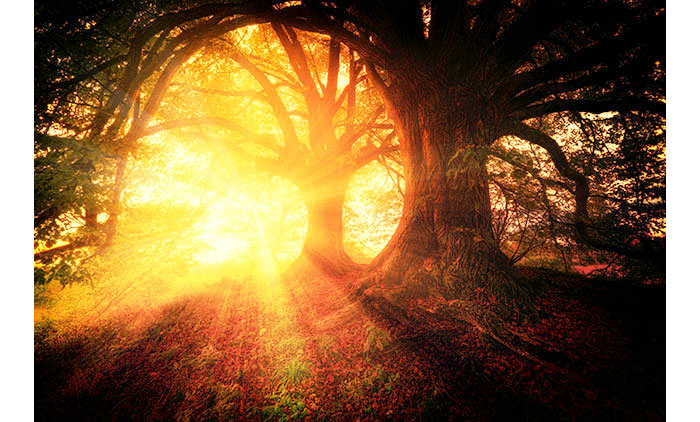
Top image credit: Radiant sunrise in a forest, © by Johannes Plenio, image from Unsplash.com. Free to use under the Unsplash License.
- See also: The King for Whom All Things Live, by Romano Guardini
Romano Guardini (1885-1968) was an influential Catholic philosopher, author, and priest in Germany. He was chaplain for a Catholic youth movement and chair of the Philosophy of Religion at the University of Berlin until the Nazis forced him to resign in 1939. He openly opposed the Nazi ideology. His books, lectures, and homilies influenced many Christian thinkers, especially in Central Europe, including Josef Pieper and Joseph Ratzinger (Pope Benedict XVI).