


”Let us worship the King for whom all things live” [an antiphon from the liturgical Office of Readings]. This is a great conception, that God is He for whom all things live. Nothing that is alive lives far from Him. Nothing that is intended to live dies for Him. But everything that can live receives fullness of life in Him.
God is the Living God, full of an ineffable power of life. There are various degrees of aliveness. Take a sample number of men and women. They are all alive, or at any rate they are not dead. But in one life is thin, feeling is meager, passion weak. In another life is ardent, pain is strong, joy is bright and airy. Whatever happens to the one, he never warms up. Things have no weight, events are colorless. But the other enters into everything. Everything speaks to him, everything is radiant and makes an impact on him, everything is instinct with joy or pain.
There are many degrees of aliveness. Sometimes one meets people whose natures are so profound, who have such a capacity for enjoyment, such a gentleness and capacity for suffering, whose whole being is so involved in the tensions of life, that they make one realize what ”life” really means. God is the Living God. There is nothing of death in Him. Nothing merely exists in Him: everything is permeated with His life. Nothing is inhibited, everything soars freely in a tense brightness. Nothing is asleep, everything burns in the presence of the one all-embracing life.
Encountering the holiness of God
So far we have approached the life of God in human terms. The real aliveness of God is His holiness. That is the deepest foundation of His aliveness, the life revealed in the prophets and in Christ, the life that moves the soul in its authentic encounter with God.
Human beings are born, they grow up, they have their joys and sorrows and their fortunes. They strive and struggle and develop, and all this happens in God. He has created them and given them their various powers. ”In Him we live and move and have our being.” When we rejoice the Living God is present in our rejoicing. He knows about our joy and rejoices in our rejoicing. And when we suffer, He suffers in our suffering. He has created us, and we are not a matter of indifference to Him.
When we work it is He who commissions us. It is not a matter of indifference to Him how the carpenter makes the table, how the mother runs her home, how the doctor serves his patients. There is an inferior kind of piety that seeks to enhance the things of God by disparaging the things of the world. It is the vengeance taken by a frustrated desire for the things of this world.
But the things of the world are not unimportant, nor are they a matter of indifference, least of all to God, since He created the world “that it might be” and He saw that it was good. He wants it to remain good, and it grieved His heart when sin invaded the goodness of His world. He took that invasion so seriously that He “gave His only-begotten Son.” God has put His work into men’s hands for them to maintain and continue, and He wants them to complete it for His joy and to give meaning to their own lives. God is with us when we do our work, whatever it may be. We are to do it for Him and with Him.
God’s presence in the daily fellowship of life, work, and community
Human beings meet one another. They touch one another, awaken life in one another, and broaden one another’s existence; they contend with one another and grow thereby; they combine with one another in loyalty and love, in the fellowship of life and work – and God is present in all these relationships. Men and women are His children. He has called them to life. He wants them to grow, one through the other, so that they may “praise Him in greater fullness.” The community also lives for God.
He presses in on us in our consciences. Holiness can find room to grow only in freedom. God calls man to give Him room in freedom. When man fails, he is judged by God in his conscience. But the purpose of God’s judgment is His desire that man should live. In his sin man feels that the deepest nerve of real life has been damaged, the nerve of goodness and union with the eternal holiness. God makes him feel this. But “He desires not the death of a sinner but rather that he may turn from his wickedness and live.” God does not cut him off. He says: “You have sinned, but there is still a way. The way is different because of sin but there still is a way. Take your sin upon you. Overcome it and then proceed.” When man acts rightly God gives His consent and there is the bliss of His holy life in this assent. God lives therein, and God’s free creatures live and grow in this affirmation.
Through Grace man has been given a share in His own life. Reborn from the depths of God, the believer lives from the divine stream of life, wholly and really himself.
It is a fact that God is alive and everything lives for Him.
And then comes death.
There is the death that is a consummation. As has been said, in such a death a man dies his own death. He dies so that his death is as it were the fruit of his own most personal life, and so that his life achieves its full maturity in death. That is a rare grace. But even such a death raises the question, Why must life come to an end at all?
There is also the death that destroys. A young life has come to its flowering: its whole life has been a preparation for the reception of the fullness of life, and it dies. What is the purpose of this sudden rupture? Another person is an indispensable support to other lives, and yet he is suddenly taken away. Or, one has seen a person growing up, seen his powers developing, seen him acquiring knowledge and attaining self-control, forming a clearer conception of his task in life, gathering experience and approaching what we call mastery. He might have done great things if he had not been tom away all too soon.
All these apparently meaningless deaths are difficult to understand, and even more difficult for the heart to bear. They seem to be a denial of life itself, and to imply a failure on the part of the Living God.
God “desires not death but life”
Faith tells us that in death God brings life to its true fulfillment. Faith says: Whatever shape a human life may take, its span is allotted to it by God, “who desires not death but life.” What He gives to it is its measure, and what may seem to be a rupture is only one form of the span He allots to life. From God’s point of view every human being dies his own death, the death that rises from his own life, the death which is intended for him. From the human point of view death may be a consummation or a sudden break. But at this point we are faced with the mystery of the mind of God.
When a human being dies, he appears before God. Then the veils drop. God is everywhere, and yet He is far from man. He is far from man because of what man is. My being and the being of things – although they reflect God and speak of Him – conceal Him from me, make Him inaccessible. In death this being which hides God from me is shattered. In death there occurs the miraculous irruption of God. God Himself tears the veils away.
Death, as our faith sees it, is a Grace from God: through it He reveals His presence. In this death man stands before God. Merely through dying he would not stand “before Him,” since no condition whether of life or death is in itself a revelation of God. But God enacts the Grace of revealing Himself. Man stands before God, and his whole being flares up like a chip of wood in a vehement fire. Man is kindled into real life. Everything dead in him is burnt up.
We living beings are not wholly alive. We are weighed down by many of the things we lug around with us. Many things that happen to us merely pass over us. How often we listen to someone telling us his troubles and are desperately aware of our own obtuseness. We are only alive here and there and now and then. But in death everything is compelled into a state of supreme animation, and the lifeless is utterly consumed. All the hardened crusts are burnt away, and everything that was constricted breathes freely.
What is Christian repentance?
Guilt is revealed and repentance becomes immeasurable. But what is Christian repentance? God judges man, and the man who stands before God together with God judges himself. God’s holiness is revealed so powerfully and with such ineffable beauty that man measures himself by the standard of God’s love. In all things, even in those things in which he has opposed the love of God. He enters into God’s judgment against himself with the most ardent passion. And if through God’s Grace his life was such that despite all its sin his innermost heart was always turned to God, guilt is consumed and despite its severity the punishment he takes upon himself is instinct with fervent life. He has penetrated into the life of holiness.
It is said of the dead that “all their works follow after them.” What man has done lives on in him. It is part of his living being strengthening or impeding him. He takes everything with him before God’s judgment seat. He enters into the glow of God’s presence, and “as if through the fire” in which everything is burnt that cannot come alive, he enters into eternal life. Everything from the laborer’s hammer blow to the supreme creations of the spirit goes with man and enters into life “as through the fire.”
“The glory of the children of God”
Yet the deepest thing has not yet been said. Through faith, God has implanted a new life in our natural life. It still moves within the natural life, but it comes from Him. It strives to grow into clarity and fullness. But the old life presses down on it, and guilt and despair make it wither and the violence and weight of finite things conceal it. So it works, underground, comes through here and there but cannot emerge entirely. One day, however, when man stands before God, it will be revealed what we are: “the glory of the children of God” will be revealed. Then the inner newness of life will break forth gloriously in the liberating light of God: the early Church called death the day of birth.
God is the King for whom all live.
Eternity is “eternal life.” An ancient thinker said that eternal life was the perfect possession, all at once, of never-ending life. But eternal life as understood by the Christian is God; it is the life of God given to man through Grace, which he has a share in living.
It has been objected – and it is as well not to ignore such observations – that the idea of eternal life represents a monotonous sameness. If one were to say to a man: The world is yours, all its materials, its treasures, its dangers, its glories, everything it contains; it is given to you for the joy of your eyes, for your full possession and enjoyment, as a problem for you to solve and an object to conquer. And over and above all this you are given a mind equal to this measureless gift, a heart strong enough to feel it, a capacity to assimilate it and digest it. Would monotony be possible?
The infinite wealth of the glory of the Living God
Eternal life implies that God is given to us as something before which the whole world vanishes into nothingness. And through Grace we are given a share in God’s own power to see, to love, to judge, to possess, to enjoy. Docs the word “monotony,” with its associations, come anywhere near describing the state of eternal life, the fact that eternal life will be an infinite penetration into the infinite wealth of the glory of the Living God?
This text is from a sermon given by Romano Guardini in Germany. The English translation is by Stanley Goodman, from The Living God, by Romano Guardini, 1957, Henry Regnery Company, Chicago, USA.
- See also: The New Heaven and the New Earth, by Romano Guardini
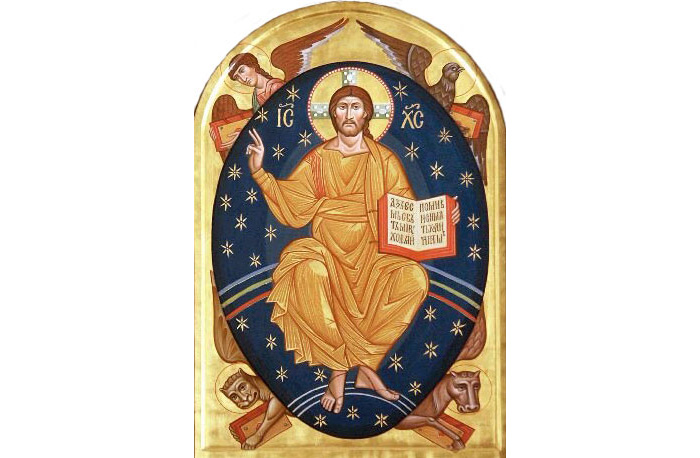
Top image credit: Icon of Christ Pantokrator, painted by Vladimir Grygorenko in 2000-2001. It is a central panel of the Iconostasis in St. Seraphim Orthodox Cathedral (OCA) in Dallas, Texas, USA. Vladimir grew up in Ukraine. In 2000 he moved with his family to Dallas, Texas. His studio is near St. Seraphim Cathedral. Visit his website at Orthodox-Icon.com to view more of his work.
Romano Guardini (1885-1968) was an influential Catholic philosopher, author, and priest in Germany. He was chaplain for a Catholic youth movement and chair of the Philosophy of Religion at the University of Berlin until the Nazis forced him to resign in 1939. He openly opposed the Nazi ideology. His books, lectures, and homilies influenced many Christian thinkers, especially in Central Europe, including Josef Pieper and Joseph Ratzinger (Pope Benedict XVI).