


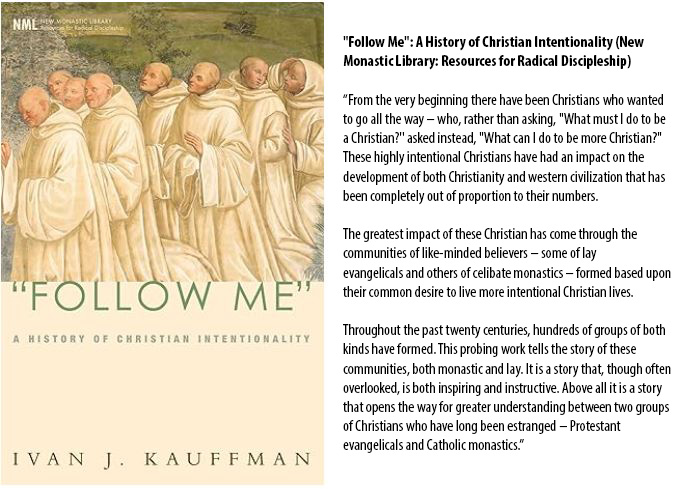
Excerpt from the Preface
This is a work of ecumenical history, an effort to view the Christian Church’s story as a single whole. It has grown out of the Mennonite Catholic ecumenical dialogue in which the author has been deeply involved, but it has become something much broader – a history of all the movements which over the past two millennia have sought to follow Christ with complete intentionality.
As my research has progressed over the past decade it has become increasingly clear that the Mennonite Catholic story is only one chapter in a much larger story – the estrangement between those who view Christian faith in institutional terms, and those who view it primarily in personal terms.
And as the dialogue between North American Mennonites and the Benedictine monks of Saint John’s Abbey in Collegeville, Minnesota, USA has progressed over this same period it has become equally clear that two distinct forms of Christian intentionality have emerged over the past 2,000 years, one celibate and monastic, the other non-celibate and evangelical.
From Anthony to Benedict (excerpt from Chapter 1)
The monastic movement began in Egypt in the 200s, when Christians were still being persecuted by the Roman imperial authorities. This movement grew rapidly within the Christian community and by the 300s had spread throughout the Christian world. By the 500s it had become so widely accepted that one of the monks at a monastery in Rome was elected pope, and as Pope Gregory the Great he in turn made the monastic rule created by an earlier Italian monk, St. Benedict, normative for all western monasticism.
St. Anthony of the Desert
One Sunday morning in the year 251 a young man from a Christian family was walking to church in Egypt. He came from a prominent and prosperous family in his village but his parents had died a few months earlier, leaving him alone in the world at age 20, except for a younger sister.
As he walked along that morning the young man was thinking of the apostles and how they had given up everything to follow Christ. And he was also thinking about the original Christian believers described in the Acts of the Apostles who had sold everything and given the money to the apostles to be distributed to the poor.
When the young Anthony reached his village church the service had already begun, and the gospel was being read. That morning it was the story of Jesus’ encounter with a wealthy young man who had asked, “What must I do to be saved?” Jesus had told the young man, “If you would be perfect go sell what you possess and give to the poor and you will have treasure in heaven.”
These words struck the young Anthony to the roots of his being. He said afterwards that he felt this story was addressed to him personally. When he left the church he immediately proceeded to give the land he had inherited to his neighbors. He sold the other property he had inherited as soon as possible and gave the money to the poor. …
The Evangelical Legacy (excerpts from Chapter 8)
Surveying the 2,000-year history of evangelical intentionality reveals four major developments that appear to be its permanent legacy to the Christian community as a whole.
- The first is that intentional evangelical communities have appeared in every century of Christianity, and in every place where the Christian faith has taken root. It now appears clear that the evangelical impulse is an integral part of the Christian tradition, not a departure from it.
- The second is the evidence that evangelical intentionality releases substantial new energy into the Christian community, resulting in increased evangelism, new institutions of many kinds, new forms of compassion and organized charity, and fundamental political changes throughout society.
- The third is the evidence that when the impulse toward greater evangelical intentionality is not provided with an appropriate place in the Church’s institutions a crisis occurs, producing dissension, doctrinal deviation and personal suffering among the believers involved.
- The final legacy is the unfortunate history of animosity between the evangelical movements and the institutional churches, now so long established that it is taken for granted by both segments of the Church.
The challenge now faced by all Christians is to acknowledge this legacy and to act on it in appropriate ways.
The Evangelical Impulse
The Gospel is like a seed, which when planted must grow. And like every seed the Gospel carries within itself specific purposes, in the same way that biological seeds contain a DNA code. The seed must realize the goal encoded in its DNA or it will die, and in the same way the Christian Church must realize the purpose for which it was founded or it too will die.
If a seed carries in its DNA the intent to produce a tree it will either produce a tree or it will die. If the seed achieves its purpose the tree will grow taller or shorter depending on the nutrients available in the soil in which it has been planted and on the rainfall it receives, but either the seed will produce a tree or else it will produce nothing.
And the tree which that seed produces, despite its differences from other trees, will have certain fundamental features – roots and a trunk, branches and leaves. In the same way the Gospel inevitably produces some version of the Church. Its visible appearance will vary greatly, depending on where it is located and whether the conditions for its growth are favorable or unfavorable, but like a tree it will always have certain fundamental features.
It will have roots – a set of traditions and practices which connect it to the past, which feed it, and which anchor it to the real world. It will also have a trunk – a culture, sustained by appropriate institutions, which connects its branches to their roots, and to each other. And it will have branches – the arms which constantly reach out from the trunk, seeking to realize the Church’s potential in new and previously untried ways.
All this is essential, but if a tree has only roots and a trunk and branches it will die, and in the same way if the Church does not produce life at the end of its branches it too will die. The purpose of the Church is to produce life, and in the same way that a tree produces life by giving life to its leaves, the Church produces life by forming individual Christians.
A tree’s leaves are the place where it takes energy from the sun and uses that energy to transform the nutrients its roots have drawn from the soil and which its trunk has transmitted to its branches into actual life by means of a process scientists call photosynthesis. In the same way the Church remains alive to the extent that new life is constantly being produced in the lives of individual believers.
This process is referred to in many ways – as conversion, as a new birth, as simply becoming a Christian or being a good Catholic, as receiving the gift of the Holy Spirit, and numerous others. But regardless of how this process is named, in the end it can only be explained by attributing it to the Holy Spirit, whose role in the Church’s life is almost exactly analogous to the sun’s role in photosynthesis.
This impulse to promote new and better lives in its individual members is essential to the Church’s existence and constitutes what can be called the evangelical impulse, a force that is a constant throughout Christian history.
But the history recounted in this book also bears witness to another equally important fact –that only when the individual leaves are attached to healthy branches, and the branches are attached to a healthy trunk, and when the trunk in turn is attached to a strong root system which is fed by sufficient water and by soil containing essential nutrients, do the individual leaves remain healthy and life giving.
Only a relatively few persons in history have chosen to pattern their lives on intentional choices, and an even smaller number of communities have formed based on intentional choices, but when such communities have formed they have had immense impacts. Even the institutional Churches have been profoundly shaped by the movements formed by intentional Christians, both the members of celibate monastic orders and the non-celibate evangelical communities.
As the third millennium of Christian history opens it is clear that the future of Christian intentionality is in the lay evangelical movements. The great question for many centuries has been whether the evangelical movements, especially the highly intentional lay communities, are a deviation from the Christian tradition or whether they are an essential part of it. Events in the twentieth century appear to have answered that question rather unequivocally. Given the growth of evangelical Christianity throughout the world how can it be doubted that these movements are an integral part of the Christian tradition?
We all drink from a single river – a river of grace
We are increasingly coming to realize that we all drink from a single river, a river of grace, and that we would not exist if this river did not exist. It supplies us with an invisible yet completely real stream of energy that flows through human history and into every human life, making every human community and every human family and every human life possible, in every second of every day. If this river were suddenly to cease flowing the entire physical universe would collapse into a single particle of nothingness, and all biological life everywhere would come to an end in a split second, like a candle blown out.
As a result of this growing realization actions that would have been completely impractical only a decade or two ago are now realistic possibilities. These include three specific actions which the Christian community could take, which if persisted in would heal the great division between the institutional and the intentional communities which now cripples us. Two of them have already begun. The third is new but well within the realm of practical possibility.
What this recent history indicates is that if the independent evangelical and pentecostal-charismatic Churches and the institutional Churches are willing to abandon the long-held assumption that their estrangement is inevitable and permanent it is entirely possible for them to find ways to join in truly Christian dialogue – one based on charity, on a willingness to face past sins and ask forgiveness for them, and one which looks to the future with hope rather than to the past with anger.
This study of Christian intentionality appears to indicate rather clearly that our task as Christians in the third millennium is not to continue the battles of the past, but to find ways to replace the animosity between the evangelical communities and the institutional Churches which we have inherited from the past with new forms of respect and cooperation.
Doing so will require great effort, and a willingness to accept the gifts that can only come to us from the Holy Spirit. But it will release immense new amounts of energy and innovation that will empower the Churches as institutions and enable their members to grow and to serve the world in new ways – a goal all Christians share, and which none of them can achieve alone.
Studying History Together
One of the first things the Mennonite Catholic dialogue revealed is that both communities have very different views of the past, and that these views are a major factor in their estrangement.
In the final report of the international dialogue, jointly published by the Vatican and the Mennonite World Conference in 2003, the first section was entitled “Considering History Together.” Several parts of this section deserve to be quoted since the experience of those involved in this dialogue has a wide relevance.
Both our traditions have had their selective ways of looking at history.… We sometimes restricted our views of the history of Christianity to those aspects that seemed to be most in agreement with the self-definition of our respective ecclesial communities.
The experience of studying the history of the church together and of re-reading it in an atmosphere of openness has been invaluable. It has helped us gain a broader view of the history of the Christian tradition. We have been reminded that we share at least fifteen centuries of common Christian history. The early church and the church of the Middle Ages were, and continue to be, the common ground for both our traditions.
We have also discovered that the subsequent centuries of separation have spelled a loss to both of us. Re-reading the past together helps us to regain and restore certain aspects of our ecclesial experience that we may have undervalued or even discounted due to centuries of separation and antagonism.
Our common re-reading of the history of the church will hopefully contribute to the development of a common interpretation of the past. This can lead to a shared new memory and understanding. In turn, a shared new memory can free us from the prison of the past.
On this basis both Catholics and Mennonites hear the challenge to become architects of a future more in conformity with Christ’s instructions when he said:
“I give you a new commandment, that you love one another. Just as I have loved you, you also should love one another. By this everyone will know that you are my disciples, if you have love for one another” (John 13:34–35).
Given this commandment, Christians can take responsibility for the past. They can name the errors in their history, repent of them, and work to correct them.
We need to be aware that we have developed significant aspects of our self-understandings and theologies in contexts where we have often tried to prove that we are right and they are wrong. We need tools of historical research that help us to see both what we have in common as well as to responsibly address the differences that separate us.
Meeting in the River
We have been living beside the river of grace, some on one side and some on the other. We have watched the river from one side or the other, drunk from it, bathed in it, occasionally launched our boats on it. We have built castles and cities along its banks, and farmed the land it waters. We have accepted its gifts and most often taken it for granted.
What we have rarely done is to cross the river to visit those who live on the other bank. We have been aware that others live there but we have noticed that they live differently than we do and we have found that frightening, a threat to our beliefs that the way we are living is the only proper way. The result is that the river which feeds us has also divided us.
Obviously the Christian community cannot be united if we continue to choose sides in this way, and the only way we can avoid choosing sides is to choose to live in the river. This means allowing the river to take us where it is destined to flow, coming ashore from time to time, sometimes on one bank and at other times on the other. Jesus called his first followers to be “fishers of men” and we can only hope to continue their mission if we too leave the safety of the shore and launch into the waters around us.
Excerpts from “Follow Me”: A History of Christian Intentionality, © 2009 by Ivan J. Kauffman. (J. Wilson-Hartgrove, Ed.; Vol. 4), published in 2009 by Cascade Books, Eugene, Oregon, USA.
- See related article: Covenant Communities in the Light of Historical Foundations, by Msgr. Bob Oliver
Ivan J. Kauffman (1938-2015) grew up in one of the oldest surviving lay evangelical communities, the Amish Mennonites. Educated as both a Mennonite and a Catholic, he has been active in Mennonite Catholic dialogues from their beginnings in the 1980s, and was a founder of the North American grassroots Mennonite Catholic dialogue, Bridgefolk, which meets regularly at Saint John’s Abbey, Collegeville, Minnesota, USA. He identified as a Mennonite Catholic.