


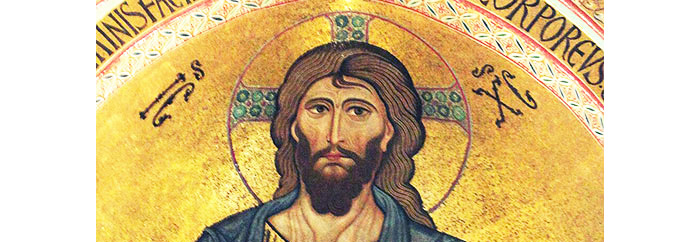
God fully reveals himself to us in Christ.
When the Word became flesh, God revealed himself to humanity fully, as never before. Previously, he had only revealed himself indirectly in creation, and more directly to the people of Israel through the Law and the Prophets. Now, however, the invisible and eternal God becomes flesh, becomes man, in the person of Jesus Christ. John expresses this full manifestation of God in Christ at the end of the first passage we quoted above: “No one has ever seen God; the only Son who is in the bosom of the Father, he has made him known” (John 1:18). The Letter to the Hebrews solemnly declares that Jesus Christ is the full and definitive manifestation of God:
1In many and various ways God spoke of old to our fathers by the prophets; 2 but in these last days he has spoken to us by a Son, whom he appointed the heir of all things, through whom also he created the world. 3 He reflects the glory of God and bears the very stamp of his nature, upholding the universe by his word of power. When he had made purification for sins, he sat down at the right hand of the Majesty on high, 4 having become as much superior to angels as the name he has obtained is more excellent than theirs.
Hebrews 1:1–4
Paul also tells us in Colossians 1:15 that Christ “is the image of the invisible God,” and Jesus himself teaches us this: “If you had known me, you would have known my Father also; henceforth you know him and have seen him… he who has seen me has seen the Father” (John 14:7, 9).
Now God can be seen, touched, heard, and experienced in Christ, the God-man:
1That which was from the beginning, which we have heard, which we have seen with our eyes, which we have looked upon and touched with our hands, concerning the word of life – 2 the life was made manifest, and we saw it, and testify to it, and proclaim to you the eternal life which was with the Father and was made manifest to us – 3 that which we have seen and heard we proclaim also to you, so that you may have fellowship with us; and our fellowship is with the Father and with his Son Jesus Christ.
1 John 1:1–3
What John conveys to us in this present letter is that he and the other apostles did indeed experience the human reality of Jesus, and through it, his divine reality. Now, through their personal testimony, recorded in the New Testament and passed down to us in the Church throughout the centuries, we too can experience God in Jesus, just as they did. Peter affirms the same thing in his Second Letter when he says: “Simon Peter, a servant and apostle of Jesus Christ, to those who have obtained a faith of equal standing with ours in the righteousness of our God and Savior Jesus Christ…” (2 Peter 1:1). Our faith is “as precious” as that of the apostles; our relationship with Christ – and through him, with the Father and the Holy Spirit – is equally direct, and in that sense, we have nothing to envy them. In the person of Jesus Christ, the Son of God made flesh, God has made himself fully present to us.
Redemption is made possible through the Cross
On the Cross, Jesus offered his life to the Father as a sacrifice and thus triumphed over sin and death. The Father ratified and crowned the Son’s sacrifice by raising him gloriously from the dead. Because he was truly God, Jesus’ sacrifice on the Cross was sufficient to erase the sin of all human beings throughout all time; and because he was truly human, he was able to do this on our behalf, representing us before the Father and making us all beneficiaries of his sacrifice. In other words, this sacrifice that obtained forgiveness for us was offered by a human being like us, but because that human being was also God the Son, the effectiveness united of his sacrifice was such that it included us all in its redemptive outcome.
Thus, Jesus Christ is a new beginning for humankind, the beginning of a new humanity, already reconciled with God and restored to the image of God that was marred by the Fall. It was because God the Son became incarnate that he was able to shed his blood, and God desired “through him to reconcile to himself all things, whether things on earth or things in heaven, by making peace through his blood, shed on the cross” (Colossians 1:20). Moreover, “out of the two [Jews and Gentiles] he created in himself one new humanity, thus making peace, and in one body reconciled both of them to God” (Ephesians 2:15–16). One of the most important aspects of the work of salvation is that those of us who believe in Christ become part of his body, and thus are joined together in him as a “new man,” that is, the new humanity. While sin had scattered human beings, Christ on his cross gathers them into one body, one people, the Church.
The incarnation continues through every Christian
Jesus is not merely an external model of how we should behave, nor is he limited to enabling the legal decision that our sins be forgiven. Rather, Jesus Christ, the Word of God, came to incorporate us into himself, to unite us to him, and in this way to make our salvation complete. By uniting ourselves to Christ, we become partakers of the nature of God that is in him, not by our own power, but by grace, by his gift.
As the Church, therefore, we Christians are the Body of Christ (1 Corinthians 12:27). In Catholic circles, the expression “Mystical Body” is often used in this regard, which in this case means something like “spiritual body” or “body in mystery.” It is clear that we are not “physically” part of the Body of Christ (his resurrected and glorified body is “in heaven,” that is, hidden in some mysterious way in God, until his final coming). But by uniting ourselves to Christ – in faith, in the sacraments – we become part, “mystically,” of his body.
That is why here on earth each Christian, and the Christian people as a whole, is like an extension of the Incarnation. This is, I repeat, in a spiritual, not strictly physical, way; but the fact is that we Christians are united to Christ as members of his body, and therefore we are his presence on earth (see 1 Corinthians 6:15–19) to carry on his work and mission. We could say that through us the Incarnation is perpetuated in history, and Christ identifies himself with those who are his disciples, so that what is done to us is done to him (see Matthew 10:40–42; 25:34–45 and Acts 9:4–5).
The “deification” of Christians
It was one of the great Greek Fathers, Saint Athanasius (whom we have already mentioned in connection with the Council of Nicaea and the struggle against Arianism), who articulated the expression that “God became man so that we might become God.” Other Church Fathers, such as Saint Irenaeus of Lyons, Saint Gregory of Nazianzus, and Saint Maximus the Confessor, emphasized this idea. Thus developed the concept of theosis, or “deification,” which is of paramount importance in the theology and spirituality of Eastern Christianity.
It is not, as we have already said, a simple call to morally imitate God the Father or Christ (although that is included), but rather that God became man to effect a change in our condition and our nature and make us like God, something that we did not have the power to achieve.
St. Paul teaches us in the Letter to the Colossians, referring to Christ:
9For in him the whole fulness of deity dwells bodily, 10 and you have come to fulness of life in him, who is the head of all rule and authority.
Colossians 2:9–10
This means that all that God is (“the fullness of the Godhead”) is found in Jesus; and now we, through him, have attained the fullness of God’s life and have been filled with that divinity that is in Christ. Obviously, this doesn’t mean we become the Second Person of the Trinity or that we attain God’s omnipotence and omniscience; but it is true that Jesus shares with us what he is: his divine life. This happens because in receiving him we are born again, we receive new life, the life of the children of God[CV1] , We are born to a life that transcends the merely natural realm, as the passage we quoted at the beginning says:
12 But to all who received him, who believed in his name, he gave power to become children of God; 13 who were born, not of blood nor of the will of the flesh nor of the will of man, but of God.
John 1:12–13
The one who infuses us with this new life is the Holy Spirit, the “Spirit of sonship” (Romans 8:15), whom we receive from God in faith and baptism (see John 3:5–8; Acts 2:38; Titus 3:5–7). And from that moment on, this divine life develops within us through the continuous action of the same Spirit, especially through our exposure to him in prayer, through the power of his Word that we read or hear, and through our participation in the sacraments, most especially the Eucharist.
So Jesus didn’t come to tell us to be a little better, to make a resolution to behave well and keep God’s commandments… He came to give us the power to be infinitely better than we were capable of being! He came to give us his own life, much more than we could have ever imagined: to be nothing less than children of God through our union with the Son, or, as many theologians summarize it, to be sons and daughters in the Son!
And that’s not about being superhuman, but about becoming fully human according to God’s original plan. Our natural condition at birth is, in fact, subhuman, and that’s the condition in which all who do not unite with Christ remain. Humankind, because of the Fall, is under the power of sin and deprived of the glory of God (Romans 3:23), so that it is “natural” for man to live in sin, to live “according to the flesh” (Romans 8:4). But that was not God’s original purpose; rather, as we know, it is the result of the Fall that thwarted that purpose. God made us to live a life like his, “we should be holy and blameless before him.” (Ephesians 1:4); he made us in his image(Genesis 1:27). God’s purpose was for us to be something far better than what we human beings actually are at birth!
And so, in Jesus, the glory of God and his image are restored to those who believe in him. We Christians recover that glory; we become children of God; we regain divine life and begin to be what God originally intended us to be. In some baptisteries (baptismal chapels) of the early Church, the font in which new Christians were immersed at baptism is decorated with scenes from Paradise. Early Christians understood becoming a Christian as a “return to Paradise” from which our first parents had been expelled because of their sin. Well then: this new life, this status as children of God, this return to Paradise… all of this is possible thanks to the incarnation of the Son of God!
This process of “deification” or theosis has only just begun in us when we unite with Christ, but if we remain steadfast in faith, we will see it grow in our daily lives as Christians. Through the action of the Holy Spirit, we are gradually transformed, becoming more like God, and this is possible because God became man. Where do we see the fruits of this transformation? We see them, for example, in the gradual growth of each individual in Christian maturity, in the Christian character expressed in the “fruit of the Spirit” (Galatians 5:22–23), and in the grace given to us to overcome sin. Those of us who live in some form of Christian community life have many opportunities to experience this growth in holiness through service, mutual love, fraternal correction, forgiveness, and reconciliation. We also see it in the strengthening of our respective Christian vocation and state in life; we see it in family life, in our work or occupation. In short, it is in all these contexts and situations that “we all, with unveiled face, beholding the glory of the Lord, are being changed into his likeness from one degree of glory to another; for this comes from the Lord who is the Spirit.” (2 Corinthians 3:18).
We know, however, and because of all this, that the transformation that makes the fruit of the Incarnation a reality in us is not yet complete. We do not yet fully reflect the image of God. We do not yet see a complete victory over sin in our lives. We have not yet reached the goal. And, although we can already experience much of what it means to be children of God, there is still much more that will only be seen when the Lord returns, completes our sanctification, and establishes his definitive Kingdom.
1See what love the Father has given us, that we should be called children of God; and so we are. The reason why the world does not know us is that it did not know him. 2 Beloved, we are God’s children now; it does not yet appear what we shall be, but we know that when he appears we shall be like him, for we shall see him as he is. 3 And every one who thus hopes in him purifies himself as he is pure.
1 John 3:1–3
On that final day, “when he appears,” all that for which God became man will have been accomplished. Therefore, as Saint John exhorts us, we must nurture within ourselves the hope of the Lord’s glorious coming, and this hope should impel us to a growing devotion to him and to a life of holiness.
This essay, The Incarnation of the Son of God, Part 1, and Part 2, © by Carlos Alonso Vargas is an adapted English translation of the original Spanish version La Encarnación del Hijo de Dios. See more essays by Carlos Alonso Vargas (in Spanish) on his website blog at https://carlosalonsovargas.medium.com/
Top image credit: Mosaic of the Christ Pantokrator (cropped) in Duomo di Cefalu, Sicily, Italy. The cathedral dates from early 12th century. Source of image from Wikimedia Commons, licensed under the Creative Commons Attribution 2.0 Generic license.
.jpg)
Carlos Alonso Vargas is a long-time leader in The Sword of the Spirit, who has served mainly in teaching and community building. With studies in philology and linguistics, he works as a translator and editor. He and his wife Dora have three adult children and five grandchildren and live in San José, Costa Rica.