


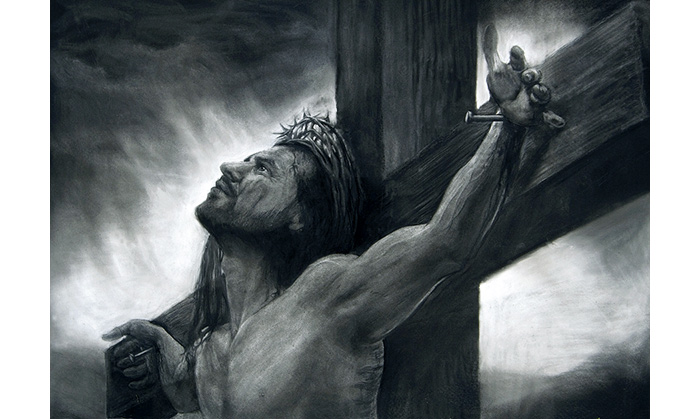
The Fight
The Personal Struggle. It is for this war of liberation that Christ came. His sufferings and death issuing in resurrection were a battle, the turning point of the war for the soul of the human race. As Colossians 2:15 tells us, the cross was the place where Christ “disarmed the principalities and powers.” There he triumphed over them.
We do not often view the crucifixion as a victory. One current of popular devotion, in fact, makes the cross seem like a great misfortune that was simply reversed by the resurrection. Nonetheless, the New Testament contains many passages where the crucifixion is seen as a combat with Satan from which Christ emerges victorious. In fact, when the sufferings and death of Christ are seen in that light, we can more easily see them precisely as redemption. On the cross, Christ was delivering human beings from an oppressive enslaving force, one from which they could not free themselves, and to deliver them, he needed to win a moral victory.
During the last day of his life, we find Christ in the garden of Gethsemane, in a situation very similar to the temptation. The Gospel of Matthew describes it this way:
“Then Jesus went with them to a place called Gethsemane, and he said to his disciples,
Sit here, while I go yonder and pray.
And taking with him Peter and the two sons of Zebedee, he began to be sorrowful and troubled. Then he said to them,
My soul is very sorrowful, even to death; remain here, and watch with me.
And going a little farther he fell on his face and prayed,
My Father, if it be possible, let this cup pass from me; nevertheless, not as I will, but as thou wilt.
And he came to the disciples and found them sleeping; and he said to Peter,
So, could you not watch with me one hour? Watch and pray that you may not enter into temptation; the spirit indeed is willing, but the flesh is weak.
Again, for the second time, he went away and prayed,
My Father, if this cannot pass unless I drink it, thy will be done.
And again he came and found them sleeping, for their eyes were heavy. So, leaving them again, he went away and prayed for the third time, saying the same words.
Then he came to the disciples and said to them,
Are you still sleeping and taking your rest? Behold, the hour is at hand, and the Son of man is betrayed into the hands of sinners. Rise, let us be going; see, my betrayer is at hand.”
Matthew 26:36-46
The fact that Christ is in a garden is probably typologically significant. He is the new Adam encountering Satan in a garden like paradise. But Gethsemane is a garden of grief in the middle of the fallen world rather than a garden of delight in the world as it was created.
Christ is going through what is often described as “the agony in the garden”. When we hear the word “agony” we primarily think of pain or suffering. That is an aspect of what Christ went through, but the word in origin means a struggle or a contest like a wrestling match. The “agony” in the garden refers to Christ’s combat, his “death struggle.”
Even though Satan is not explicitly mentioned, Jesus is there in combat with him. The three times Christ returns to prayer are probably connected to the three times he had to undergo temptation by Satan in the desert. If that is so, “the agony” is something of a repeat of the temptation. The scene in the garden may be itself an encounter with Satan. Or it may be a preparation for the real struggle with Satan on the cross when Jesus was given over to the power of darkness (Luke 22:53) – just as the temptation in the wilderness was a preparation for the struggle with Satan that was his public ministry. Perhaps it was both at the same time.
In the Garden of Gethsemane, Satan has the initiative. He wants to turn back the initial incursion of the Son of God. He intends to do so primarily by working through the Jewish and Roman leaders.
In the wilderness Satan tempted Christ to use the power he had for his own worldly success. He tempted Christ to set up a kingdom over this world, an empire that would embrace “all the kingdoms of the world”. Satan no doubt made such an endeavor seem good. If Christ actually controlled the entire world, could he not see to it that the human race would live in a better way? The encounter with Satan, however, was a test as to whether Christ would turn aside from the path on which his Father had set him.
In the Garden of Gethsemane, Christ faced a different type of temptation to turn aside. If events continued on their present course, he would go to his death the next day. He knew he would face crucifixion, the death reserved for insurrectionists, those claiming to be messiahs and seeking to establish a Jewish kingdom independent of the Romans.
Christ knew what crucifixion was like. The Romans crucified people on the roads entering cities so that the sight would deter others from committing similar crimes. Crucifixion was a cruel, degrading death, deliberately made to be a torture. Moreover, such a death would involve the humiliation of being an apparently failed messiah. It would be a seeming defeat at the hands of the very ones he had challenged – the worldly authorities and behind them the ruler of this world, Satan himself. It was no doubt such a death that was before Christ’s eyes in the Garden of Gethsemane.
Yet he was still free. Instead of staying at the garden where Judas and the temple police would find him, Christ could take the road that passed Gethsemane away from, rather than toward, Jerusalem. He could then escape across the Jordan to safety. The temptation he faced in the garden was the temptation not to die, not to lay down his life, and therefore not to obey his Father in the face of great suffering.
When Christ prayed to his Father, he was troubled by fear and sorrowful at what lay ahead. Yet he also knew why he would have to undergo such a death. He had come to serve, to give his life as a ransom for the many. Christ had come, as he had just told his disciples, to pour out his blood for many so that they could be part of the new covenant and receive forgiveness for their sins. He “must” suffer and die. His Father had given him a command to do so in order that those who believe in him should not perish but have eternal life.
Christ was free not to die – only too free. That freedom was probably itself the source of the testing. When we have no choice, there is not as much of a struggle to endure suffering. We usually swallow what we have to take with some measure of resignation. When we could get out of a difficult situation but believe we should undergo it, then we face a much more difficult test. Jesus faced such a test in Gethsemane.
The victory of Christ was expressed in the prayer, “Not my will, but yours be done.” In praying such a prayer, Christ rejected the course of action any human would have wanted to take, and instead accepted the full purpose of God. That prayer was probably a plea for help to go through what faced him. It was, however, a willing acceptance of God’s will and a desire to see other human beings served as a result of what he would do. In the Gospel of John, in a scene that corresponds to the agony in the garden, Christ expressed the same willingness to do the will of God,
“Now is my soul troubled. And what shall I say, ‘Father, save me from this hour’? No, for this purpose I have come to this hour. Father, glorify thy name.”
John 12:27-28
Losing to Win. Christ then began what is sometimes called “his passion”. “Passion” can mean “suffering” and here refers to the suffering Christ knew he must undergo for the salvation of human beings from their sins. His passion was an ordeal involving a true humiliation, but one that he went through with a great deal of self-mastery and personal dignity. Christ knew what he was about because he had made a decision in Gethsemane. He died well, in a way fitting for an unblemished lamb.
The Gospel of John records the last words of Christ on the cross: “It is finished” (John 19:30). By these words he did not simply mean that his sufferings were over and now he would die. He also meant that he had completed the task for which he came. His words registered victory rather than defeat. Christ had succeeded in putting aside “my will”, his own human desire that recoiled from such an ordeal, and had instead embraced “your will”, his Father’s plan for the redemption of the human race. He had been obedient to death. The Son of God had therefore succeeded in dying in such a way that his sufferings and death could be a payment for the redemption of human beings.
In the death of Christ, Satan was defeated. As the Letter to the Hebrews states the point,
“We see Jesus, who for a little while was made lower than the angels…so that by the grace of God he might taste death for every one… He…partook of the same nature [as those he was to save], that through death he might destroy him who has the power of death, that is, the devil, and deliver all those who through fear of death were subject to lifelong bondage.”
Hebrews 2:9, 14-15
Not only was Satan defeated but so were all those who share in his rule. Colossians says,
“God made [you] alive… having forgiven us all our trespasses, having canceled the bond which stood against us with its legal demands; this he set aside, nailing it to the cross. He disarmed the principalities and powers and made a public example of them, triumphing over them in it [RSV: him].”
Colossians 2:13-15
Both passages speak about Christ’s death as a defeat of Satan. The first says he “destroyed” Satan, although that translation is misleading because it seems to imply that Satan went out of existence after Christ’s death. The word in this context rather indicates that Satan lost his ability to inflict death, spiritual, eternal death, on the “many sons” who belonged to Christ (Hebrews 2:10-13). Once Christ died, Satan did not lose all power over the human race, nor all power to inflict death. He did, however, lose his ability to hold in bondage those who belonged to Christ. That power was destroyed by what Christ did. Christ “tasted death”, that is, underwent death for a short period of time, so that other human beings would not have to swallow the poison of death, that is, die eternally.
The Colossians passage provides an explanation for why that was. On the cross the debt due to sin was canceled and we were forgiven our trespasses. As a result, Satan’s power due to our indebtedness to the punishment of sin was taken away. His power can no longer affect those who are “in Christ” (Colossians 2:10-12). The death of Christ on the cross was the greatest defeat Satan suffered, the reversal of the great victory he won when he induced Adam to fall.
When Christ fought and defeated Satan, clearly he did not defeat him by physical force. He was “crucified in weakness” (2 Corinthians 13:4), in what looked like a defeat from a human perspective. He was humiliated in the eyes of all, treated like a great criminal, apparently ending his life as a failed messiah. And yet, in fact, he was winning a great victory.
Christ’s way of fighting was paradoxical. To fight, he refused to fight. He refused to defend himself, not so that he could be a pacifist but so that he could be a sacrificial Lamb set apart to be slain. He deliberately chose to “endure the shame” of defeat (Hebrews 12:2) in the confidence that his very defeat would be victory, that his very lowering would be a raising up.
In the eyes of a fallen world, such a way of fighting makes no sense. It only makes sense from a heavenly perspective, which allows for the Messiah to make his life an offering to overcome sin. As Augustine put it in his Confessions (10, 43), addressing God the Father: “For our sake he became in your sight both victor and victim — victor, indeed, because he was victim.”
At the same time, Satan, who looked like he was achieving his greatest victory, was undergoing defeat. In the words of many Christian writers, he “overreached himself”. He was like a commander who seems to be winning a battle and charges deep into the ranks of his enemy – only to find that he has fallen into a trap and is surrounded with no hope of escape.
At the very moment Satan seemed to be achieving his greatest triumph, he was being most completely defeated. Because the human race was under the sentence of death as a consequence of the fall, he could have put anyone else to death with justice. Instead, Satan put to death the sinless Son of God, the one who was truly innocent, and who therefore did not deserve to undergo the penal consequences of sin. Christ’s death consequently could be an expiation for the sins of others. Satan went too far and so produced the one event which would deprive him of his hold over the whole human race.
Did Satan know what he was doing? How could he have allowed this to happen? The answer seems to be that he did not know what he was doing. As Paul put it, “None of the rulers of this age understood this; for if they had, they would not have crucified the Lord of glory” (1 Corinthians 2:8). Ignatius of Antioch, a man who lived in the time of the apostles, described Satan’s ignorance this way: “Now, Mary’s virginity and her giving birth escaped the notice of the prince of this world, as did the Lord’s death” (Ephesians, 19,1). Leo the Great (died A.D. 460) stated it this way,
“And in order that he might set the human race free from the bonds of deadly transgression, He hid the power of His majesty from the raging devil, and opposed him with our frail and humble nature.”
Leo the Great, Sermon LXII, 3
Satan seemed to understand enough to know that Jesus was the Messiah and the Son of God in the sense in which kings of Israel were sons of God. But he had defeated would-be messiahs and kings of Israel before. He did not seem to reckon with the fact that this King was God’s Son in a more than human way. Satan did not seem to understand the “secret and hidden wisdom of God” (1 Corinthians 2:7), that is, God’s plan to restore the human race to a glorified life that only became obvious with the resurrection.
Satan was tricked – not tricked in a mean way, but outwitted by a plan conceived in divine wisdom. Perhaps even more accurately, he was outwitted by his own pride. Satan was so set on his own exaltation and dominion that he could not imagine the willingness of his divine adversary to lower himself to the complete humiliation of giving his life for the sake of his creatures. He had no way of reckoning on the humility of God.
A Trial of Justice. The crucifixion was a contest of justice between God and Satan. Traditionally the Book of Job has been used to provide a perspective on the sufferings of Christ. It is now often overlooked in teaching on the crucifixion, but nonetheless it is still illuminating.
Many Christian teachers throughout the centuries have seen Job himself as a type of Christ. The Book of Job narrates a contest between God and Satan. God is holding court as the King and Judge of human affairs. Satan comes before God in the role of “adversary”, something like a prosecuting attorney. He enters into debate with God, because if he can establish his case as just or righteous, he can get his way. God is willing to argue, because he is only willing to reign in justice or righteousness and because he wants it to be seen clearly that justice is being done.
God points out Job, a blameless man who fears God and refuses to do evil. In God’s view, Job is the example of a man who proves that sin is not all-powerful and that righteousness can prevail. Satan’s reply to God is, “Does Job fear God for nothing?” He is making the claim, in other words, that Job does not serve God because he truly is a servant of God. Rather, Job serves God because he gets what he wants from doing so. He is merely a hireling. He was, so to speak, bribed by God to behave. Implied in Satan’s position is the claim that no human being serves God for the sake of serving God.
As we know, God allowed Satan to afflict Job, depriving him of every human good, and although Job complained, he remained steadfastly righteous. Job’s endurance was a reply to Satan, an imperfect one but a reply nonetheless. God’s full reply to Satan, however, did not come in the Book of Job. It came in Christ, the truly righteous servant of God. It came in the way Christ underwent “the afflictions of Job” in his sufferings and death. In his crucifixion, Christ was God’s response to Satan. His death showed God’s justice in a way the world and Satan could see (cf. Romans 3:25-26).
The crucifixion is God’s counter-statement to Satan’s most fundamental accusations against the human race. It is first of all a statement that the human race is capable of being what God asks it to be. Christ underwent the sufferings of Job, not for personal reward but for the sake of the glory of his Father. He had nothing to gain personally. After all, he began with heavenly glory in the presence of God (John 17:5; Philippians 2:6).
Being rich, Christ impoverished himself for the sake of others and therefore for the sake of God who sent him to serve them (2 Corinthians 8:9). He went through sufferings great enough to make human life seem valueless, and he did so willingly to the end in order to accomplish his mission. He showed that human nature could keep the commandments of God. In so doing he victoriously refuted Satan’s accusation.
Even more, the very path of the crucifixion and of the redemption is a counter-statement to Satan. In the way Christ died, he lowered or humbled himself. He voluntarily underwent the humiliation of defeat and degradation as a criminal. As a result, he offered his Father an act of humility for the redemption of others. This was not only a fitting sacrifice in atonement but also a stunning counter-statement to the pride with which Satan fell, and which he taught to Adam and Eve to induce them to fall.
In the Gospel of John, Christ describes his “lifting up” as the judgment of Satan, “the ruler of this world” (John 16:11; 12:31). “Judgment” here means “condemnation.” His statement probably does not mean that Satan was personally condemned at that point for his rebellion against God. Rather Christ is referring to the way in which Satan is deprived of his power. He is condemned the way a corrupt governor might be removed from office or the way a defeated king who had usurped his power might be deprived of his authority.
With the crucifixion of Christ, Satan lost his rule or power over those members of the human race who would choose to belong to Christ. But when he was deprived of that position, Satan was deprived in full justice. God pointed to his Son and said, “See my servant. He was obedient and faithful to death. You are without excuse, as are all who have chosen your path. You could have obeyed. Had you obeyed, you would not have lived in constant humiliation but rather in glory, as he will. You deserve to have no power over human beings, and so you will have none over those who come to my Son to be set free from you.”
The Humility of the Redeemer
The way to live is to die. The way to be victorious is to undergo defeat. The way to go up is to go down. This principle is paradoxical, but it describes the path Christ took. That same principle applies to our own lives. The way Christ died is not just the source of our redemption but also a pattern that should shape our redeemed lives in this fallen world.
Scripture states this truth in various ways. “Christ suffered for you, leaving you an example, that you should follow in his steps” (1 Peter 2:21). “Have the same orientation [RSV: this mind] among yourselves which is yours in Christ Jesus who…humbled himself and became obedient unto death, even death on a cross” (Philippians 2:5, 8). “Walk in love, as Christ loved us and gave himself up for us, a fragrant offering and sacrifice to God” (Ephesians 5:2). “For I have given you an example, that you also should do as I have done to you” (John 13:15). “Take up [your] cross and follow me” (Matthew 16:24).
We are to imitate Christ (1 Corinthians 11:1). Yet if we do not understand what this means, imitating Christ could get us into a great deal of trouble. It does not mean imitating him in his power or authority, claiming to be king and messiah, relating to others as their lord. Denouncing people the way Christ denounced the Pharisees, for instance, may be appropriate under certain circumstances when we have an authorization from God similar to the one Christ had. It is not, however, supposed to be something we do whenever we come across someone not behaving well simply because we want to follow Christ’s example.
Imitating Christ in his humility, suffering, and sacrificial love
If we look at all the passages in which we are urged to imitate Christ, we find that they concern his sufferings and death. We are called to imitate him in his lowliness or humility, not in his messiahship, or his divinity, or his exaltation. We are to imitate him in the way he chose to go down in order to go up.
Here again we could make a mistake, less dangerous than the previous one but distorting nonetheless. We could decide that imitating Christ in his sufferings was the key to handling all circumstances in life. We could “open not our mouths,” never reproving wrong or explaining ourselves when falsely accused. We could become pacifists simply because Christ told his disciples in Gethsemane not to use the sword to defend themselves.
Such responses, based on words that were given in a particular situation, may be good responses in similar situations (such as those of persecution by lawful authority) on the basis of the imitation of Christ. We can see such an application in Peter’s exhortation to slaves with masters who mistreat them (1 Peter 2:18-25). But Christ’s approach to his passion is not a universal rule for handling every situation. This was demonstrated by his own previous conduct, when he himself “went after” the scribes and Pharisees and other ruling authorities (e.g., Matthew 23), rather than “opening not his mouth.”
We are most especially called to imitate Christ’s humility in the readiness to undergo sufferings for the kingdom of God. We are called to willingly undergo loss of reputation, loss of possessions, physical harm, and even death because of our faithfulness to God. The summons to take up our cross and follow Christ is the summons to follow a master who provokes opposition from the kingdom of darkness and a fallen world – but who steadfastly refuses to give up obeying his Father because of that opposition.
We are, however, also called to imitate Christ more broadly – in the way he loved God and neighbor. We are to have the servant-love Christ manifested in the way of the cross. He humbled himself to become a servant. As a servant, he was obedient to God and he gave his life to serve those his Father sent him to. He loved in humility.
Humility points us away from making our own good and our own glory our aim. To be sure, when we are humble, we do not lose our desire for happiness or excellence. In fact, God intends them for the human race. Christ came to bring us to glory (Hebrews 2:10). But the way to go up is to go down. God does not put our glorification into our own hands. Our fallenness means that we cannot seek our own glory and fully seek the good of others at the same time. We need to correct for the self-centered tendencies of our fallen nature. God’s plan, therefore, is that we please him by loving others as Christ loved us, and leave our glorification to him. The way up is the way of reliance on God.
Going down to go up – dying to live
When our human fallenness has been completely overcome in the glorified life, loving others as ourselves may be easy, even effortless. In this life, however, there will always be resistance to overcome, both internal and external. In this life, there will always be personal cost. We will have to choose to suffer losses to live consistently for the welfare of others. In no other way can the fallen world be overcome in our own lives in this age. That is why the new covenant reformulation (the reformulation for disciples of Christ) of the second great commandment is “love one another as I have loved you” (John 15:12). That reformulation does not change what we are asked to do. Rather, it describes the only path that will allow us to do what we are asked to do: going down to go up, suffering defeat to achieve victory, dying to live.
Humility would have been important for human beings even if they had not fallen. Adam and Eve would have had to show humility towards God by obedient submission and by gratefully receiving his gifts and blessings as his creatures. They would have had to show humility towards one another by daily servant-love. That humility would have made it possible for human life to reflect the glory of God.
But for the new Adam, humility inevitably involved humiliation – personal suffering, defeat, and death. These are not in themselves God’s desire or purpose for the human race. Rather, they are the necessary way for anyone who fulfills God’s purpose and keeps his commandments to succeed at living a godly life in a fallen world, a world dominated by sin, Satan, and death.
The path of the cross understood as the path of love is a model of the purpose of human life, a model of the kind of love God wants human beings to live for all eternity. The path of the cross understood as the path of suffering is a model of the means to that end, a model of the way to love in this fallen world. Tragic as it may seem, in a fallen world the only way to truly love is to go through suffering.
The path of the cross is also a path of faith and hope in God. It is not exactly a human, earthly strategy. Humble, humiliated service and death is not the normal way great earthly victories come about. Only when we recognize that God and his action is the key to overcoming the fallen state of the human race can we follow Christ’s path of humility, and only when God acts is that path of humility redemptive and victorious. Therefore, that path can only be followed by having faith and hope in God because of what God did in Christ. As First Peter explains:
“Through him you have confidence in God, who raised him from the dead and gave him glory, so that your faith and hope are in God.”
1 Peter 1:21
Because of his divinity we tend not to think of Christ as someone who needed faith and hope. But his path of humiliation to exaltation could only be taken in faith and hope. I once had the experience of watching a neophyte learn hang gliding. We were on the top of a cliff and I overheard him being instructed. I heard the veteran say that the way to soar aloft was to jump off the cliff. For me that meant plunging to the rocks below. When I looked at the neophyte with his eyes gazing downward over the cliff, and his face turning whiter and whiter, I was sure that was what he thought the instructions amounted to as well.
As it turned out, whatever his instructor had told him worked. The young hang glider jumped off the cliff and began to soar. But I was convinced that no matter how sure I was that jumping off the cliff was the way to fly, I would have “sweated blood” if I were to try it.
Even worse would have been knowing that the way to soar was not only to jump off, but in fact to crash on the rocks and die in pain a few hours later with the assurance that I would then wake up, find myself free to soar wherever I wished whenever I wished, and experience an indescribable joy and gladness that I had done what I did. Even if I was sure of what I had to do, my human nature could not have accepted it peacefully.
Divine though he was, Christ’s human nature was “like ours in all things except sin.” He was able to take the way down, to suffer and die in great humiliation. But it was very costly. And it was a step he could not have taken without reliance upon his Father.
This article is excerpted from Redeemer: Understanding the Meaning of the Death and Resurrection of Jesus Christ – Revised Edition, Chapter 8, © 2004 by Stephen B. Clark.
The book is available to read online or download in PDF format for personal use.
Top image credit: Christ on the cross looking heavenward, illustration from Bigstockphoto.com, © Brian Dunne, stock photo ID: 1636279. Used with permission.
Steve Clark has been a founding leader, author, and teacher for the Catholic charismatic renewal since its inception in 1967. Steve is past president of the Sword of the Spirit, an international ecumenical association of charismatic covenant communities worldwide. He is the founder of the Servants of the Word, an ecumenical international missionary brotherhood of men living single for the Lord.
Steve Clark has authored a number of books, including Baptized in the Spirit and Spiritual Gifts, Finding New Life in the Spirit, Growing in Faith, and Knowing God’s Will, Building Christian Communities, Man and Woman in Christ, The Old Testament in Light of the New.
- See articles by Steve Clark in Living Bulwark Archives