


Introduction:
Shortly after the fall of the Batista regime in [Cuba] 1959, a 23-year-old office worker for the Ministry of Communications of the Cuban Revolutionary Government was arrested. His crime was his outspoken opposition to communism around the workplace. He refused to display a plaque on his desk saying, “If Fidel [Castro] is a Communist, then put me on the list. He’s got the right idea.” Armando Valladares’s imprisonment would last 22 years.
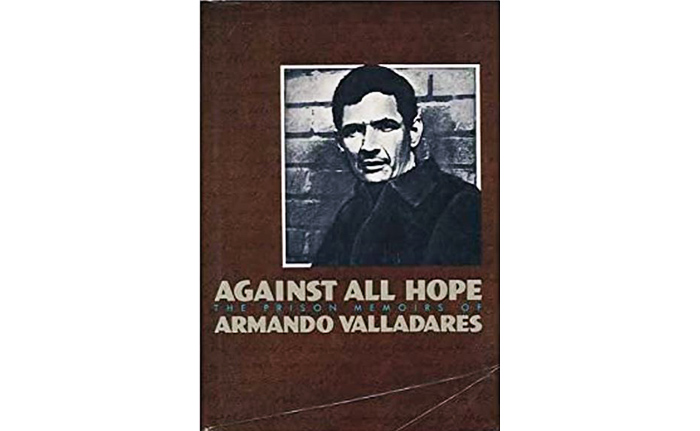
In Against All Hope, Cuban poet Valladares has produced a painstaking account of his sojourn in hell. His tour of life in Cuban prisons reveals man’s lowest capabilities… Valladares and his fellow political prisoners were routinely beaten, tortured, and psychologically manipulated. Every act of the guards was intended to break the will of the inmates and cause them to enter “political rehabilitation” courses. Valladares held his ground throughout and paid for it dearly. His account is a relentless tale of human degradation: months spent in solitary confinement, submersion in a ditch filled with human excrement, infrequent visits from family, and overcrowded conditions.
Against All Hope takes its title from Romans 4:18, and its author’s faith in Jesus Christ is gripping. When first incarcerated, Valladares heard the nightly cries of those before the firing squads: “Viva Cristo Rey!” (Long live Christ the King). This witness led to the author’s conversion.
“I not only understood instantly, as though by a sudden revelation, that Christ was indeed there for me at the moments when I prayed not to be killed, but realized as well that he served to give my life, and my death if it came to that, ethical meaning.”
The reader catches in Armando Valladares a faith that works in the depths of desperation. In contrast to the oft-heard American gospel of success and prosperity, the author exposes his readers to a gospel of hope. Valladares cries out to a God who doesn’t “make everything okay” but who is God nonetheless:
“I never asked him to get me out of there; I didn’t think God should be used for that kind of request. I only asked that he allow me to resist, that he give me the faith and spiritual strength to bear up under these conditions without sickening with hatred. I only prayed for him to accompany me. And his presence, which I felt, made my faith an indestructible shield.”
(source: Christianity Today Magazine)
The following excerpt from Against All Hope describes the “Brother of Faith” who turned the prison of hell into a community of living faith in Jesus Christ.
The blows of the machetes and bayonets on the prisoners’ backs sounded like low thunder. The file began to break up, but the guards chased the men down, striking out blindly. The first prisoners made a superhuman effort and almost ran to dodge the blows. Suddenly, one prisoner, as the guards rained blows on his back, raised his arms and face to the sky and shouted, “Forgive them, Lord, for they know not what they do!” There was not a trace of pain, not a tremble in his voice; it was as though it were not his back the machete was lashing, over and over again, shredding his skin.
The brilliant eyes of the “Brother of the Faith” seemed to bum; his arms open to the sky seemed to draw down pardon for his executioners. He was at that instant an incredible, supernatural, marvelous man. His hat fell off his head and the wind ruffled his white hair. Very few men knew his real name, but they knew that he was an inexhaustible store of faith. He managed somehow to transmit that faith to his companions, even in the hardest, most desperate circumstances.
“Faith, brother,” he constantly repeated, and he left a wake of optimism, hope, and peace. All of us called Gerardo the Brother of the Faith. He was a Protestant minister and had dedicated his life to spreading the word of God. He was his own most moving sermon. When he came to the prison of La Cabana, thousands of prisoners were squeezed into those galeras. There was simply no space. Men slept on the floor, in corners, under beds. And the fear of death permeated our nights, for those were the nights of the firing squads.
We never knew if we would ever again see our friends who walked off to the tribunals. Bullets killed so many Cubans who stood up to the dictatorship; the centuries-old moats shook with the brave cries of “Down with Communism!” or “Viva Cuba Libre!” But at those instants of almost unbearable anguish and dread, the Brother of the Faith would say that the prisoner they had shot was a privileged man, that God had called him to His side.
He helped many men face death with strength and serenity. He came and went constantly among the groups of men, trying to instill faith, trying to calm their spirits, trying to give support.
When they opened the galeras he would go through them, looking for sick men, and whether the sick men wanted him to or not, he would carry off their dirty clothes. And you would see him down there in the prison yard, with a piece of burlap bag or plastic tied around his waist like an apron, standing over mountains of dirty clothes, bent over the washbasins with sweat pouring off him.
He would get us out of our cots to go to the prayer meeting. “Get up, you lion cub! The Lord is calling you!” It was impossible to say no to the Brother of the Faith. If he saw that someone was pensive and downcast, he would say to him, “I want to see you at the prayer meeting this afternoon,” and you had to go. His sermons had a primitive beauty; he himself had an extraordinary magnetism. From a pulpit improvised from old salt-codfish boxes covered with a sheet behind a simple cross, the thundering voice of the Brother of the Faith would preach his daily sermons. Then we would all sing hymns he wrote out on cigarette packages and passed out to those of us at the meeting. Many times the garrison broke up those minutes of prayer with blows and kicks, but they never managed to intimidate him. When they took him off to the forced-labor fields of Isla de Pinos, he organized Bible readings and choirs. Having a Bible was a subversive act, but he had, we never knew how, a little one which he always carried with him.
If some exhausted or sick prisoner fell behind in the furrows or hadn’t piled up the amount of rock he had been ordered to break, the Brother of the Faith would turn up. He was thin and wiry, with incredible stamina for physical labor. He would catch the other man up in his work, save him from brutal beatings. When one of the guards would walk up behind him and hit him, the Brother of the Faith would spring erect, look into the guard’s eyes, and say to him, “May God pardon you.”
There were more than a thousand prisoners in that building. We all had great admiration, great affection for the Brother of the Faith. Whenever the guards broke in to beat the stragglers out to work, there, always encouraging us, cheering us up, was the Brother of the Faith. “Don’t tempt the devil, brothers,” he would call out to the tardy men. While we stood in the long line for “breakfast”—the never-failing sugar water—many times the Brother of the Faith would tell Bible stories or make us laugh with his original and highly personal disquisitions on sin and men’s conduct. “Don’t ever forget that I lived in sin and knew temptations,” he would tell us. His constant labor was to teach us not to hate; all his sermons carried that message.
Excerpt from Against All Hope: A Memoir of Life in Castro’s Gulag, Chapter 31, pages221-223, author © 2001 Armando Valladares, published by Encounter Books, New York, London.
- See related article, Communities of Faith and Light in the Darkest of Places, by Charles Colson
Top image credit: Against All Hope original book cover, courtesy of Amazon out of print used book.