


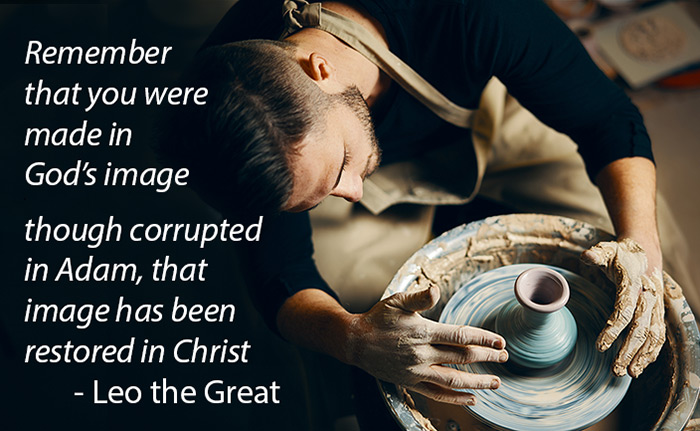
Our Lord Jesus Christ, born true man without ever ceasing to be true God, began in his person a new creation and by the manner of his birth gave man a spiritual origin. What mind can grasp this mystery, what tongue can fittingly recount this gift of love? Guilt becomes innocence, old becomes new, strangers are adopted and outsiders are made heirs. Rouse yourself, man, and recognise the dignity of your nature. Remember that you were made in God’s image; though corrupted in Adam, that image has been restored in Christ.
Use creatures as they should be used: the earth, the sea, the sky, the air, the springs and rivers. Give praise and glory to their Creator for all that you find beautiful and wonderful in them. See with your bodily eyes the light that shines on earth, but embrace with your whole soul and all your affections the true light which enlightens every man who comes into this world (John 1:9). Speaking of this light the prophet said: Draw close to him and let his light shine upon you and your face will not blush with shame. If we are indeed the temple of God and if the Spirit of God lives in us, then what every believer has within himself is greater than what he admires in the skies.
Our words and exhortations are not intended to make you disdain God’s works or think there is anything contrary to your faith in creation, for the good God has himself made all things good. What we do ask is that you use reasonably and with moderation all the marvellous creatures which adorn this world; as the Apostle says: The things that are seen are transient but the things that are unseen are eternal (2 Corinthians 4:18).
For we are born in the present only to be reborn in the future. Our attachment, therefore, should not be to the transitory; instead, we must be intent upon the eternal. Let us think of how divine grace has transformed our earthly natures so that we may contemplate more closely our heavenly hope. We hear the Apostle say:
“You are dead and your life is hidden with Christ in God. But when Christ your life appears, then you will also appear in glory with him (Colossians 3:3-4), who lives and reigns with the Father and the Holy Spirit for ever and ever. Amen.”
The excerpt is from a sermon by Leo the Great for the Feast of the Nativity, Sermon 27, translation source from Universalis.com.
Top image credit: Potter making a new creation from clay, photo from Bigstockstock.com, © by Gladkov, stock photo ID: 296903161. Used with permission. Quote from Leo the Great added.
Leo the Great was born into a Roman aristocratic family in the 5th century AD. His response to the call of the Lord transformed him into one of the greatest church leaders of Christian history. He was one of the first to be given the title “the Great.” Details pertaining to Leo’s place of birth are not known, but it is believed his ancestors come from Tuscany.
Leo became a very well-known deacon of the Church by 431 AD, serving the church under the Pope Celestine I. Leo was widely respected for his love for the Lord, intelligence and persuasive nature. He was also gifted in bringing reconciliation between disputing groups of Christians.
That is why he was often sent out to settle disputes, both secular and theological. Following Celestine, the next bishop of Rome was Pope Sixtus III. Sixtus III passed away while Leo was visiting Gaul at the request of Emperor Valentinian III. His task was to bring peace between one of Gaul’s chief military commanders and the chief magistrate.
Leo was then unanimously elected as the bishop of Rome to succeed Sixtus III in 440. His swift election reflected the respect he had garnered among the people from his service to the Lord and the affection the faithful had this pastoral and wise servant of the Lord. Along with his dynamic faith and outstanding theological wisdom, Leo I was also courageous. He led Rome’s defense against Attila the Hun’s barbarian invasion on Italy in 452, by taking on the role of peacemaker.
Leo focused heavily on the pastoral care of his people. He inspired and helped to foster charitable work in areas of Rome affected heavily by famine, refugees and poverty. To him, being a Christian was not only about embracing the fullness of the Gospel theologically but living it out in a world filled with hurt, suffering and needs. Leo I was renowned for his profoundly spiritual sermons. With his words, Leo could reach the everyday needs and interests of his people. It was his reputation as an “instrument of the call to holiness, well-versed in Scripture and ecclesiastical awareness” that helped him become one of the greatest church leaders in the history of the Church. (bio source)