


“If you continue in my word … you will know the truth, and the truth will make you free.”
John 8:31
Why do the Scriptures refer to God as the Word? I think that it is because words and speech are the most basic currency we have for making sense of the world, for assigning meaning and value to things, for bringing order out of chaos. There is ultimately no communication without words. They connect us.
They overcome distances. Words reveal us to ourselves:
“Out of the abundance of the heart the mouth speaks.”
Matthew 12:34
They reveal us to one another. We are known by our words. And while all of creation is in some sense a word from the Creator to his creatures, the word that God speaks to us calls us into relationship in a way that no tree or star ever could. From the beginning, God is a community of persons who speak to each other. That is why we are called to community: to imitate the life of the Trinity. We need to speak to each other, and we need to hear from each other. We do not complete ourselves: others do. I remember a conversation with a bishop in Ireland, about one of his parishioners who was becoming a leader in the work we were doing. I said to the bishop, “He is a revelation.” The bishop immediately replied, “You have revealed him to himself.” Unique and unrepeatable in our gifts and limitations, we complete one another. This is the creative capacity of speech.
John’s Gospel reveals God as the Creator:
“All things were made through him, and without him was not anything made that was made.”
John 1:3
Light, for example, did not emerge out of the primordial darkness. God spoke, “Let there be light,” and there was light. There was no fight, no hint of resistance on the part of nothingness. Nothingness was not a force to be reckoned with as though it were in rivalry with God, as one finds in some Mesopotamian myths. Rather, there was perfect compliance and submission.
“For he spoke, and it came to be.”
Psalm 33:9
Why is this so important? Because if he can create, he can recreate. When I am struck down by my sin, I try to imagine myself as made new: still me, but without the sin that has deformed me.
God’s Word shows me how to live. When I am awake to its power, it sets my heart on fire. It is the word that has sent men and women all over the world since the days of the Apostles, because they could not but speak of what they had seen and heard (Acts 4:20).
Our current tragedy, at least in the West, is that the Word has been so attenuated, so domesticated through boring, rote, uninspired preaching (with many notable exceptions), and unreflective listening that it is no longer considered relevant by many. No less tragic is my lack of personal responsibility to read the Word, believe the Word, ponder the Word, and act on the Word. As a friend once said, “You don’t like the homily? Give yourself a homily.” The Church, beginning with me, needs a great awakening to the power of the Word. This, thank God, is happening in many places.
The power to live in the truth, to choose the truth over my feelings, my desires, and my inclinations, is radical: it gets at the very root of my personality and identity. God’s Word sets parameters within which I live in freedom, like a fence around a garden or a wall around a castle. It warns me that if I don’t live in the truth, I live a lie, no matter how fetching that lie appears. When I know the truth about reality and conform my life to that truth, then I am free, no matter how painful or costly that journey may be.
The truth transforms my life.
“The word of God is living and active, sharper than any two-edged sword, piercing to the division of soul and spirit, of joints and marrow, and discerning the thoughts and intentions of the heart.”
Hebrews 4:12
God’s Word does what it says it is going to do. If it is a word of comfort, it comforts; if it is a word of rebuke, it rebukes. It is sharp; it cuts in where other words cannot. It convicts me of my sin and mediocrity in a way that no other words can. It tells me of my dignity as no other words can. It is a sword. God takes that sword and does surgery on me: “He wounds, but he binds up” (Job 5:18). “He has torn, that he may heal us” (Hosea 6:1).
The best “experiment” I ever conducted as a young man was to posit that the words of the Bible were indeed words spoken by God, that they were true, that they were spoken by God to me, and that if I obeyed them, I would find life. If the one who loved me without measure was speaking to me the deepest things of his innermost heart, would I not listen carefully? What about his parting words to me? Would I not pay close attention to the things he told me on the night before he died? The experiment converted my mind. The conversion to thinking with the mind of Christ, however, is a journey that will not end until I see him face-to-face.
I have been reading the Word of God for almost fifty years now. Much of my reading has been sloppy, distracted, uninterested, and superficial. Shame on me. Fortunately, God is more persistent than I am. Once, at a prayer meeting in college, I left my Bible on the floor. We used to sit on the floor for most of the time, so I didn’t think much of it. There was an Episcopalian nun at that prayer meeting. She came over to me, knelt down, picked up the Bible, and placed it reverently on a nearby table. “That is the Word of God,” she gently said. It was all she needed to say. My Bible has never been on the floor since.
Over the years, the beauty and power of his Word have taken up residence in my mind. The words come to me unbidden, time and again. They are words that have formed my mind. They tell me about myself, about the world I live in, and most importantly, about God. When Jesus speaks about the coming of the Holy Spirit he says,
“But the Counselor, the Holy Spirit … He will … bring to your remembrance all that I have said to you.”
John 14:26
The Holy Spirit reminds us, he brings to our minds the words of God that we need to hear in a particular moment. He forms an integrated whole out of the seemingly disparate pieces of our lives.
The Blessed Virgin Mary is the exemplar of making a home in the Word. When the angel Gabriel came to this young girl with the shattering news that she would conceive in her womb and bear a son who would be the savior of the world, she responded to his announcement by saying,
“Let it be to me according to your word.”
Luke. 1:38
Mary not only heard the word, but she also allowed the word to form her even as she formed the Word of God in her womb. When she had given birth to Jesus and the shepherds came to her and told her everything the angel had told them about the child Jesus, Scripture says that
“Mary kept all these things, pondering them in her heart.”
Luke 2:19
In the midst of all the heavenly and earthly celebration, she thought deeply about the meaning of everything that had happened to her and to the world through the coming in the flesh of the Son of God. She weighed it carefully. She reflected on it quietly. That is why she is a model for us. As with Mary, what we ponder becomes part of us. That is why we are warned about what we take in, because what we fill our minds with, forms them.
“Do not be conformed to this world but be transformed by the renewal of your mind.”
Romans 12:2
Mary filled her mind with the Word of God.
While God’s word reveals us to ourselves, the most important work it does is to reveal God to us. Jesus tells us that he is “the way, and the truth, and the life” (John 14:6). He is life in its fullness, and he offers us a way of life, a life of union with God, union with ourselves, union with all of humanity, and, ultimately, union with all creation. This is objective truth that I can stand on, as on a rock.
The revelation of God’s word is that Jesus Christ is not just an ethical system, a way of living that is morally superior. He is infinitely personal. To him belongs every tender and compassionate word of the Old Testament because he is one with the God of the Old Testament. It is he who makes springs burst forth in the wildernesses of our lives, he who makes streams appear in the deserts (Isaiah 35:6). It is he who promises perfect peace if we keep our minds stayed on him (Isaiah 26:3), he who knitted us together in our mothers’ wombs, he who was thinking of us from the moment of our conception (Psalm 139:13).
He is also the God who drove out the nations in order to give the Promised Land to his chosen people. The psalmist recounts that it was not by their own sword that they won the land, nor by their own arm that they won the victory. Rather, it was
“Your right hand, and your arm, and the light of your countenance; for you delighted in them.”
Psalm 44:3
God’s right hand and his arm are metaphors for his omnipotence, his unlimited power to deliver us from our enemies, conquer our foes, and deliver us from evil. Just so, the light of his face is a metaphor for his glory, his compassion, and his kindness. With all that power he loves me. With all that compassion and kindness, he loves me.
While every word of Scripture has its historical context, and while it is helpful to read it with the context in mind, it is equally true that every word of God is a word written to me. Every word of God is a revelation of his divinity, his authority, and his love. It is a letter written to me by my Father in heaven that discloses his mind, reveals his heart, and opens to me the treasures of his kingdom.
This reflection by © Gregory Floyd is excerpted from the book, Unforgettable: How Remembering God’s Presence in Our Past Brings Hope to Our Future, chapter 6, published by Paraclete Press, Brewster, Massachusetts, USA, 2022.
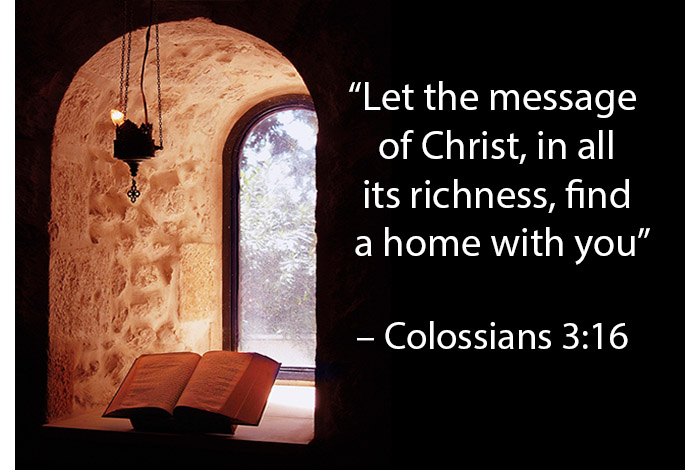
Top image credit: Photo of opened Bible with lighted candle near a window, from Bigtockphoto.com, © by Fotozon, stock photo ID: 1663708. Used with permission. Scripture passage from Colossians 3:16 added
Gregory Floyd is Assistant Director for the Center for Diaconal Formation at Seton Hall University in South Orange, New Jersey, USA. He is a coordinator of The People of Hope, a Catholic charismatic covenant community based in New Jersey, and a member community of the international Sword of the Spirit. Gregory and his wife Maureen are the parents of nine children. They live with their younger children in Warren, New Jersey.