


The Legend of St. John
When I was a young disciple, I heard a story about St. John, the writer of the Gospel of John, in late life. (I don’t know if the story is true, but it does seem to align well with his teaching). As the story goes, St. John was carried on a pallet to give a sermon to the congregation. He sat up and said, “Love one another!”, and then motioned to be carried out. After doing this on a few more occasions, he was asked why he was repeatedly giving the same short sermon. His reply was, “Until you get that, I can’t teach you anything further.”
Today, there are Christians everywhere who want to grow as disciples of Christ. This legend says that love of the brethren is foundational to growth as a disciple: John would not take them further until they got that right.
In addition to the desire to grow, Christians everywhere desire to spread the Gospel and to see people come to Christ. As with John, Jesus connects this kind of success with the love and unity of the brethren (brothers and sisters in Christ).
“By this ever one will know that you are my disciples, if you have love for one another.”
John 13:35
“… I in them and you in me, that they may become perfectly one, so that the world may know that you have sent me and have loved them even as you have loved me.”
John 17:23b
“This is my commandment, that you love one another as I have loved you.”
John 15:12
A Johannine Conversion
When I was a young disciple, I thought John’s writings were a little “sappy”, all of this talk about love and affection. I considered myself a man of action who could help the kingdom to come “on earth as it is in heaven”, one brick at a time. As with John, I am now an older disciple who has outlived many other disciples. I now realize that those “bricks” are Christian relationships of love, support, and spiritual power. John was right; the younger version of me was wrong.
Is there a hole in the spectrum of love?
By way of review, in Part 1 we considered a sort of “snapshot” of the spectrum of human love. There are two broad sections of the spectrum: the first is instinctive and designed into our DNA: (natural) love of parents, siblings, etc. The second part is spiritual, and in some cases, supernatural: love of the poor, mankind, enemies, and love of the brethren (brothers and sisters in Christ).
The second part is the purview of the second commandment. The second commandment even has two phrases that could be laid over the spectrum: “as yourself” from part one of the spectrum; and “love your neighbor” from part two of the spectrum. The second commandment is about “love of neighbor.” The word neighbor is used here very inclusively and includes many different types of folks: the Good Samaritan (Luke 10:29-37), the poor, enemies, etc.
Here we are focusing on “love of the brethren” as an essential part of our response to “love of neighbor.”
“For as in one body we have many members, and all the members do not have the same function,so we, though many, are one body in Christ, and individually members one of another. … love one another with brotherly affection; outdo one another in showing honor.”
Romans 12:4-5, 10
When Jesus said, “Love one another as I have loved you” (John 12:34), he was not just issuing a command, but a description of the “body of Christ” (Romans 12:4-5, 10), a prescription for his church on earth. Famous people (including Tertullian) would write, “See how they love one another” to describe outside observations of the early church. Would they say that about us today?
Frequency
When I was in grade school, I noticed that, particularly in English class, we seemed to learn the same things over and over. By the eighth grade, with growing impatience, I asked, “Teacher, why are we learning the same things as last year and the years before that.” She answered me in Latin: “Repititio est mater eruditio!” It means “repetition is the mother of learning.” I didn’t bother her for a week or so. If I was going to have to translate her answers, it would be easier to keep my head down!
I learned other lessons that day. One such lesson is this: when someone repeatedly makes a point, he is hoping that you will eventually get it! When raising a child, you often have to say something many different ways or many different times to have it stick.
The phrase, “love one another” is written 13 times in six different Biblical books, including the weightiest statement by Jesus, “Love one another as I have loved you.” (John 13:34). Since my eighth-grade lesson, I like to notice the frequency with which a topic appears in scripture. Beyond the specific phrase, the topic, “love of the brethren” comes up repeatedly using different words. Much of the New Testament is instruction about, or a “how to” handbook on loving God and loving one another. “On these two commandments depend all the law and the prophets” (Matthew 22:40).
Structural Difficulties
Most Christian churches are designed to be “First Commandment” churches: we are mostly taught to love, obey, and to worship God. The second commandment tends to get short shrift. As mentioned earlier, the relationships tend to be described by the phrase, “See you next Sunday!” Some people long for and seek to develop deeper relationships, but it often feels like swimming upstream if it’s not designed into our structure or not approved by, or initiated by the pastor or elders.
It should be said that some churches work at and design for a second commandment response. God’s blessing is on anyone who tries, and grace will flow into these relationships. Remember that these relationships are not instinctive but are a response to a commandment and require grace to be fruitful.
Finally, an example: in my pastoral work, one of my assignments was to visit Christian communities across North America to (hopefully) make recommendations and give input to certain initiatives already in development. We had identified certain key elements that could serve a community growing in discipleship and relationship.
One such community was Morningstar in Jackson, Michigan USA. I can’t remember all the details, but one of their members had an unusual handicap. I was inspired by the members’ response to this individual: a fully developed plan was working and in place to serve this person and his family’s needs. It was very impressive to me, and I could easily say, “See how they love one another.”
Possible Questions:
- What does “you will know them by their fruits” mean to you?
- Does loving the poor (serving in a soup kitchen) or loving your enemies (a coworker who has canceled you) seem a nobler and more worthy endeavor than loving the brethren?
- How does loving the brethren impact our success in evangelizing people and bringing them to Christ?
- What role does Christian community fill in helping us to live out the command to “love one another as I have loved you”?
- What kind of parishes, congregations or groups might cause observers to say, “See how they love one another”?
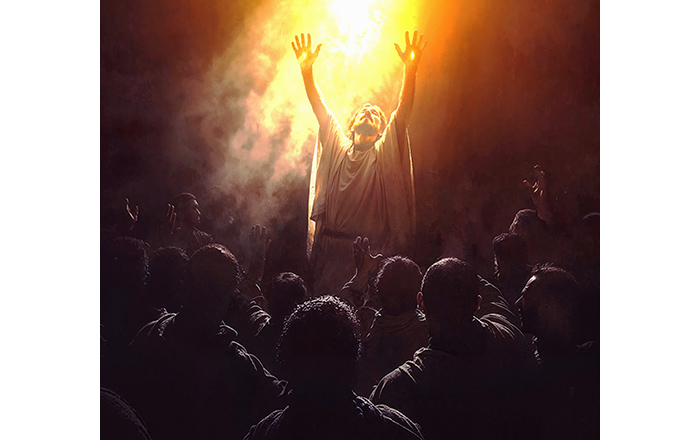
Top image credit: Risen Christ with his disciples, (c) by Kevin Carden, from ChristianPhotoshops.com. Used with permission.
Bob Tedesco is a profound teacher and prolific writer on building Christian family life and community in the light of Christian truth, Biblical wisdom, and the call to live and grow as disciples of Jesus Christ. Check out his previous articles and books in the Living Bulwark archives.
Bob is also the author of three books, Essays on Christian Community, Choosing Discipleship, By God’s Design. and forty-two Christian life articles published in the Sword of the Spirit international online magazine, Living Bulwark. He has a BS in Aerospace Engineering from the University of Pittsburgh and worked as a consulting engineer for twenty years. He and his wife, Bobbie, have been married for sixty-five years (as of June 24, 2026). They currently have ten children, thirty-seven grandchildren, and thirty great-grandchildren. They reside in Coraopolis, Pennsylvania, USA.