


“There is no God else beside Me; a just God and a Savior; there is none beside Me.”
Isaiah 45:21
God couldn’t abandon humanity to be swept away by the process of decay; this would be unacceptable, unworthy of a good God.
However, it’s equally true that the righteous claims of God’s law pressed against us. God must show Himself true to His word concerning death as sin’s consequence. It would be monstrous if God, the Father of Truth, went back on His word concerning death, becoming false in order to preserve us.
So again, what was God to do? Should He require repentance from humans for their transgression? We could say this was worthy of God, that as we became subject to perishing through transgression, so through repentance we might return to imperishability. Yet mere repentance wouldn’t safeguard God’s consistency with Himself. He still wouldn’t be true to His word, if death failed to hold mastery over disobedient humans. Nor does repentance bring humans out of their natural condition of mortality; all it does is stop them sinning again.
Repentance would have sufficed, if all that needed rectifying was a bare act of sin, rather than the corruption of our nature that followed the act. But once sin had begun, humans fell under the dominating power of the decay proper to their nature, deprived of the grace belonging to them as God’s image-bearers.
What else was required? How could we receive the grace we needed, and be rescued from decay? Our only hope lay in the Word of God, who originally made everything from nothing. He alone had power to restore the perishing to imperishable life, and to safeguard the Father’s consistency toward us all.
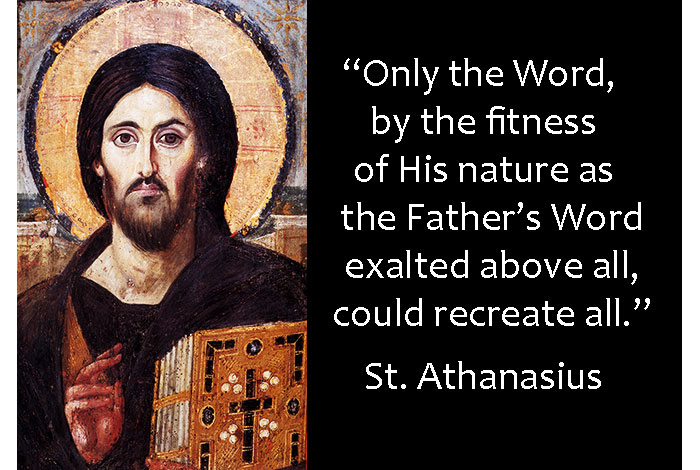
Only the Word, by the fitness of His nature as the Father’s Word exalted above all, could recreate all; He alone was worthy to suffer for all, and be an ambassador for all with the Father.
This treatise by Athanasius is excerpted from On the Incarnation of the Word 6:10–7:5, translated by © Nick Needham, Daily Readings from the Early Church Fathers, 2017, Christian Heritage, Scotland, UK.
Top image credit: Christ Pantocrator (Ruler of All), icon from St. Catherine’s Monastery, Mount Sinai, Eqypt, painted in the 500s AD. Image in the public domain.
Athanasius of Alexandria (298-373 A.D.) was a bishop of Alexandria (Egypt), in the fourth century. Before reaching the age of 20, Athanasius wrote a treatise entitled On the Incarnation, affirming and explaining that Jesus was both God and Man. In about 319, when Athanasius was a deacon, a presbyter named Arius began teaching that there was a time before God the Father begat Jesus Christ when the latter did not exist. Athanasius responded that the Father’s begetting of the Son, or uttering of the Word, was an eternal relationship between them, not an event that took place within time. Thus began catholic Christianity’s fight against the heresy of Arianism.
Athanasius fought consistently against Arianism all his life. He accompanied bishop Alexander to the First Council of Nicaea in 325 AD, which council produced the Nicene Creed and anathematized Arius and his followers. On May 9, 328, he succeeded Alexander as bishop of Alexandria. As a result of rises and falls in Arianism’s influence, he was banished from Alexandria only to be later restored on at least five separate occasions, perhaps as many as seven. This gave rise to the expression “Athanasius contra mundum” or “Athanasius against the world.” During some of his exiles, he spent time with the Desert Fathers, monks and hermits who lived in remote areas of Egypt. In his lifetime he earned the characteristic title of “Father of Orthodoxy.”
[Biographical sources from Theopedia and New Advent]