


Intro: In his treatise on the Beatitudes, Augustine of Hippo begins with the weighty proclamation that “anyone who piously and earnestly ponders the Sermon on the Mount – as we read in the Gospel according to Mathew – I believe he will find therein… the perfect standard of the Christian Life.”
The Lord’s Sermon on the Mount is reliably dated to the period 393–394, early in Augustine’s career. At that point Augustine had been a priest at Hippo for two or three years, having probably been ordained in early 391. Soon after his ordination he had begged Valerius, his ordaining bishop, for time to study the Scriptures in preparation for his priestly ministry, and he had most likely devoted about a year to that task. The Lord’s Sermon on the Mount was his initial foray into the New Testament, and it represented the first time that anyone had separated the Sermon on the Mount from the rest of the Gospel of Matthew and treated it independently. (intro by Boniface Ramsey)
Part 1: The Beatitudes in the Gospel of Matthew
If anyone were to ponder with piety and seriousness the sermon which our Lord Jesus Christ gave on the mount, I believe that he would discover there, as far as norms for high moral living are concerned, the perfect way to lead the Christian life.
We would not be rash enough to make this promise of ourselves, but we deduce it from the very words of that same Lord. Indeed, from the conclusion of the sermon it is evident that all the precepts necessary for regulating a person’s life are contained in it. His words are as follows:
Anyone who hears my words and does them I shall compare to a wise man who built his house upon rock. The rain fell, floods came, the winds blew and battered that house, and it did not fall, for it was built on rock. But anyone who hears my words and fails to act on them I shall compare to a foolish man who built his house on sand. The rains fell, floods came, the winds blew and battered that house, and it fell, and its ruin was great.
Matthew 7:24–27
The fact that the Lord did not merely say, Anyone who hears my words, but said instead, Anyone who hears these words of mine, is proof enough, then, in my judgment, that the words he spoke on the mount serve as such a perfect template of instruction for those people who wish to model their lives on them that they can rightly be compared to the man who built his house on rock. What I have said is intended to show that this sermon embodies the perfect summary of all those precepts necessary for leading the Christian life. We shall discuss this assertion in more detail in its appropriate place.
The sermon, then, begins as follows:
Seeing the large crowd, he went up the mount, and when he had sat down his disciples came to him. And opening his mouth he taught them, saying.
Matthew 5:1-2
If we look for the meaning of mount it could justifiably be understood as signifying the greater precepts of righteousness,1 because those of less importance had been given to the Jews. Yet it was the one God who gave the lesser precepts, through his holy prophets and servants, to a people for whom it was still opportune to be bound by fear, in accordance with a most just ordering of times.
And through his Son he gave the greater ones to a people for whom it was now fitting to be set free by charity. Since the lesser ones were given to those not yet fully mature and the greater ones to those who had come of age, they were given by him who alone is competent to dispense the appropriate medicine to the human race, suitable for its time. Nor should we wonder that the greater precepts have been given for the sake of the kingdom of heaven and the lesser ones for the sake of the earthly kingdom by one and the same God who made heaven and earth.2
[In Psalm 36] The prophet remarks of that greater righteousness,
Your righteousness is like the mountains of God
Psalm 36:6
and this expresses well how such sublime truths are to be taught on the mount by one single competent teacher.3
He taught them sitting down, which pertains to the dignity of a teacher. His disciples came closer to him in body in order to hear his words, for they were already close in mind as far as the fulfilling of his precepts was concerned. He opened his mouth and taught them, saying. The expression that says, And opening his mouth, could be a device which suggests that the sermon to follow will be an extended one, or perhaps it means that he who was once accustomed to opening the mouths of the prophets in the Old Testament was now opening his own mouth.4
What then does he say?
Blessed are the poor in spirit, for theirs is the kingdom of heaven.
Matthew 5:3
In a text about the desire for earthly possessions we read, All is vanity and presumption of spirit (Ecclesiastes 1:14). Presumption of spirit means arrogance and pride. Generally speaking, proud people are said to have inflated spirits, and rightly so, since spirit is also called wind. Scripture says, Fire, hail, snow, ice, stormy wind(Psalm 148:8). Who does not know that the proud are described as inflated, blown up as though with wind? Hence we have the words of the Apostle, Knowledge inflates, love builds up (1 Corinthians 8:2). With good reason, therefore, can the poor in spirit be understood as those who are humble and fear God – who do not, in other words, possess an inflated spirit. Indeed, blessedness can have no other beginning if we wish to arrive at perfect wisdom. The beginning of wisdom is the fear of the Lord (Sirach 1:14; Psalm 111:10), because in contrast it is written, Pride is the beginning of all sin (Sirach 10:13).5 Let the proud, therefore, desire and love the kingdoms of this world, but blessed are the poor in spirit, for theirs is the kingdom of heaven.
Blessed are the meek, for they shall inherit the earth.
Matthew 5:4
I believe that the earth referred to here is the one spoken of in the Psalms: You are my hope, my heritage in the land of the living (Psalm 142:5). It indicates that the eternal inheritance has a kind of solidity and stability where the soul, possessed of true affection, rests in its own place as a body does on the earth, and is nourished there on its own food just as a body is from the earth. Such is the repose and life of the saints. The meek are those who yield to insults and do not resist evil but conquer evil with good.6 Let the violent dispute and fight over what is earthly and temporal, but blessed are the meek, for they shall inherit the earth, from which they cannot be driven out.
Blessed are the sorrowful, for they shall be comforted.
Matthew5:5
Sorrow is sadness at the loss of what we hold dear. But those who have turned to God let go of the things which they held dear in this world. They no longer find pleasure in them as they once did, and until they experience the love of what is eternal they are in some way grief-stricken. The Holy Spirit will therefore comfort them, because he is first and foremost named the Paraclete, or Consoler, so that in letting go of what is temporal they may rejoice in what is eternal.
Blessed are those who hunger and thirst for righteousness, for they shall be satisfied.
Matthew 5:6
Such people he declares to be lovers of that good which is true and steadfast. They will find satisfaction in that food of which the Lord himself says, My food is to do the will of my Father (John 4:34), which is righteousness, and with that water of which he says that, whoever drinks of it, it shall become in him a spring of water, welling up to eternal life (John 4:14).
Blessed are the merciful, for they shall obtain mercy.
Matthew 5:7
He declares blessed those who come to the help of the unfortunate, for they will be repaid by being delivered themselves from misfortune.
Blessed are the pure of heart, for they shall see God.
Matthew 5:8
How foolish then are those people who search for God with the outer eyes, since it is by the heart that he is seen, as we find written elsewhere, Seek him with an undivided heart (Wisdom 1:1). In fact, a pure heart is an undivided heart.7 And just as we cannot see the light except with eyes that are pure, neither can God be seen unless that through which we see him is pure.
Blessed are the peacemakers, for they shall be called sons of God.
Matthew 5:9
Perfection is to be found in peace, where nothing is at odds, and therefore the peacemakers are sons of God, because nothing is opposed to God, and sons indeed ought to bear the likeness of their Father. But those who order all the affections of the soul and subject them to reason – that is, to the mind and to the spirit – and have subdued the desires of the flesh are peacemakers within themselves and become the kingdom of God.
In that kingdom everything is ordered in such a way that what distinguishes and is surpassing in man rules over those other things which do not resist and which we have in common with the animals. And so that very thing which is outstanding in man, his mind and reason, becomes subject to one who is more powerful, Truth itself,8 the only-begotten Son of God. For man could not rule over what is inferior to himself were he not subject to one higher than himself.
This is the peace that is given on earth to people of goodwill;9 this is the life of the wise person who has attained the summit of perfection. The prince of this world has been expelled from this most peaceful and ordered kingdom,10 for he exercises his dominion over those who lead obdurately wayward and disordered lives. Firmly established and ordered from within, and notwithstanding the persecutions stirred up from without by the one who has been expelled, this peace only serves to enhance that glory which is according to God. Nor does he cause anything to collapse within this edifice, but through his abortive scheming he only succeeds in making clear just how solid its internal construction is. And so it follows,
Blessed are those who suffer persecution for the sake of righteousness, for theirs is the kingdom of heaven.
Matthew 5:10
The total number of these maxims amounts to eight. Referring to others, he goes on to address those present with the words, Blessed are you whenever they curse you and persecute you (Matthew 5:11). He expressed the previous maxims in general terms, for he did not say, “Blessed are the poor in spirit, for yours is the kingdom of heaven,” but rather, for theirs is the kingdom of heaven. Nor did he say, “Blessed are the meek, for you shall inherit the earth,” but rather, for they shall inherit the earth, and so on as far as the eighth maxim, which states, Blessed are those who suffer persecution for the sake of righteousness, for theirs is the kingdom of heaven.11
Part 2: The Stages of Blessedness
[Christ] now turns his attention to those who are present and addresses them, since what he said just previously also concerned those who were present and heard these things. What was to follow, which also appeared to refer in a particular way to those who were present, was intended to apply as well to those who were not present or who would come afterwards. For this reason the number of those maxims merits careful consideration.
Blessedness begins from humility.12
Blessed are the poor in spirit, meaning those who are not puffed up, because their soul is subject to divine authority, lest after this life it suffer punishment, even if by chance it believed itself to be blessed in this life.
From here the soul proceeds to an acquaintance with Sacred Scripture, where it must show itself to be meek in piety, lest it dare disparage what appears absurd to the unlearned and, through engaging in obstinate disputes, no longer be docile.
From here it begins to discover the nature of the ties of this world because of carnal habit and sin. And so at this third stage where there is knowledge, because of its involvement in things which are inferior, it mourns the loss of the supreme good.
The fourth stage involves toil, where the soul labors strenuously to extricate itself from the attachments which have entrapped it with their deadly sweetness. Here there is hunger and thirst for righteousness, and fortitude is absolutely necessary, because what is adhered to out of pleasure is not relinquished without pain.
The fifth stage counsels a means of exit to those who persevere in their struggle, because unless they are aided by a higher power they are in no way capable of extricating themselves from such powerful snares of misery. The counsel is indeed a just one, that whoever wishes to receive help from someone more powerful must himself assist someone weaker in a situation where he finds himself the stronger. Therefore, Blessed are the merciful, for they shall obtain mercy.
The sixth stage concerns purity of heart, which is the result of a sound conscience and good works that enable the soul to contemplate the supreme good, which is only perceptible through an intellect that is pure and serene.
Finally, the seventh stage is wisdom itself, the contemplation of truth, bringing peace to the whole person and establishing a likeness to God, which reaches its apogee in this way: Blessed are the peacemakers, for they shall be called sons of God.13
The eighth stage returns, as it were, to the beginning, because it shows and demonstrates what is in fact complete and perfect.
In the first and eighth stages mention is made of the kingdom of heaven: Blessed are the poor in spirit, for theirs is the kingdom of heaven, and: Blessed are those who suffer persecution for the sake of righteousness, for theirs is the kingdom of heaven. We read in Scripture, Who will separate us from the love of Christ: tribulation, distress, persecution, hunger, nakedness, peril, or the sword? (Romans 8:35) There are seven beatitudes, therefore, which lead to perfection, for the eighth, starting again from the outset as it were, adds clarity and shows what has been accomplished, so that through these gradations the others may reach completion.
And in my opinion the sevenfold working of the Holy Spirit, of which Isaiah speaks,14 corresponds to these stages and maxims. But the order is different. For in Isaiah the list begins with what is more excellent, whereas here we start with what is less so. The prophet begins with wisdom and concludes with the fear of God, but the beginning of wisdom is the fear of God (Sirach 1:16; Psalm 111:10).15
Therefore, if we ascend by stages and in numerical order, as it were, the first stage is the fear of God, the second piety, the third knowledge, the fourth fortitude, the fifth counsel, the sixth understanding, and the seventh wisdom. The fear of God accords with the humble, of whom it says here, Blessed are the poor in spirit, those who are not puffed up or proud, whom the Apostle exhorts, Do not aspire to what is beyond you, but be fearful (Romans 11:20), in other words, do not exalt yourself. Piety accords with the meek.
The pious seeker honors Sacred Scripture and finds no fault with what he does not yet understand, nor does he set his mind against it, which is what it means to be meek. So it is said here, Blessed are the meek. Knowledge accords with the sorrowful, who have discovered from the Scriptures what evils have held them bound, which the uninstructed pursue as good and beneficial. So it is said here, Blessed are the sorrowful.
Fortitude accords with those who hunger and thirst, for they struggle in their desire for the joy which comes from truly good things and are eager to divert their love from what is material and pertains to the body. So it is said here, Blessed are those who hunger and thirst for righteousness. Counsel accords with the merciful. This is the one remedy for escaping great evils: that we forgive just as we wish to be forgiven,16 and help others as far as we are able in the same way that we desire assistance when we are unable to help ourselves. So it is said here, Blessed are the merciful.
Understanding accords with the pure of heart, like an eye that has been cleansed. Through it can be discerned what the eye of the body has not seen, nor ear heard, nor has it entered into the human heart (Isaiah 64:4; 1 Corinthians 2:9). Of such people it is said here, Blessed are the merciful.
Wisdom accords with the peacemakers. In them everything is ordered, and no affection vies with reason, but all things are subject to the spirit of man, because he himself in turn obeys God.17 Of them it is said here, Blessed are the peacemakers.
Part 3: One Single Reward – The Kingdom of Heaven
The one single reward for all these differently named stages, however, is the kingdom of heaven. In the first place comes, as is proper, the kingdom of heaven, which constitutes the perfect and supreme wisdom of the rational soul. And so it is stated, Blessed are the poor in spirit, for theirs is the kingdom of heaven, which is the equivalent of saying, The beginning of wisdom is the fear of the Lord.
Their inheritance is given to the meek, as to those who devoutly seek the Father’s will: Blessed are the meek, for they shall inherit the earth.
Consolation is given to the sorrowful, as to those who are aware of what they have lost and are immersed in the troubles in which they find themselves: Blessed are the sorrowful, for they shall be consoled.
Satiety is given to those who hunger and thirst, as refreshment to those who struggle and fight with fortitude for salvation: Blessed are those who hunger and thirst for righteousness, for they shall be satisfied. Those who have been merciful will receive mercy, as those who have followed the truest and best counsel, and so they will receive from someone more powerful what they have shown to others weaker than themselves: Blessed are the merciful, for they shall obtain mercy.
Those who are pure in heart will be empowered to see God, as those who have the clarity of vision to understand things that are eternal: Blessed are the pure of heart, for they shall see God. The likeness of God will be conferred on the peacemakers, as on those who possess the fullness of wisdom and have been formed in the image of God through the regeneration of the new man: Blessed are the peacemakers, for they shall be called sons of God.
All of these can certainly be accomplished in this present life, just as we believe that they were accomplished in the life of the apostles,18 although the transformation into angelic form promised us after this life19 can in no way be expressed in words. Blessed are those who suffer persecution for the sake of righteousness, for theirs is the kingdom of heaven.
This eighth maxim, which returns to the beginning and evokes the image of the perfect man, is perhaps signified by the Old Testament practice of circumcision on the eighth day20 and by the Lord’s resurrection after the sabbath day,21 which is both the eighth and the first day, and by the celebration of eight days of rest which we mark in the rebirth of the new man, and by the very number of Pentecost. For when we multiply seven by seven we have forty-nine, and, if an eighth [day] is added, the number fifty is complete, and in a manner of speaking we arrive back at the beginning.22
On this day the Holy Spirit was sent, by whom we are led into the kingdom of heaven and by whose doing, thanks to whom we receive our inheritance, we are consoled and fed, obtain mercy, are purified and restored to peace. And so, having attained perfection, we endure for the sake of truth and righteousness all those external trials which come our way.
Blessed are you when people curse and persecute you and, lying, speak all kinds of evil against you because of me. Rejoice and be glad, for your reward is great in heaven. (Matthew 5:11–12)
Whoever in the name of a Christian seeks the pleasures of this world and an abundance of temporal things should be aware that our blessedness is to be found within, as the prophetic word says of the soul of the Church, All the beauty of the king’s daughter is within (Psalm 45:13).
For curses, persecutions and slander are promised externally to those whose great reward is in heaven, which is perceived in the hearts of those who suffer, who can now declare, We glory in our afflictions, knowing that affliction brings patience, patience brings endurance, and endurance hope. And hope is not deceived, because the love of God has been poured into our hearts through the Holy Spirit who has been given to us. (Romans 5:3–5) Suffering such things brings no benefit, but rather bearing them for the name of Christ not only with an outlook that is serene but also with joy. In fact many heretics, using the Christian name to lead others astray, undergo many such sufferings, but they are excluded from the reward that has been spoken of, for it says not only Blessed are those who suffer persecution but also for the sake of righteousness.
Where sound faith is not found, then there can be no righteousness, for the righteous man lives by faith(Habakkuk 2:4; Romans 1:27). Nor should schismatics promise themselves any part of this reward, for, likewise, where there is no charity there can be no righteousness, because love does no wrong to the neighbor(Romans 13:10). If they possessed it, they would not tear asunder the body of Christ, which is the Church.23
This treatise on the Beatitudes by Saint Augustine is excerpted from The Works of Saint Augustine – A Translation for the 21st Century, New Testament I and II I/15 and I/16, The Lord’s Sermon on the Mount (De sermone Domini in monte), translated by Michael G. Campbell, O.S.A., published in the United States by New City Press, Hyde Park, New York, ©2014 Augustinian Heritage Institute.
See related articles:
- Living the Beatitudes as Christ Has Taught Us, by Steve Clark
- Jesus Calls his Community of Disciples “Blessed”, by Dietrich Bonhoeffer
- On the Beatitudes of God’s Kingdom, by Augustine of Hippo
- The Beatitudes Are Inseparable from the Cross, by Fulton J. Sheen
- To Bless and Be Blessed – The Call to Live the Beatitudes as Disciples of Christ, edited by Don Schwager
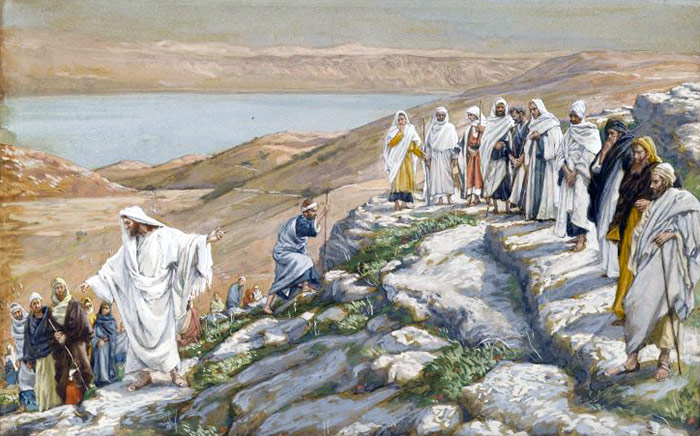
Top image credit: Jesus chooses his 12 apostles, watercolor illustration by James Tissot, 1886-1894, Brooklyn Museum, New York, USA. Image in the public domain.
Notes:
1 “Righteousness”: justitiae. This is the usual translation of justitia throughout.
2 “Who made heaven and earth”: a phrase possibly inspired by the creed, although it does not seem to have formed part of the creed that was used in Hippo. See J. N. D. Kelly, Early Christian Creeds, 3rd ed. (New York 1972) 176.
3 See Matthew 23:8.
4 The expression (circumlocutio) is in fact a standard Hebraicism to which Augustine, in his second suggested interpretation, gives a rich allegorical meaning.
5 The text that Augustine had before him cited Sir 10:13 here (and also below at I,11,32) in this version. But the best Hebrew and Greek manuscripts cite the verse otherwise: The beginning of all pride is sin. Augustine often referred to his version (as in The City of God XIV,13 and elsewhere) to demonstrate the primacy of pride among the vices. See William M. Green, “Initium omnis peccati superbia: Augustine on Pride as the First Sin,” in University of California Publications in Classical Philology 13 (1949) 407–431.
6 See Romans 12:21.
7 “Undivided heart … undivided heart”: simplicitate cordis … simplex cor. “Undivided” is the usual translation of simplex throughout.
8 See John 14:6.
9 See Luke 2:14.
10 See John 12:21.
11 Had Christ spoken in the second person rather than in the third, he would have been addressing only those who were present. In the following section Augustine points out that Christ now addresses those present in particular.
12 The role of humility as the basis of the spiritual life is especially evident in Letter 118,3,22.
13 The supremacy of wisdom is often stressed in Augustine’s writings, especially since it is sometimes identified with God. See, e.g., Confessions IX,10,24; Teaching Christianity I,8,8.
14 See Isaiah 11:2–3.
15 The Latin editor variously reads “God” (Dei), as here, and the more familiar and scripturally correct “Lord” (Domini), as in I,4,12.
16 See Matthew 6:12, 14–15.
17 See Revisions I,19 (18),1, where Augustine observes that such a state cannot in fact be attained in this life.
18 See Revisions I,19 (18),2, where Augustine denies that the apostles were no more capable than anyone else of achieving anything more than could be achieved in this life.
19 See Matthew 22:30 par.
20 See Genesis 17:12 and frequently thereafter.
21 See Matthew 28:1.
22 In Augustine’s numerology, the numbers seven, eight and fifty signify completion or perfection; see, e.g., The City of God II,31 (seven); ibid. XXII,30 (eight); Teaching Christianity II,16,25 (fifty). Seven, however, is made even more perfect by the addition of one; see, e.g., The City of God XXII,30.
23 See Colossians 1:24. In this section Augustine has referred to both heretics and schismatics and seems to make a distinction between them, which was not always made in Christian antiquity. Although it is not evident who the heretics might be, the schismatics are almost certainly the Donatists, who were frequently accused by Augustine of being without charity and of divisiveness, as they are here. See in particular the Homilies on the First Epistle of John schismatics promise themselves any part of this reward, for, likewise, where there is no charity there can be no righteousness, because love does no wrong to the neighbor (Romans 13:10). If they possessed it, they would not tear asunder the body of Christ, which is the Church.23
Aurelius Augustine was born in 345 in the town of Tagaste, in Roman North Africa, in what is today Algeria. His mother was Monica, a very devout Christian who had a significant influence on her son’s life. His father, named Patricius, was a pagan of significant status in society. Patricius became a Christian shortly before his death.
Augustine was educated at Carthage where he enjoyed academic success. He also enjoyed the party life, and at the age of 17 fell in love with a woman whom he never named. They lived together unmarried for 13 years and had a son whom Augustine named Adeodatus, meaning “gift from God.” His son died in his youth.
At the age of 19, after reading Cicero’s Hortensiusat, Augustine fell in love with philosophy. He later wrote, “It gave me different values and priorities. Suddenly every vain hope became empty to me, and I longed for the immortality of wisdom with an incredible ardour in my heart.” While he pursued Platonic philosophy and the theology of the Manichaens, a Christian heretical sect, he became restless for truth and virtue. Shortly before his 30th birthday, Augustine encountered Ambrose, the saintly bishop of Milan. Augustine was moved by Ambrose’s example and his inspired teaching and preaching of the gospel. At the age of 32 Augustine found peace with God and was baptized by Ambrose during the Easter liturgy in 387. Augustine returned to North Africa and formed a monastic community with a group of friends. He was ordained a priest in 391 and became a noted preacher. In 396 he reluctantly became a bishop and remained the bishop of Hippo until his death in 430. He left his monastic community, but continued to lead a monastic life with the parish priests of Hippo in his episcopal residence. Augustine died on August 28, 430, during the siege of Hippo by the Vandals.
Augustine was a prolific writer and original thinker. His numerous writings, including theological treatises, sermons, scripture commentaries, and philosophical dialogues, number into the hundreds. His autobiography, the Confessions, was considerded the first Western autobiography. It was highly read among his contemporaries and has continued as a classic throughout the ages.
Augustine is one of the most important figures in the development of Western Christianity. He is esteemed as a great Latin church father and a Doctor of the Roman Catholic Church. Many Protestants consider him to be one of the theological fathers of Reformation teaching. Among Orthodox he is called St. Augustine the Blessed.