


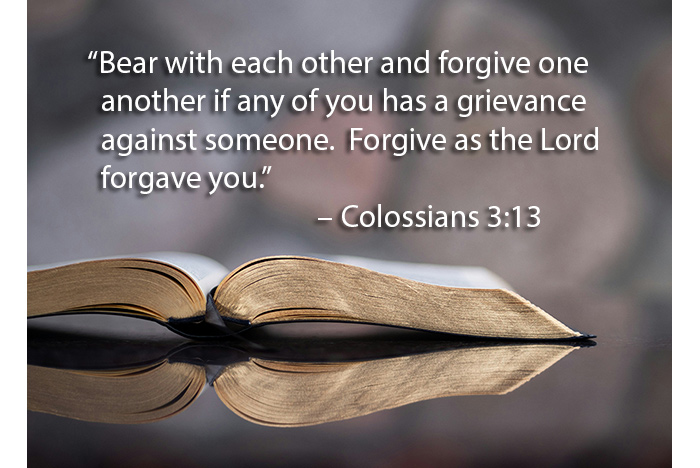
Forgiveness
“So if you are offering your gift at the altar, and there remember that your brother has something against you,leave your gift there before the altar and go; first be reconciled to your brother, and then come and offer your gift.”
Matthew 23:20
Jesus taught about being properly dressed for a wedding (Matthew 22:11). From the above scripture, we can also conclude that we should wear the mantle of forgiveness as the garment for worship… don’t bring your resentment into a worship setting, but reconcile first.
The cross is the symbol of Christianity, and it is a symbol of forgiveness, of salvation and of love.
“For God so loved the world that he gave his only Son, that whoever believes in him should not perish but have eternal life. For God sent the Son into the world, not to condemn the world, but that the world might be saved through him.”
John 3:16-17
So, LOVE shows itself by an act of forgiveness with Jesus’ death on the cross. Forgiveness is intrinsic to love. We are not qualified to worship while harboring resentments. It’s the exact opposite of “love one another”:
“And forgive us our debts as we also have forgiven our debtors…”
Matthew 6:12
…and forgive us our sins, for we ourselves forgive everyone who is indebted to us; and lead us not into temptation.”
Luke 11:4
These Scriptures contain two of the scariest words in the Bible: “AS WE.” Earlier, we were told not to worship if we needed to work out a conflicted relationship. Here, we are told not to expect forgiveness if we do not forgive our brothers and sisters. The striking thing to me is that many or most of us say the Lord’s prayer every day, or at least weekly, during our Sunday services. This teaching is underscored by the parable of the unforgiving servant.
“Then Peter came up and said to him, “Lord, how often shall my brother sin against me, and I forgive him? As many as seven times?” Jesus said to him, “I do not say to you seven times, but seventy times seven.
“Therefore, the kingdom of heaven may be compared to a king who wished to settle accounts with his servants. When he began the reckoning, one was brought to him who owed him ten thousand talents; and as he could not pay, his lord ordered him to be sold, with his wife and children and all that he had, and payment to be made. So the servant fell on his knees, imploring him, Lord, have patience with me, and I will pay you everything.’ And out of pity for him the lord of that servant released him and forgave him the debt. But that same servant, as he went out, came upon one of his fellow servants who owed him a hundred denarii; and seizing him by the throat he said, ‘Pay what you owe.’So his fellow servant fell down and besought him, ‘Have patience with me, and I will pay you.’He refused and went and put him in prison till he should pay the debt. When his fellow servants saw what had taken place, they were greatly distressed, and they went and reported to their lord all that had taken place. Then his lord summoned him and said to him, ‘You wicked servant! I forgave you all that debt because you besought me; and should not you have had mercy on your fellow servant, as I had mercy on you?’ And in anger his lord delivered him to the jailers, till he should pay all his debt. So also, my heavenly Father will do to every one of you, if you do not forgive your brother from your heart.”
Matthew 18:21-35
We can study these verses, but a more important step would be to resolve to reject all unforgiveness and resentment today. God forgives all repented sin.
Can we be stricter than the Lord?
A Loophole?
“If your brother sins against you, go and tell him his fault, between you and him alone. If he listens to you, you have gained your brother. But if he does not listen, take one or two others along with you, that every word may be confirmed by the evidence of two or three witnesses. If he refuses to listen to them, tell it to the church; and if he refuses to listen even to the church, let him be to you as a Gentile and a tax collector.
Matthew 18:15-17
First of all, this section begins with, “If your brother…” It’s clearly about resolving relational difficulties or wrongdoing in the body of Christ. It is often applied to every kind of wrongdoing or sin.
These verses hinge on the “70×7” response of Jesus (in v 22). Almost all of the sermons and teachings we hear preached focus on the 70×7 (some translations read 77 times) and how Peter should respond. Almost all of these sermons ignore the above verses (15-17) where it prescribes a process of reconciliation potentially involving the church or church authorities. So, the “loophole” for Peter is this: it describes a repentant brother. Peter must forgive a repentant brother. Peter must forgive a repentant brother 70×7 times. The “loophole” is eliminated if the brother is repentant. This section of Matthew is about the handling of sin and reconciliation in the body of Christ.
Virtually none of the teachings that I have heard deal with the other guy. Yet this is one of the important aspects of Jesus’ teaching here: v 17: “If they still refuse to listen, tell it to the church, treat them as you would a pagan or a tax collector.” So, this is another way that Jesus teaches that if you are unrepentant, unforgiving, or refusing to reconcile… your membership in the body of Christ is in danger
These are lessons for life inside the church (brother or sister, v 15), yet many Christians extend them to life in the world. There is a difference between biblical forgiveness requirements inside of the body of Christ or outside of the body. Also, repented sin is handled differently than unrepented sin.
Called to be Godly
We are called to reflect the nature of God to the world. “Forgiving” is one of the primary character traits of the Lord. The cross radiates love that is forgiving. However, we should not presume upon God’s forgiving nature to justify sin. The devil has already run that experiment and the results were clear, but not pretty. To be godly, we must be able to forgive all repented sin. We must be anxious and ready to reconcile. We must also be willing to forbear and overlook a lot of human weakness. That’s how we love one another!
What About the Loophole?
By God’s design the loophole could apply outside of the body of Christ. This study is concerned with love of the brethren, so I don’t really have to weigh in on that issue. I am certain that God is just, and unrepentant sin is dealt with. Also, any time a person thinks to be standing on biblical ground in being unforgiving, be sure that you have completed the whole process: first go to the person, then take another brother, then involve the authority of the church. Even then, be careful not to harbor resentment.
I think that due to cultural developments and social science influences, many folks think that God is all-forgiving and everything works out in the end. This sort of soft “teddy bear” view of the Lord doesn’t wash with the rest of Scripture and particularly the book of Revelation: he expects repentance, he expects fruit.
“By these three plagues a third of mankind was killed, by the fire and smoke and Sulphur issuing from their mouths. For the power of the horses is in their mouths and in their tails; their tails are like serpents, with heads, and by means of them they wound.
“The rest of mankind, who were not killed by these plagues, did not repent of the works of their hands nor give up worshiping demons and idols of gold and silver and bronze and stone and wood, which cannot either see or hear or walk, nor did they repent of their murders or their sorceries or their immorality or their thefts.”
Revelation 9:18-21
The Great Cross of Forgiveness
Forgiveness is a decision, but often the emotions do not easily follow. Depending on the nature of the sin or betrayal, it can take some time to be fully at peace with the decision to forgive. In some cases, the emotions never catch up and we are faced with a daily cross of deciding to forgive and rejecting resentment, anger and animosity. Those things are corrosive to the soul, and it really is in our best interests to be godly…and stand by our decision.
Getting Even
It is certainly natural or normal to desire or expect wrongdoing to be held accountable.
“Alexander the coppersmith did me great harm; the Lord will requite him for his deeds.”
2 Timothy 4:14
“When he opened the fifth seal, I saw under the altar the souls of those who had been slain for the word of God and for the witness they had borne; they cried out with a loud voice, “O Sovereign Lord, holy and true, how long before you will judge and avenge our blood on those who dwell upon the earth?”Then they were each given a white robe and told to rest a little longer, until the number of their fellow servants and their brethren should be complete, who were to be killed as they themselves had been.“
Revelation 6:9-11
I had a brother and friend who turned against me and tried to interfere with my work. It was a deeply troubling betrayal, and my decision to forgive him was not being supported by positive emotions. Somehow, I made the decision to pray for him: that the Lord would bless him, and bless him with success. As I heard them, I could hardly believe my own prayers! The Lord heard my prayer and he was given a promotion and moved about 2,000 miles away! It was much easier (emotionally) to forgive him at a distance.
It’s normal and natural to want to get even, but it’s not our job.
“Beloved, never avenge yourselves, but leave it to the wrath of God; for it is written, ‘Vengeance is mine, I will repay, says the Lord.’”
Romans 12:19
“You shall not take vengeance or bear any grudge against the sons of your own people, but you shall love your neighbor as yourself: I am the Lord.”
Leviticus 19:18
Our Posture
Resentments and unresolved conflicts can be personally destructive and a hindrance to our spiritual growth and worship. Unforgiveness is corrosive to our soul. We want to be godly, to be like Jesus, to be Christian. Jesus forgives repentant sinners and welcomes them into the kingdom … and so should we.
There may be some cases where we don’t have to forgive, but the healthiest posture is to want to forgive… It’s best for us and for our brothers and sisters.
Forgiveness is one primary way that we express love of the brethren.
Possible questions for discussion or reflection:
- When someone wrongs me or treats me badly, how do I respond? Am I unforgiving, or quick to lash back with harsh words or physical force?
- Do I nurse a grudge, or allow resentment to grow and fester?
- Do I try to get even by speaking against the offender with others behind his back?
- Do I choose to forgive from the heart (the seat of choice, will, and decision) and with a genuine desire to reconcile (where this may be feasible)? The choice and act of forgiveness brings freedom to the one offended from the emotional burden of anger, resentment, and bitterness.
- Does anyone come to mind that I need to forgive?
Love of the Brethren Bible Study Series by Bob Tedesco:
- Love of the Brethren, Part 1
- Love of the Brethren, Part 2
- Love of the Brethren, Part 3
- Love of the Brethren, Part 4
- Love of the Brethren, Part 5
Top image credit: Open Bible reflected on a glass table top, photo by Aaron Burden on Unsplash. Free to use under the Unsplash License. Quote from Colossians 3:13 added.
Bob Tedesco is a profound teacher and prolific writer on building Christian family life and community in the light of Christian truth, Biblical wisdom, and the call to live and grow as disciples of Jesus Christ. Check out his previous articles and books in the Living Bulwark archives.