


Intro: In his introduction to the Psalms (Prayer Book of the Bible, 1940), Bonhoeffer writes: “Psalm 119 becomes especially difficult for us perhaps because of its length and uniformity. Here a rather slow, quiet, patient movement from word to word, from sentence to sentence is helpful. We recognize, then, that the apparent repetitions are in fact always new variations on one theme, the love of God’s word. As this love can have no end, so also the words that confess it can have no end. They want to accompany us through all of life.” (Dietrich Bonhoeffer Works, English edition 5:164–65).
“I treasure your word in my heart, so that I may not sin against you.”
Psalm 119:11
When God’s word comes to us, it wants to be secured in fertile ground. It does not want to lay by the wayside so that “the devil comes and takes away the word from their hearts, so that they may not believe and be saved.” It does not want to fall on the rocks where it cannot take root even though “they hear the word, receive it with joy. But these have no root; they believe only for a while and in a time of testing fall away.” It does not want to fall among the thorns where it is choked “by the cares and riches and pleasures of life” and does not come to fruit (Luke 8:11ff.).
It is a great miracle that the eternal word of the almighty God seeks a dwelling within me, wants to be held within me like seed in the soil. God’s word is held not within my intellect but within my heart. The aim of the saying that comes from God’s mouth is not to be thought to pieces but to be moved by the heart, just as the word of a beloved person dwells in our heart, even when we do not think about it consciously.
If I have God’s word only in my mind, my mind will often be preoccupied with other things, and toward God, I will be missing. Therefore, it is never enough to have read God’s word. It must enter us deeply, dwell in us like the Holiest of Holies in the sanctuary, so that we do not stray in thoughts, words, and deeds. Often it is better to read little and slowly in the Scriptures, and to wait until it has penetrated into us, than to know much about God’s word but not to “treasure” it.
“I will meditate on your precepts, and fix my eyes on your ways.”
Psalm 119:15
There is no standing still. Each gift, each realization that I receive, only drives me more deeply into the word of God. I need time for God’s word and often have to ponder the words for a long time in order to understand the precepts of God correctly. Nothing would be more mistaken than that kind of activity or sentimentality that devalues pondering and reflection. It is also a matter not only for those especially called to this but rather for everyone who wants to walk in God’s ways. True, God often demands fast and immediate action, yet he also demands silence and contemplation. Thus I may and must often stay for hours and days with one and the same word before I am enlightened with the correct realization. No one is so far advanced that he would no longer be in need of this. No one may think that he is exempt from it because of strong demands on him.
God’s word claims my time. God himself entered time and now wants me to give him my time. To be a Christian is not the matter of a moment but takes time. God gave us Scripture in which we are to recognize his will. Scripture needs to be read and pondered anew every day. God’s word is not the sum of a few general sentences that could be in my mind at any time; rather it is God’s daily new word addressed to me, expounded in its never-ending wealth of interpretation.
Meditation, that is, prayerful consideration of the Scriptures, and exegesis are indispensable for the one who honestly seeks God’s precepts, not his own thoughts. A theologian who does not practice both denies his office. But every Christian will be granted the time that he needs if he truly seeks it. Meditation means to take God’s word prayerfully into my heart; exegesis means to recognize and understand God’s word in Scripture as God’s word. The one does not exist without the other. But both are reflection, which needs to be practiced on a daily basis.
If I want to recognize God’s commands, I must look not at myself and my situation but at God’s paths alone. My way should be determined solely by what God did for me when he acted on his people and in Jesus Christ, by what God’s deeds in becoming human, the cross and resurrection of Jesus Christ as divine actions mean for me. “For you were bought with a price; therefore, glorify God in your body” (1 Corinthians 6:20). “You were bought with a price; do not become slaves of human masters” (1 Corinthians 7:23).
“I will delight in your statutes; I will not forget your word.”
Psalm 119:16
Why is it that my thoughts deviate so quickly from God’s word and that the right word for the right time does not occur to me? Do I forget to eat and to drink and to sleep? Why do I forget God’s word? Because I cannot yet say as the psalm says: I delight in your statutes. I do not forget the things in which I delight. To forget or not to forget is (not) a matter (of the intellect but) of the whole human being, of the heart. I can never forget that on which body and soul depend. The more I begin to love God’s orders in creation and in word, the more present they will become to me in every hour. Only love protects us against forgetting.
Because God’s word has spoken to us in history, that is, in the past, remembering and the repetition of what has been learned is a daily, necessary exercise. Every day we need to return once again to the saving deeds of God in order to move forward. Therefore, Scripture warns gravely, again and again, against forgetting: “Do not forget all his benefits” (Psalm 103:2). “Take care that you do not forget the Lord, who brought you out of the land of Egypt, out of the house of slavery” (Deuteronomy 6:12; read the entire chapter!). “Remember Jesus Christ” (2 Timothy 2:8). Faith and obedience live out of remembrance and repetition. Remembrance becomes the power of the present because it is the living God who has acted for me once and assures me of that today. In and of itself, the past is irrelevant. But because something decisive happened “for me” in the past, the past becomes present for the one who grasps the “for me” in faith, “for the words for you require altogether believing hearts” (Luther).
Because my salvation lies not within me but outside myself, because my righteousness is the righteousness of Jesus Christ alone, because this can only be proclaimed to me in the word, therefore, remembering and repeating are necessary for the sake of blessedness, and therefore, forgetting has the same significance as falling away from faith.
In the daily remembering of Jesus Christ, however, I am promised that God has loved me from eternity and has not forgotten me (Isaiah 49:14ff.). If I know that God does not forsake me because he loves me, I rejoice, and new love for God’s faithfulness in his word fills me, and I learn to say: I will not forget your words.
“Deal bountifully with your servant, so that I may live and observe your word.”
Psalm 119:17
I ask for life, as the servant asks his master. Life is a benefaction from God. Life is not a means to an end but is fulfillment in itself. God created us so that we may live; he reconciled us and redeemed us so that we may live. He does not want to see the triumph of ideas over a devastated field of corpses. Ideas exist for the sake of life, not life for the sake of ideas. Where life is turned into an idea, there the truly created and redeemed life is destroyed more thoroughly than through any other idea. Life is God’s goal with us. If it becomes a means to an end, then a contradiction enters life that makes it a torment. Then the goal, the good, is sought in the hereafter, and that can be acquired only by the negation of life. This is the circumstance in which we find ourselves before we receive life in God, and we have been taught to call this circumstance “good.” We became haters and despisers of life and lovers and devotees of ideas.
I ask God for the benefaction of life. Only the life that he gives is a benefaction. All other life is torment. Only life from God is goal and fulfillment, is the overcoming of the contradiction between “is” and “ought.” Life is the time of grace; death is judgment. Therefore, life is divine benefaction because I am given time for the grace of God. Such time is given as long as the word of God is with me. To hold on to this word is life from God that is affirmed. God’s word is not in the hereafter; it does not lower life to a means to an end; rather, it protects life from succumbing to the contradiction, to the lordship of ideas. God’s word is the fulfillment of life beyond which there is no other goal. Therefore, I ask God for the benefaction of life that has succumbed to him, as the life of the servant before the master, and which will be fulfilled through the observance of the word of God.
“Open my eyes, so that I may behold the wonders in your law.”
Psalm 119:19
I must close the eyes of my senses when I want to see what God shows me. God blinds me when he wants to let me see his word. He opens the eyes of the blind. Now I see what I would not have recognized otherwise, namely, that God’s law is full of wonders. How could I walk along the long path of this psalm and begin it ever anew, how could I not tire of these unceasing repetitions, if God had not shown me that each of his words is full of undiscovered and unfathomable wonders?
How could I preserve God’s word day after day without the opened eyes that want to see their fill of the glory and depth of this word? To the eyes of my intellect, God’s law must appear as a possibly necessary but quickly learned and understood rule of life, about which there is not much to think, talk, or marvel anymore. As long as I think that I see with these eyes, I have no longing for the opened eyes. But if I have become blind, if God has led me into the deep night, if I am caught in dark misery and guilt so that my natural eyes no longer recognize and understand anything, then I cry out for better eyesight.
Only the blind person cries for opened eyes. But is the person who prays our psalm, who is so capable of praising God’s word, is he blind? Precisely the one who has glimpsed the wondrous world of the law of God knows how blind he still is and how much he needs to have his eyes opened, lest he sink back into utter night.
Each day it is a new prayer, when we open our eyes in the morning and when we close them at night, that God may give us illumined eyes of the heart, eyes wide open when the day wants to deceive our natural eyes and when night dupes us with bad dreams, eyes opened and enlightened, filled at all times with the wonders of God’s law.
We must emulate the blind Bartimaeus. When he hears Jesus walking past him on the road of Jericho, he lets nothing silence him, instead crying for help until Jesus hears him. Responding to Jesus’s question: what do you want me to do for you? he answers: My teacher, let me see again! Thus, he receives healing (Mark 10:46ff.). But just as the blind man of Bethsaida (Mark 8:22ff.) receives only a gradual, step-by-step recognizing and seeing, so too our eyes will only be opened slowly and advance from one recognition to the next.
But whoever thinks he can see, even though he is blind, cannot be helped anymore, but will perish in his blindness (John 9:40–41). It is a gift of grace to recognize one’s own blindness to God’s word and to be able to pray for opened eyes.
One whose eyes God has opened to his word will see into a world of wonders. What had appeared dead to me is full of life; contradictions resolve themselves into a higher unity; harsh demands become gracious commands. Within the human word I hear God’s eternal word; in past history I recognize the present God and his working for my salvation. The merciful consolation becomes a new claim of God; the unbearable burden becomes an easy yoke. The great wonder in God’s law is the revelation of the Lord Jesus Christ. Through him, the word receives life, contradictions receive unity, revealed things receive unfathomable depth. Lord, open my eyes.
This selection from the writings of Dietrich Bonhoeffer is excerpted from Bonhoeffer’s Meditation of Psalm 119, written in the winter of 1939-40. Copyright: Dietrich Bonhoeffer Works, Volume 15: Theological Education Underground copyright © 2012 Augsburg Fortress. English translation source is from Theological Education Underground: 1937–1940 (D. Schulz & V. J. Barnett, Eds.; C. D. Bergmann, P. Frick, S. A. Moore, & D. W. Stott, Trans.; Vol. 15 of Dietrich Bonhoeffer Works, English edition, pp. 519–521). Fortress Press, Minneapolis, Minn., USA.
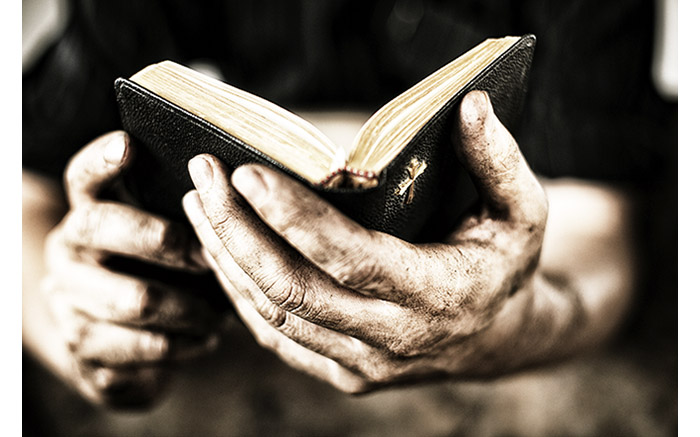
Top image credit: Photo close-up of a man devoutly reading from his Bible, from Bigstock.com, © by stocksnapp, stock photo ID: 6172854. Used with permission.
Dietrich Bonhoeffer (1906-1945) was a German Lutheran pastor and a founding member of the Confessing Church. He was the first of the German theologians to speak out clearly against the persecution of the Jews and the evils of the Nazi ideology. In spring of 1935 Dietrich Bonhoeffer was called by the Confessing Church in Germany to take charge of an “illegal,” underground seminary at Finkenwalde, Germany (now Poland). He served as pastor, administrator, and teacher there until the seminary was closed down by Hitler’s Gestapo in September,1937.
In the seminary at Finkenwalde Bonhoeffer taught the importance of shared life together as disciples of Christ. He was convinced that the renewal of the church would depend upon recovering the biblical understanding of the communal practices of Christian obedience and shared life. This is where true formation of discipleship could best flourish and mature.
Bonhoeffer’s teaching led to the formation of a community house for the seminarians to help them enter into and learn the practical disciplines of the Christian faith in community. In 1937 Bonhoeffer completed two books, Life Together and The Cost of Discipleship. They were first published in German in 1939. Both books encompass Bonhoeffer’s theological understanding of what it means to live as a Christian community in the Body of Christ.
He was arrested and imprisoned by the Gestapo in April 1943. On April 8, 1945 he was hanged as a traitor in the Flossenburg concentration camp. As he left his cell on his way to execution he said to his companion, “This is the end – but for me, the beginning of life.”