


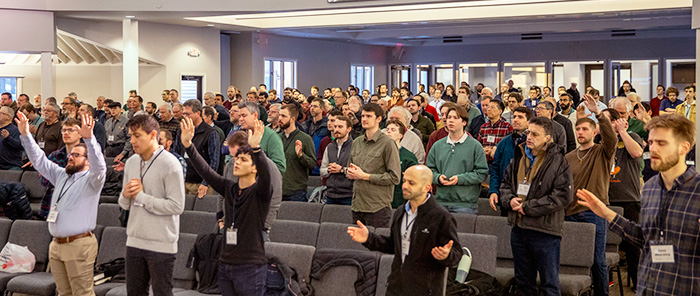
Intro: The following presentation was given at a recent weekend retreat in February 2026 for men from Sword of the Spirit communities located in Michigan and Indiana.
My name is Mark Fjelsted and I originally hail from God’s country – the beautiful state of Minnesota (USA). Nearly seven years ago, my wife Laura (of the Giles clan) and I packed our four children into the minivan and ventured East to join a little covenant community, called the Light of Christ, in Grand Rapids, Michigan. And it is here that the Lord has justified that call he put on our hearts, doing deep work in the hearts of my family and of our community.
Discipleship – the most noble calling of all
So here we are. 250 men, from different communities, different backgrounds, different stages of life, but all of us are here on retreat for the same reason. We said yes to something. At some point, each of us made a decision to follow Jesus. Not just to believe in him, not just to go to church, but to follow him. To be his disciple. This is the most noble, the most demanding, and the most rewarding thing any of us will ever do with our lives.
One of the things that really inspires me about the call to discipleship is that it does not discriminate. The downtrodden man who has lived a life of debauchery and sin is equally called, and equally capable of answering that call by God’s grace, as the man who has led the more socially acceptable life.
Jesus began his ministry at a time when it was common for Jewish religious teachers, or rabbis, to travel from place to place with their disciples. These disciples were followers dedicated to learning the ways and teachings of their rabbi.
A disciple, in this context, is not just someone who believes certain things about Jesus. A lot of people believethings about Jesus. A disciple is not someone who shows up on Sunday mornings and checks a box. A disciple is someone who has looked at Jesus and said: “I’m not just agreeing with you. I’m following you. I’m arranging my entire life around you.”
Think about the way Jesus actually called people. He didn’t hand out a pamphlet. He didn’t say, “Here are some ideas I’d like you to consider.” He said two words:
“Follow me.”
Matthew 4:19
That’s it. Follow me. Come with me. Walk where I walk. Live how I live. Learn from me. Become like me. That’s the invitation. It’s simple, but it’s total. And every single man in this room has, at some point, said yes to that invitation.
Some of you said yes decades ago. Some of you are still figuring out what that yes means in practice. It doesn’t matter. The call is the same. And it is the highest calling a human being can receive: to be personally invited by the Creator of the universe to walk with him, to learn from him, and to be transformed by him.
The Beatitudes: Jesus’ Portrait of a Disciple
So if that’s the call – to follow Jesus, to become like him – what does that actually look like? What kind of person are we becoming?
I want to take us to a passage that I think gives us the clearest answer to that question. It’s the very first major teaching Jesus gives in the Gospel of Matthew. He’s just begun his public ministry, crowds are gathering, and he sits down on a hillside and opens his mouth to teach. And the first thing out of his mouth is this:
“Blessed are the poor in spirit, for theirs is the kingdom of heaven. Blessed are those who mourn, for they shall be comforted. Blessed are the meek, for they shall inherit the earth. Blessed are those who hunger and thirst for righteousness, for they shall be satisfied. Blessed are the merciful, for they shall receive mercy. Blessed are the pure in heart, for they shall see God. Blessed are the peacemakers, for they shall be called sons of God. Blessed are those who are persecuted for righteousness’ sake, for theirs is the kingdom of heaven.”
Matthew 5:3–10
The Beatitudes
This is Jesus’ opening manifesto. His inaugural address. And I want to make a bold suggestion: that this is not a list of rules. It’s not a checklist of things to do. It’s a portrait. It’s a picture of the kind of person who is being transformed by God. And here’s the thing: it’s a self-portrait. It’s a picture of Jesus himself. He was poor in spirit. He mourned. He was meek. He hungered for righteousness. He was merciful. He was pure in heart. He made peace. He was persecuted. When Jesus describes the blessed life, he’s describing his own life.
And that is what discipleship is. It’s the process of having this portrait formed in us. It’s taking on the character of Jesus Christ.
These characteristics run afoul of what societal masculinity has often meant historically. And because we are not completely immune from the cultural influences around us, that same societal rot has, at times, even infiltrated some Christian circles and their opinion of masculinity. Pride, conquest, power, dominance, aggression, generational grudges, emotional suppression, fear of showing weakness, hyper-independence. Characteristics that are being modeled for us by the secular leaders of today give a giant middle finger to the Beatitude life.
A journey of transformation
Now, I don’t think the Beatitudes are random sayings of Jesus. I think there’s a movement to them – a progression. They describe a journey, and each step builds on the one before it. I want to briefly walk through them with you so we can individually consider “where am I on this journey?” Is the Holy Spirit tugging at your heart, or maybe even smacking you over the head, about a line or a color or a shape within this portrait? Then we’ll really dial in on one or two that I think are particularly important for us men.
“Blessed are the poor in spirit, for theirs is the kingdom of heaven.”
It begins here with honesty about our need. Poverty of spirit means recognizing that we are not self-sufficient. We cannot do this on our own. We need God. This is the doorway to everything else in the Christian life. Until a man is willing to say, “I need help. I can’t do this alone,” the journey hasn’t even really started.
“Blessed are those who mourn, for they shall be comforted.”
It moves through mourning – real grief. Grief over our own sin, over the brokenness of the world, over the distance between how things are and how God intends them to be. A disciple is not numb to what’s wrong. He feels it. He brings it to God. And Jesus says: that man will be comforted. Not by the world, but by God himself.
“Blessed are the meek, for they shall inherit the earth.”
Into meekness. And let’s be clear about what meekness is, because it gets badly misunderstood. Meekness is not weakness. Meekness is strength under God’s control. It’s power that has been surrendered. Think of a horse that has been broken. You don’t walk up to a horse and say, “You, sir, may attempt to kick me, because you are a weak horse.” It’s no less powerful, but its power is now directed, under authority. That’s meekness. The world says: assert yourself, push your way to the front. Jesus says: submit your strength to the Father. And he says the meek – not the aggressive, not the self-promoters – the meek will inherit the earth.
“Blessed are those who hunger and thirst for righteousness, for they shall be satisfied.”
Toward a deep hunger for righteousness. Notice the language. Not “interested in righteousness.” Not “curious about righteousness.” Hunger and thirst. This is aching desire. This is a man who doesn’t just want to know about God’s ways. He wants to live them. He chases holiness the way a starving man chases bread. And Jesus says: that man will be satisfied. God will fill him.
And then something shifts. The first four Beatitudes have been mostly about our inner transformation – our posture before God. Now the fruit starts to show on the outside.
“Blessed are the merciful, for they shall receive mercy.”
Producing mercy. As we’ve been broken open by poverty of spirit, as we’ve mourned and surrendered and hungered, mercy begins to flow out of us toward others. This isn’t forced or manufactured. It’s the natural fruit of having received mercy ourselves. A man who knows how much he’s been forgiven becomes a man who forgives.
“Blessed are the pure in heart, for they shall see God.”
Producing purity. Not perfection, but integrity. An undivided heart. Singleness of purpose. A man whose inner life and outer life are moving toward alignment. A man who is the same person at the retreat that he is at work, at home, and when no one is watching. And the promise? He will see God. Not just know about God. See him, encounter him, be in his presence.
“Blessed are the peacemakers, for they shall be called sons of God.”
Producing peace. And notice – it doesn’t say peacekeepers. Peacekeepers avoid conflict. Peacemakerswade into the mess and build reconciliation. This takes courage. It takes initiative. It takes sacrifice. It costs something. And the promise is stunning: they will be called sons of God. Our identity as God’s sons is connected to our willingness to do the hard, costly work of making peace.
“Blessed are those who are persecuted for righteousness’ sake, for theirs is the kingdom of heaven.”
And culminating in a willingness to endure persecution. The journey comes full circle. Notice the promise – it’s the same as the very first Beatitude: theirs is the kingdom of heaven. The man who begins in poverty of spirit and walks this whole road ends up with the same promise: the kingdom. A man who lives the Beatitude life will face resistance. He will be misunderstood. He will pay a price. But that’s not a sign something has gone wrong. It’s a sign he’s on the right road – the same road Jesus walked.
A brief thought on pride and humility: Poverty of spirit
What do we have that truly belongs to us? That we have truly earned of our own accord? All we have ultimately comes from God and belongs to him.
The Cost and the Gain
Now, let’s be honest with each other. Everything I have just described – that journey through the Beatitudes – it’s beautiful, but it is not easy. Embracing the struggle is a fundamental step in surrender to God. And there isa struggle. Discipleship costs something.
It’s not easy to be poor in spirit in a culture that rewards self-promotion. It’s not easy to be meek in a world that rewards aggression. It’s not easy to hunger for righteousness when there are a hundred easier things to hunger for. It’s not easy to be a peacemaker when it would be so much simpler to just walk away.
So yes, discipleship involves surrender. It involves sacrifice. It involves saying “no” to things the world says “yes” to.
Look at what we gain
Go back and read the promises attached to each Beatitude. The kingdom of heaven. Comfort from God himself. Inheriting the earth. Being satisfied, filled with righteousness. Receiving mercy. Seeing God. Being called sons of God. These aren’t small consolation prizes. These are the deepest longings of the human heart and Jesus says they belong to the man who walks this road.
There’s a line made famous to us modern folk by the missionary Jim Elliot, who was killed at the age of 28 bringing the Gospel to an unreached tribe in Ecuador. It can actually be found in writing as far back as the mid-1600s, and likely existed in concept for a long time before that, but I digress. We know it today because of Jim’s life and witness, and so in his honor, I recite what he wrote in his journal:
“He is no fool who gives what he cannot keep to gain what he cannot lose.”
Jim Elliot
That’s the economy of discipleship. We give up things we can’t keep to gain something we can’t lose.
What can’t we keep? Our self-sufficiency. It was always an illusion anyway. Our need to be in control. Our comfort-first approach to life. The world’s version of the “good life.” None of that lasts. None of it satisfies. We were never going to keep it.
And what can’t we lose? Everything Jesus promises in the Beatitudes. The kingdom. God’s presence. Our identity as his sons. The deep satisfaction of a life lived for something that matters. No one can take that from us. Nothing. Not hardship, not failure, not persecution can separate us from it.
This is not deprivation, brothers. This is exchange. We give up the smaller thing for the infinitely greater thing. And Jesus, at the end of the Beatitudes, tells us how we should feel about it:
“Rejoice and be glad, for great is your reward in heaven.”
Matthew 5:12
He doesn’t end with a somber warning. He ends with joy. The life of discipleship, even with its cost and even with its struggle, is the most joyful, most rewarding, most fully alive way a human being can live. It is a noble calling. The noblest there is.
There’s a well-known verse in the book of Hebrews that often gets used in the contexts, and I think we should use it too, but it captures what this retreat together is all about:
“And let us consider how to stir one another up to love and good works, not neglecting to meet together, as is the habit of some, but encouraging one another, and all the more as you see the Day drawing near.”
Hebrews 10:24–25
Stir one another up. That’s what we’re here to do. Not to sit and listen passively. Not to check out for the weekend. But to stir one another up. To love, to good works, to deeper discipleship. That’s what brothers do.
Different ages, different backgrounds, different stories, but the same call. These are your brothers. Not in a sentimental sense, but in a real, covenant sense. You have committed your lives to the same Lord and the same way of life.
The Beatitude life – the life I’ve been describing here is the life that many have already said yes to. Whether you’ve been walking this road for forty years or four months, you’re on it. And here’s the good news: you don’t have to walk it alone. That’s why it is important for brothers in the Lord to meet together regularly. That’s why we do retreats. That’s why we worship together, serve together, and meet in sharing groups together. Because the character of Christ is formed in us not just through private devotion but through shared life.
Top image credit: Sword of the Spirit All Michigan Men’s Retreat February 2026, photo © by Nico Angleys.
Mark and Laura Fjelsted and their four children live in Grand Rapids, Michigan USA.