



Many media outlets are reporting that “young adults” are returning to church at an unprecedented rate. Respected pollsters – including Gallup, Barna Group, and Pew Research – show that Gen Z and Millennials1 who already identify as Christian, are now attending in-person services twice as often as they did a few years ago.
While true, this return does not offset the dramatic losses of a few years ago. All of us remember how church attendance tanked in 2020 to 2022 during the pandemic period of six foot social distancing, wedding parties of five people, and closed churches. Pew surveys had 13% of Americans attending church in July of 2020.2 By November of 2022 that rebounded to 28%. Church attendance today averages 33% for both groups. (The boomers have not returned to their pre-COVID in person attendance rates, leading many analysts to note that church participation in the overall population is still flat.)
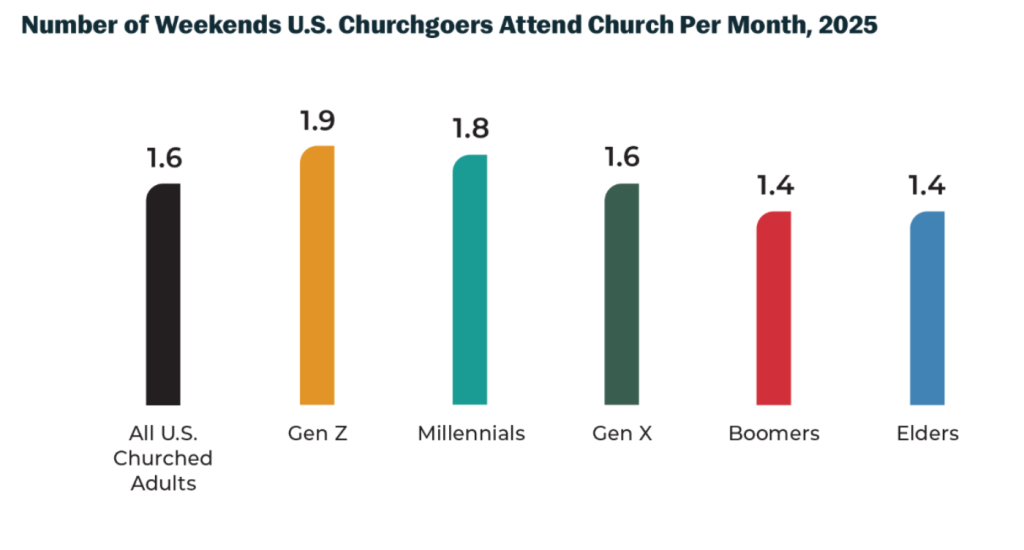
Regardless, for the first time in modern tracking, the youngest generation of church-goers is attending more often than their Elders, reversing the long‑standing pattern where older adults were the most regular attendees. Within the subset of the young Christians who do attend, their average frequency has increased from around once a month (during or just after the pandemic) to almost twice a month.
There are also many “eye-witness reports” from individual church leaders of an increase in the number of young adult men attending church, being converted, reverting, or just seeking something from Christianity. Christian media outlets and ministries interpret this as a “resurgence” or “great reversal,” arguing that it signals new spiritual openness, a search for truth and a desire for real, not digital, community, after years of isolation, secularization, PR spin and cultural upheaval.
Application
Some of you have GenZ grandchildren or even children in this age range. Ask them whether they have seen evidence of what USA Today and The New York Times are reporting – that young men are coming back to church but young women are leaving. Ask them why that might be true? Have they seen evidence of it? Then listen… and then listen some more. Your goal is not to instruct them. Your purpose is not to get them to change their minds. The most important transaction you can have in a conversation like this is: understanding them. See if they open the door to deeper conversation on what is happening spiritually with them.
Notes:
1 Gen Z are those born between 1997 and 2012, thus 14- to 29-year-olds. Millennials are those born between 1981 and 1996, thus 30- to 45-year-olds.
2 Most churches were closed in March of 2020 but reopened with significant social distancing in June.
This article, A Surprise Among Young Adults? Or Not? by Mike Shaughnessy, founder of Grandly, is excerpted from Grandly, dated February 2026. Copyright © 2022-2026 Grandly Missions, Inc.
To read more click below:
Top image credit: Kairos Christian university students worship together, photo courtesy of © Kairos EME 2026.
Mike Shaughnessy is a lifelong member of the Servants of the Word, an international ecumenical brotherhood of men living single for the Lord. He is a prolific writer. He has written extensively about youth work and currently leads Grandly, a ministry helping grandparents pass on their faith to their grandchildren. He lives in Lansing, Michigan USA.