


Wake up, O man – it was for you that God was made man! Awake, O sleeper, and arise from the dead, and Christ shall give you light. For you, I say, was God made man. Eternal death would have awaited you had he not been born in time. Never would you be freed from your sinful flesh, had he not taken to himself the likeness of sinful flesh. Everlasting would be your misery, had he not performed this act of mercy. You would not have come to life again, had he not come to die your death. You would have broken down, had he not come to help. You would have perished, had he not come.
Let us joyfully celebrate the coming of our salvation and redemption. Let us celebrate the hallowed day on which the great eternal day came from the great eternal day into this, our so short and temporal day. He has become our justice, and our sanctification, and our redemption. And so, as scripture says: “Let him who glories, glory in the Lord.”
Truth, then, is sprung out of the earth: Christ who said, “I am the truth,” is born of a virgin. And justice looked down from heaven: man, believing in him who has been born, has been justified not by himself, but by God.
Truth is sprung out of the earth, for the Word was made flesh. And justice looked down from heaven, for every best gift, and every perfect gift, is from above.
Truth is sprung out of the earth – flesh born of Mary. And justice looked down from heaven, for a man cannot receive anything, unless it be given him from heaven.
Being justified by faith, let us have peace with God, for justice and peace have kissed each other, through our Lord Jesus Christ, for Truth is sprung out of the earth. Through him we have obtained access to this grace in which we stand, and we glory in our hope of sharing the glory of God. Saint Paul does not say, “our glory,” but “the glory of God” – because justice does not proceed from us, but has looked down from heaven. Let him who glories then, glory, not in himself, but in the Lord. Because of this, when the Lord was born of the Virgin, the angels announced, “Glory to God in the highest; and on earth peace to men of good will.”
Whence is peace on earth, if not from the fact that Truth is sprung out of the earth, that is, Christ is born of flesh? And he is our peace, who has made both one, that we might be men of good will, bound together by the sweet bonds of unity.
Let us, then, rejoice in this grace, that our glory may be the testimony of our conscience, and we may glory, not in ourselves, but in the Lord. Obviously, it was because of this that it was said, ‘my glory, who lifts up my head’.
For what greater grace could have dawned upon us from God, than that he, who had only one Son, made him the son of man, and so in turn made the son of man a son of God. Ask yourself whether this involved any merit, any motivation, any right on your part; and see whether you find anything but grace!
This excerpt is from a sermon by Augustine of Hippo.
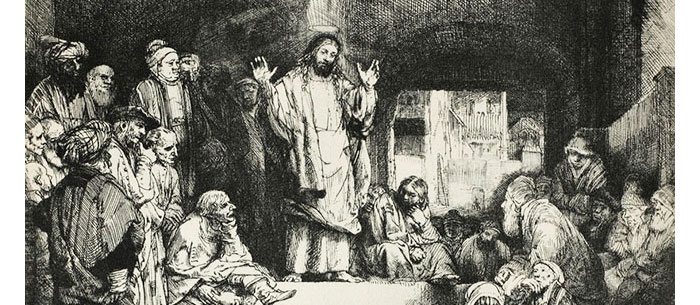
Top image credit: Christ preaching to the people the good news of the kingdom of heaven, etching by Rembrandt, image in the Public Domain.
Aurelius Augustine was born in 345 in the town of Tagaste, in Roman North Africa, in what is today Algeria. His mother was Monica, a very devout Christian who had a significant influence on her son’s life. His father, named Patricius, was a pagan of significant status in society. Patricius became a Christian shortly before his death.
Augustine was educated at Carthage where he enjoyed academic success. He also enjoyed the party life, and at the age of 17 fell in love with a woman whom he never named. They lived together unmarried for 13 years and had a son whom Augustine named Adeodatus, meaning “gift from God.” His son died in his youth.
At the age of 19, after reading Cicero’s Hortensiusat, Augustine fell in love with philosophy. He later wrote, “It gave me different values and priorities. Suddenly every vain hope became empty to me, and I longed for the immortality of wisdom with an incredible ardour in my heart.” While he pursued Platonic philosophy and the theology of the Manichaens, a Christian heretical sect, he became restless for truth and virtue. Shortly before his 30th birthday, Augustine encountered Ambrose, the saintly bishop of Milan. Augustine was moved by Ambrose’s example and his inspired teaching and preaching of the gospel. At the age of 32 Augustine found peace with God and was baptized by Ambrose during the Easter liturgy in 387. Augustine returned to North Africa and formed a monastic community with a group of friends. He was ordained a priest in 391 and became a noted preacher. In 396 he reluctantly became a bishop and remained the bishop of Hippo until his death in 430. He left his monastic community, but continued to lead a monastic life with the parish priests of Hippo in his episcopal residence. Augustine died on August 28, 430, during the siege of Hippo by the Vandals.
Augustine was a prolific writer and original thinker. His numerous writings, including theological treatises, sermons, scripture commentaries, and philosophical dialogues, number into the hundreds. His autobiography, the Confessions, was considerded the first Western autobiography. It was highly read among his contemporaries and has continued as a classic throughout the ages.
Augustine is one of the most important figures in the development of Western Christianity. He is esteemed as a great Latin church father and a Doctor of the Roman Catholic Church. Many Protestants consider him to be one of the theological fathers of Reformation teaching. Among Orthodox he is called St. Augustine the Blessed.