


In dialogue with God through his words
The word of God draws each of us into a conversation with the Lord: The God who speaks teaches us how to speak to him. Here we naturally think of the Book of Psalms, where God gives us words to speak to him, to place our lives before him, and thus to make life itself a path to God. In the Psalms we find expressed every possible human feeling set masterfully in the sight of God; joy and pain, distress and hope, fear and trepidation: here all find expression.
Along with the Psalms we think too of the many other passages of sacred Scripture which express our turning to God in intercessory prayer (cf. Exodus 33:12-16), in exultant songs of victory (cf. Exodus 15) or in sorrow at the difficulties experienced in carrying out our mission (cf. Jeremiah 20:7-18). In this way our word to God becomes God’s word, thus confirming the dialogical nature of all Christian revelation, and our whole existence becomes a dialogue with the God who speaks and listens, who calls us and gives direction to our lives. Here the word of God reveals that our entire life is under the divine call.
The word of God and faith
25. “‘The obedience of faith’ (Romans 16:26; cf. Romans 1:5; 2 Corinthians 10:5-6) must be our response to God who reveals. By faith one freely commits oneself entirely to God, making ‘the full submission of intellect and will to God who reveals’ and willingly assenting to the revelation given by God.”76 In these words the Dogmatic Constitution Dei Verbum gave precise expression to the stance which we must have with regard to God. The proper human response to the God who speaks is faith.
Here we see clearly that “in order to accept revelation, man must open his mind and heart to the working of the Holy Spirit who enables him to understand the word of God present in the sacred Scriptures.”77
It is the preaching of the divine word, in fact, which gives rise to faith, whereby we give our heartfelt assent to the truth which has been revealed to us and we commit ourselves entirely to Christ:
“Faith comes from what is heard, and what is heard comes from the word of Christ.”
Romans 10:17
The whole history of salvation progressively demonstrates this profound bond between the word of God and the faith which arises from an encounter with Christ. Faith thus takes shape as an encounter with a person to whom we entrust our whole life. Christ Jesus remains present today in history, in his body which is the Church; for this reason our act of faith is at once both personal and ecclesial.
Sin as a refusal to hear the word of God
The word of God also inevitably reveals the tragic possibility that human freedom can withdraw from this covenant dialogue with God for which we were created. The divine word also discloses the sin that lurks in the human heart. Quite frequently in both the Old and in the New Testament, we find sin described as a refusal to hear the word, as a breaking of the covenant and thus as being closed to God who calls us to communion with himself.78
Sacred Scripture shows how man’s sin is essentially disobedience and refusal to hear. The radical obedience of Jesus even to his death on the cross (cf. Philippians 2:8) completely unmasks this sin. His obedience brings about the New Covenant between God and man, and grants us the possibility of reconciliation. Jesus was sent by the Father as a sacrifice of atonement for our sins and for those of the whole world (cf. 1 John 2:2; 4:10; Hebrews 7:27).
We are thus offered the merciful possibility of redemption and the start of a new life in Christ. For this reason it is important that the faithful be taught to acknowledge that the root of sin lies in the refusal to hear the word of the Lord, and to accept in Jesus, the Word of God, the forgiveness which opens us to salvation.
This article is excerpt from Verbum Dei, paragraphs 24-26, by Pope Benedict XVI, original source from the Vatican website.
Notes:
- Second Vatican Ecumenical Council, Dogmatic Constitution on Divine Revelation Dei Verbum, 5.
- Propositio 4.
- For example: Deuteronomy 28:1-2,15,45; 32:1; among the prophets, see: Jeremiah 7:22-28; Ezekiel 2:8; 3:10; 6:3; 13:2; up to the latest: cf. Zechariah 3:8. For Saint Paul, cf. Romans 10:14-18; 1 Thessalonians 2:13.
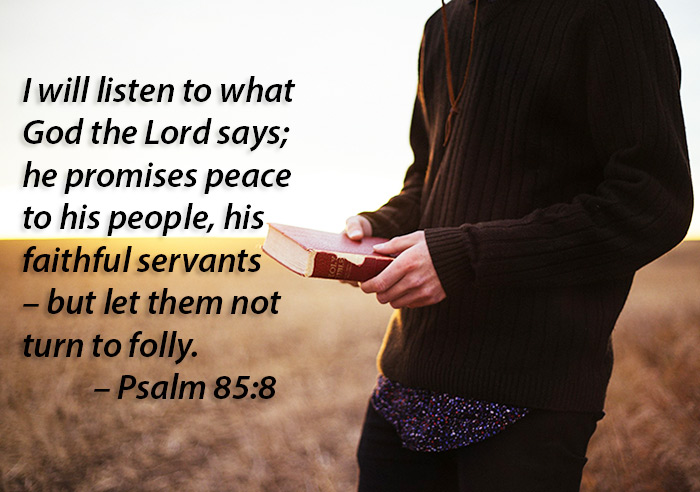
Top image credit: Photo of a young person holding a Bible, © by Priscilla Du Preez 🇨🇦 on Unsplash. Free to use under the Unsplash License. Quote from Psalm 85:8 added.