


The human
Day three and day six correspond to one another in the order of account of creation because they both have two acts of creation, not just one. On day three God makes earth (the dry land) appear, separated from the sea, and then in a second action God creates plants to cover it. On day six God creates the land animals and then in a separate action creates human beings to rule the fish, birds, and animals. Days three and six seem to be a center of focus toward which the account is leading. On the third day the place of main concern, earth (dry land) covered with plants, the source of animal life (Genesis 1:29–30), is created. On the sixth day, the living beings of main concern, land animals and human beings, are created. The goal of the work of which God did in creation (Genesis 2:3) is human beings who live with animals on the vegetation-covered earth.
The completion of the work of creating material beings in Genesis 1, then, occurs in the second part of the sixth day with the creation of the human race. Not only does it describe the last act of creation, but it is also the lengthiest account and one that is special in several ways. It begins this way:
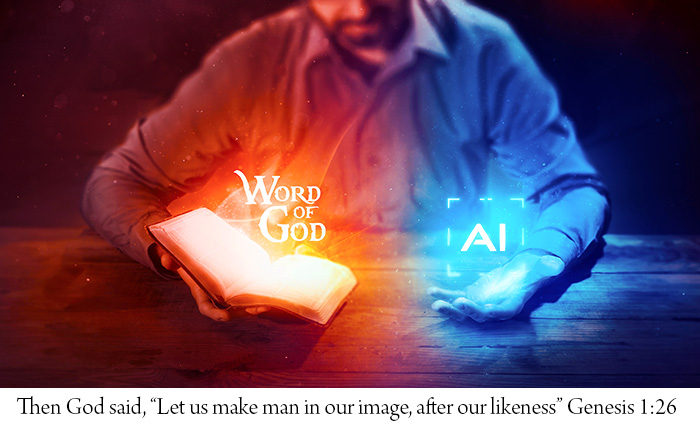
Then God said, “Let us make man in our image, after our likeness; and let them have dominion over the fish of the sea, and over the birds of the air, and over the cattle, and over all the earth, and over every creeping thing that creeps upon the earth.” So God created man in his own image, in the image of God he created him; male and female he created them. And God blessed them, and God said to them, “Be fruitful and multiply, and fill the earth and subdue it; and have dominion over the fish of the sea and over the birds of the air and over every living thing that moves upon the earth.”
Verse 26 [RSV] says, Let us make man in our own image. The Hebrew word translated as “man” is “‘adam.” “Adam” can be used as a corporate term in Hebrew, meaning “human race” or “humanity,” as well as the proper name of an individual human being. Sometimes, in fact, the word translated in the RSV as the proper name “Adam” is translated by others as just “human,” because the meaning of the name of the first human being in Hebrew is “human.”
In addition, the text shifts back and forth from the singular to the plural: Let us make man in our image, after our likeness; and let them have dominion over the fish of the sea, and over the birds of the air. God created man in his own image, in the image of God he created him; male and female he created them. The word adam, then, is the antecedent of both a singular and a plural pronoun. This implies that Adam was an individual, but he also was humanity. This first individual human being sums up and represents – and begins – the whole human race.
Adam, then, is “The Human.” Throughout the Scripture a name often reveals something of the identity and significance of the person (as the name Abraham means “the father of the people” and the name Joshua or Jesus means “the one who brings salvation”). So the name of this particular individual – Adam, Human – indicates who he is. He is the human race, the beginning of the human race, the head of the human race, and the father of the human race. He is, simply put, “The Human Being.”
Two truths
In this text we have two facts about the way Adam is created and therefore about the way the human race is created: first, that the human race is created in the image of God, and second, that the human race is created male and female. These are the two primary truths that we are told about God’s creation of the human race: God created man in his own image … male and female he created them (Genesis 1:27).
These two facts are connected in a parallelism to two commands. The first command is, Have dominion over the fish of the sea and over the birds of the air, and over the cattle, and over all the earth, and over every creeping thing that creeps upon the earth (Genesis 1:27). This first command, to rule or exercise dominion, is connected to the first fact: The reason that the first human beings can and should rule is because they are created in the image of God and so are capable of representing God. Human beings, the human race, were created to share God’s rule over his creation.
We can see something of what it means to be in the image of God by looking at Genesis 5:3, where we have a reference to the birth of Seth, born as the son of Adam and described as in Adam’s “image and likeness.” Image and likeness, when used in regard to human beings, can be a way of speaking about sonship and so a sameness of nature. Therefore, as Seth was the son of Adam, Adam (the human race) was the son of God.
Such an understanding can also be found in the Gospel of Luke, which traces Christ’s genealogy back to Adam, and then traces Adam’s back to God himself. Luke makes God part of the genealogy, concluding the genealogy by saying: … who was the son of Adam, who was the son of God (Luke 3:38). The reference to image and likeness in Genesis 1:26, then, is an indication that Adam is created to be the son of God and to be like God as a son is like his father.
To see what is involved for a human to be in the image of God, we should begin by looking at what God is like in Genesis 1, the text that describes human beings as in God’s image. God orders creation. He determines what things are and how they are to act. He names them and so can identify them. He speaks in a personal way to those who are capable of understanding speech. He acts with a purpose in mind, a final vision of what he is trying to bring about. The result of his action is good.
To be in the image of God does not mean that we are omnipotent, omniscient, omnipresent, that is, all-powerful, all-knowing and everywhere present, and so on. If we were, we would be God, not one of his creatures. We do not have the same (divine) nature as he has. But we are nonetheless like him. To be created according to God’s image is to be like him in the ways he acts in Genesis 1, that is, to be a rational agent, an agent who can act with wisdom and understanding, deliberately bringing about a good world.
There is, however, another aspect of being in the image of God that we might miss. It does not have to do solely with intelligence and with power to do things, but also with good character. Good character is the developed orientation to seeking that the things we do are good (desirable). It especially involves seeking that the things we bring about are morally good (desirable because they uphold the good order of the universe). We can see this in the book of Colossians in an exhortation about being in the image of God:
Do not lie to one another, seeing that you have put off the old nature [literally, old human being] with its practices and have put on the new nature [literally, new human being], which is being renewed in knowledge after the image of its creator.… Put on then, as God’s chosen ones, holy and beloved, compassion, kindness, lowliness, meekness, and patience, forbearing one another and, if one has a complaint against another, forgiving each other; as the Lord has forgiven you, so you also must forgive. And above all these put on love, which binds everything together in perfect harmony.
Colossians 3:9–14
This exhortation begins with encouragement to put off the old nature, the one we are born with, and put on the new nature. The new nature is one that is renewed after (in accordance with) the image of God. Then, when the passage continues to explain what that is like, we have a list of good character traits, moral virtues, traits that God has and that we need to have if we are in his image. Therefore, the human race, if it is renewed in the image of God, should be like him in his character and as a result make use of the power and authority that God gives to order the world in a good way, a moral way, a beneficial way. If we make use of our nature to rule but rule in a bad way, we may not have destroyed but we have certainly marred the image of God in us – as fallen human beings regularly do.
Many of the early Christian Fathers distinguished between the image and the likeness of God in human beings. They understood the image of God as the nature given us and the likeness of God as something we need to attain by growth in character. In such an understanding, we are in the image of God, but we need to grow in the likeness of God.
The extent of good human responsibility in a situation, then, depends on the extent to which we are like God in the way we exercise the responsibility we have been given. The more like God we become in the way we act, the more we do what is good, the more effectively we can govern as his representatives, bringing creation to the purpose for which he made it. Our exercise of the authority God has given us has important consequences for what happens on earth, and if we exercise this authority the way he would, we will see good results, results that will fulfill what his purpose was in creating the world in the first place.
The second command to the first human beings is be fruitful and multiply and fill the earth. The second command is connected to the second fact, namely that the human race is created male and female. After human beings are created male and female, they are commanded to be fruitful and multiply. The creation of sexual differentiation is connected to the command to be fruitful and multiply, or, as we might put it, a primary purpose of sexual differentiation, certainly the primary purpose according to Genesis 1, is to have children. That in turn should result in human beings filling the earth.
It is not only human beings that are created male and female. The animals are as well. Being male and female is a characteristic human beings share with the animals, a manifestation of their animal nature, because both humans and animals reproduce sexually. God, on the other hand, is not male and female. Unlike human beings and the rest of the animal kingdom, unlike Pagan gods, he does not increase and multiply. There is only one God and never will be another.
To say that human beings were created male and female is to say that they, unlike God, but like the animals, can and should have offspring in order to fulfill the purpose for which God created them. Being male and female, the second fact in this passage contrasts with being in the image and likeness of God, the first fact in the passage.9 Both put together say that we are animals (with emphasis on the way that we, like other animals, reproduce), but at the same time transcend animality by our rationality. To use another biblical wording, we are both earthly and heavenly in the way we were created.
The second command also tells us something important about the developmental role of human beings in God’s creation. God created Adam and Eve good in themselves, and he created both of them in his image and likeness. But he did not create them in a way in which they could fulfill his command to rule the earth all by themselves. They had to increase and multiply and fill the earth with a race of human beings. This would take time. In other words, the human race was made to complete God’s work of creation and, in a process of development, to make his creation as a whole into what he intended it to be. The world was not created perfect or complete – although it was created good in principle – but was created to eventually become completely what God had in mind.
The connection of the two commands to the two facts about human nature shows us something additional about the way God’s commands function. God commands us to do things that are in conformity to the way we are made. His very first two commands are not just arbitrary requirements, but follow from the nature of human beings. We cannot say that all of God’s commands can be tied precisely to the way we are created. In fact, we shall see in the next chapter of Genesis that he does give a command that does not seem to be tied to our nature. But for the most part God’s law is a reflection of his creation. His commands are not usually arbitrary or simple tests of obedience. And the most important ones are not commands just to deal with a temporary situation. They are for our own good and the good of others, given to enable us to express, by how we act, the way in which we are created, and they enable us to accomplish the purpose for which we and the things around us were created.
This illustrates another important fact about God’s creation. Genesis 1 could seem as if God simply does everything that needs to be done: he speaks the word and creation simply comes into existence. But Genesis 1 makes equally clear that there is more to it. The plants bring forth seeds that become more plants; the birds, fish, and other animals increase and multiply; the human beings do likewise. All his creatures take an active role in furthering the work of creation.
God brought into existence a set of creatures, a part of his creation, to represent him by ruling over that creation on his behalf. He made those creatures with an animal nature and so capable of reproducing so they could gradually fill the earth. And he made them capable of ruling over creation by bestowing on them his image and likeness. As the corporate son of God, the human race was to be God’s viceroy in creation.
Presumably, God put the human race in such a position so that in a certain way creation could develop itself, since human beings were part of creation and could act as created beings, who could lead in the development of creation – although, of course, not without God’s providential sustaining power. But he constituted them in such a way that they would not rule by their own arbitrary or selfish decision, but as his ministers, ruling according to true wisdom, the wisdom that God gives to those he made in his image and likeness to be partners with him in bringing creation to its full purpose.
Let us . . .
There is another feature of the text on the creation of the human race that seems small, but that has been the source of much discussion. The passage starts off by saying, Then God said, “Let us make man …” This itself marks off the creation of the human race from the rest of creation as something of special importance. Instead of just commanding something to come to be, God addresses “us” and calls “us” to make man. This, however, raises the question: to whom is he referring when he says “us”?
There have been a number of proposals about the “us,” both over the centuries and now in scholarly writings. None of these has received universal agreement, especially among modern scholars. One of the better proposals is that God is here addressing his heavenly court, made up of angels, the hosts of heaven. This has the advantage that the rest of the Bible has many references to such beings. It has, however, the difficulty that these beings have not been mentioned in Genesis 1 as either created or involved in creation. It would be strange to just refer to them as if readers – perhaps readers who are reading the Bible for the first time and start at the beginning – would understand that the members of his heavenly court were the “us.” Moreover, they are never spoken of as involved in the work of creating human beings.
The Medieval theologian Thomas Aquinas, representing a common view, held that this opinion was “perverse.”10 He said this because most traditional Christian interpreters saw “us” as a reference to the Trinity. This view has the significant advantage, especially over understanding the reference being to the angels, that the “us” is involved in an act of creation, and the Hebrew verb for “create” (at least in the forms used in our passage) is only used of God. Moreover, after speaking of creating the human race in “our” image and likeness, the text speaks of the fact that the human race was created in the image of God. Such a phrasing has the consequence that the “us” was God. In other words, as Aquinas thought was important, the “us” has to be divine. As a result, the passage lets us know that there is some kind of plurality in God.
We do not have to see Aquinas’ view as any more than a common Christian interpretation. We do not have to see it as the only one interpretation a Christian teacher can take and be a faithful Christian teacher. However, it is likely the leading interpretation in Christian tradition, deserving of special respect. More important for our purposes here, it shows the importance Christian teachers have placed upon the fact that human beings are created in the image and likeness of God.
God’s good work
After the creation of the human race, God establishes the relationship of the human race (and of all animals) to the plant kingdom:
And God said, “Behold, I have given you every plant yielding seed which is upon the face of all the earth, and every tree with seed in its fruit; you shall have them for food. And to every beast of the earth, and to every bird of the air, and to everything that creeps on the earth, everything that has the breath of life, I have given every green plant for food.” And it was so. And God saw everything that he had made, and behold, it was very good. And there was evening and there was morning, a sixth day. (Genesis 1:29–31)
This passage describes God’s provision for human beings (and animals). God provides for human beings as a father provides for his children (and his domestic animals), in this case giving them food. In fact, several elements of God’s fatherly care are shown in this chapter. He provides a place for the human race to live; he gives them work, the responsibility of ruling the material creation; he calls them to take his place of authority; and finally he gives them physical provision.
At the end of God’s work of creation, which was accomplished in the six days, the text says, And God saw everything that he had made, and behold, it was very good. The results of all he did were very good, not only intrinsically worthwhile but also fulfilling the purpose he set out to accomplish.
The goodness of all creation is an important Christian (and Jewish) teaching, one that has often been a point of controversy. In the early church, one of the greatest heresies was Gnosticism, and a fundamental tenet of many forms of Gnosticism was that the created, material world was evil. However, the Christian teaching is that all creation, including the material world, was good when it first came from the hand of God. The origin of evil in human history first comes up in Genesis 3, and we will discuss that in the next chapter
THE SEVENTH DAY
The first three verses of the second chapter of Genesis form a literary unit with the first chapter. They have the same style and also connect by content with the material in chapter 1. They describe the last day of the week of creation:
Thus the heavens and the earth were finished, and all the host of them. And on the seventh day God [had] finished his work which he had done, and he rested on the seventh day from all his work which he had done. And [RSV: so] God blessed the seventh day and hallowed it, because on it God rested from all his work which he had done in creation.
The text then adds, as we have seen:
These are the generations of the heavens and the earth when they were created.
The generations of the heavens and the earth seems to mean the elements – or elements in a series – that made up the heaven and earth.
Creation is here presented as having lasted a week. The seventh day comes at the very end of the section we are referring to as Genesis 1. When God created the world, he worked for six days until he finished his creation of heaven and earth, and then he rested (ceased) on the seventh from all his work which he had done.
But what did God do when he “rested” on the seventh day? With modern ideas of rest, we might be tempted to think he slept in to recover from his work week, or at least took a long nap, or perhaps headed for the beach. But a study of the use of “rest” in the Scriptures shows that it does not usually imply inactivity, much less engaging in entertainment or refreshing recreation. Therefore, here it most likely does not refer to complete inactivity but to a different sort of activity than “work” does.
“Rest,” the translation of two different words in the Hebrew Bible that are rough synonyms (see Gen 2:2–3 and Ex 20:11 where the two Hebrew verbs are interchanged), is used in a somewhat different way than in ordinary English. As in English these words can be used for ceasing work, mainly for ceasing difficult or laborious work. In Isaiah 14:3, the Hebrew Bible describes a rest God would give his people as “rest from your pain and turmoil and the hard service with which you were made to serve.”
“Rest” in Scripture is especially used to speak about the state in which an individual or people has become free from enemy attack, either because they have fended it off and so been victorious or because the enemy has lost the ability to be dangerous. For instance, Second Samuel 7:11 reads, and I will give you rest from all your enemies. Fighting, whether in attack or defense, was a very strenuous effort. To say, then, that God rested on the seventh day seems to imply that he was able to cease from what we would understand to be the difficult or burdensome work of bringing the creation he wanted into existence, perhaps with a certain amount of fighting.
“Rest,” however, is commonly used in a broader way in the Bible. It is used, for instance, for the kind of rest that involves creating a space for celebration. Esther 9:17 describes the celebration after the deliverance of the Jewish people by saying, And on the fourteenth day they rested and made that a day of feasting and gladness. In other words, resting (from work or fighting) creates a space for feasting and gladness. Many overlook the important truth that the sabbath day in the Jewish calendar is a feast day – the primary feast day (Lev 23:1–3) – and so is not “a day off,” but a day of celebrating the goodness of the Lord.
“Rest” can even be used as a synonym for delight (enjoying a good result that is finished). Proverbs 29:17 says, Discipline your son, and he will give you rest; he will give delight to your heart. In Genesis 1:31 we possibly see a similar indication as to what God did on the sabbath feast day. There it says, And God saw everything that he had made, and behold, it was very good. In other words, at the end of the sixth day, he had completed his work of creation and, so to speak, stepped back, looked at it, and was satisfied with what he had done. He then took a day to rejoice or to celebrate or to delight in what he had done. To say that God rested on the seventh day therefore seems to indicate that it was a time for God to contemplate and enjoy a successful accomplishment after striving, even fighting, to reach his goal.
Genesis 2:3 adds that God blessed and hallowed (made holy) the seventh day. This could mean that he set it apart for a special purpose. He made it a special day, the way he set apart feast days for special observance (cf. Nehemiah 8:9, 11). We probably most naturally think that the phrase blessed and hallowed means he set the seventh day of our week apart so that we would observe it as a day of rest.
Certainly God has set apart the sabbath for a day of rest, for the Jews especially, but also for Christians. We find the commandment to do so in Exodus 20:8–11 when he requires it as part of the law. This commandment is linked to the fact that God rested on the seventh day:
Remember the sabbath day, to keep it holy.… for in six days the LORD made heaven and earth, the sea, and all that is in them, and rested the seventh day; therefore the LORD blessed the sabbath day and hallowed it.
The reason for the observance provided in the text is the Lord’s example, and this has been a very common reason given for God’s action as described in the Genesis 1 account of creation. God, in this view, intended to give a good example of resting after a work week, and we therefore should follow that example.
But Genesis 2:1–3 does not contain a command to do likewise. It does not tell us to set apart one day in seven for a day of rest. That only comes after the Exodus, when God provided manna for his people in the wilderness (Exodus 16:22–30) and then when he commanded them to observe the seventh day as a sabbath to the Lord (Exodus 20:8–11). This likely indicates that the main significance of the hallowing of the seventh day of Genesis 1 has to do with God and not with us, even though later on it was to be taken as an example to imitate.
To hallow or to “make holy” or to “consecrate” or to “sanctify” – all possible translations of the Hebrew verb with slightly different connotations in English – can mean to set something created apart for God. Setting something apart makes it a holy thing, something that especially belongs to God. But something becomes holy not only when human beings set it apart for God, but also when he becomes spiritually present in it, as when he becomes present in a temple. In this case it is made holy by his presence, as the Lord, speaking of the door of the tent of meeting, said,
There I will meet with the people of Israel, and it shall be sanctified by my glory; I will consecrate the tent of meeting and the altar. (Exodus 29:43)
If this is an aspect of the meaning of hallowing the seventh day, the fact that God hallows the seventh day would indicate that he becomes especially present in it. This meaning would also go along with the fact that he blesses and hallows the seventh day. We can see in Exodus 33:14 that God’s presence is a source of blessing and rest.
Making the day holy then is connected to God’s rest on the seventh day. When someone or something spiritual becomes present in some place or thing, especially when they become present in an ongoing or abiding way, they are said, in the Hebrew idiom, to “rest” there. Such an idiom is commonly used of temples. When God established a tabernacle or temple, he then came to rest in it and dwell in it (Exodus 40:34–35; 1 Kings 8:10–11, Psalm 132:5, 8), hallowing it, setting it apart as something that was especially his. In so doing he filled it with his presence and power, and from it came salvation and blessing for his people (Psalm 132:13–18).
The fact that God rests (dwells) in a temple is significant for understanding the seventh day because in the Torah the old covenant teaching from God, the temple and the sabbath are connected. In Leviticus 19:30 it says, You shall keep my sabbaths and reverence my sanctuary: I am the LORD, linking the two as if they were similar holy things. The laws in Exodus about the building of the tabernacle are linked with laws about keeping the sabbath (Exodus 31:12–18; 35:1–3), indicating that the two are related. The likely implication is that the sabbath is like a temple in time, that is, a time when God is especially present. It, then, is the time when the purpose of a temple is most fully achieved and the time when those who observe the sabbath receive blessing from God.
Finally, the description of the completion of the temple seems to contain allusions, or at least parallels, to the completion of the work of creation.11 If that is so, then creation itself is intended to be a kind of temple, a place where God intends to dwell. This truth is expressed more directly in Isaiah 66:2, a passage that will be discussed in the next section. These considerations about God’s seventh day rest might well indicate that the seventh day of creation is a time when God rests in his creation and makes it holy. These considerations raise the question: when did God begin to dwell in the temple of his creation?
The sabbath and the age to come
The most common interpretation of the seventh day given now by Christian teachers is as a description of God ceasing work and resting at the end of the first week of creation, a time in the distant past. From that is taken the understanding that we are to imitate him in observing the sabbath once a week, and he will bless our doing so. But there is another view of the seventh day in Genesis 1, namely, that it refers to something that has not yet happened: the age to come. God’s work of creation is not yet completed, but will be in the age to come.
There is a special feature of the text that seems to point toward the seventh day as something that will happen in the future. All the days so far in Genesis 1 have been described by saying there was evening and there was morning, a limited period of time. But there is no evening and morning on the seventh day. Some traditional commentators have said that this indicates that the seventh day is an eternal day. In addition, the text, though similar, is also quite different from the texts of the previous days. It simply says three times, emphatically, without the usual features of the descriptions of the other days, that God ceased from his work, indicating that the work of creation was now all done.
Many have interpreted these things to mean that the seventh day is an image or symbol, perhaps even a prophecy, of the age to come. In such a view, we are in the sixth day.12 And there is something yet to come, something that will last for all eternity: the day of God’s rest.
This understanding seems to be stated in some places in the New Testament. Christ himself spoke about God “still working.” He said, My Father is working still, and I am working (John 5:17). He said this after having healed the paralytic on the sabbath (and also having warned him not to sin again). In doing this he was imitating his heavenly Father who even on sabbaths now brings human beings into existence and judges them, as Jewish teachers of the time would admit. But, he said, the hour is coming (John 5:28–29) when there will be a last judgment. This seems to imply that after the Christ comes again and summons the dead from the tombs, God will then cease from his work—at some future time.
Likewise, Second Peter, after describing the Second Coming of Christ, which brings the day of God, the new heavens and new earth, concludes with a doxology to Christ,
But grow in the grace and knowledge of our Lord and Savior Jesus Christ. To him be the glory both now and to the day of eternity. Amen. (3:18)
The day of eternity probably refers to the age to come that occurs after the redeeming work of Christ will be completed. The view presented in these passages builds upon a prophecy in Isaiah. Isaiah 65:17–25 speaks of the new creation, the new heaven and the new earth to come, and then in Isaiah 66:1–2, the Lord, probably speaking of the dispensability of the earthly temple building, says:
Heaven is my throne and the earth is my footstool; what is the house which you would build for me, and what is the place of my rest? All these things my hand has made, and so all these things are mine, …
In other words, the heaven and the earth are a temple in which the Lord rests, that is, a temple in which he dwells and from which he rules, seated on his throne. If the Lord speaks of heaven and earth (the cosmos) as a temple, then the seventh day of Genesis 1, the day of the completion of his creation, is the day on which he rests in the temple of the cosmos.
In such a view the seventh day then would be the day of the new creation in which God dwells or takes up his full residence in all of creation, having completed his work of bringing it into existence, filling it or ruling it, so that it is fully his and fully pleasing to him (Rev 21:1–8). It is the age to come when all of his creation is fully a holy place in a holy time, the day when he will be everything to everyone or all in all (1 Corinthians 15:28).
It is perhaps not common for Christians or Jews now to look at the seventh day of Genesis as a symbol or prophecy of the age to come. Many Jews, however, have done so. In the time of the second temple in Jerusalem, during the liturgy of the daily offering, “On the Sabbath they [the Levite singers] sang A psalm: a Song for the Sabbath Day, a Psalm, a song for the time that is to come, for the day that shall be all Sabbath and rest in life everlasting” (Mishnah, Tamid 7:4). Many of the Christian Fathers have done so as well. For example, Ephrem, the Syrian Church Father, said of the seventh day in Genesis, “It was given to them in order to depict by a temporal rest, which he gave to a temporal people, the mystery of the true rest, which will be given to the eternal people in the eternal world” (Commentary On Genesis 1.32–33.2).
We can therefore see the seventh day as the completion of God’s work of all creation – when he does not just rest in a single place (a temple) or on a single day to be present to bless his people as he does in the old covenant (and in a different way in the new covenant). Rather, he rests or fills all of his creation, making it his, making it holy, and making it something that is completely according to his will, completely his kingdom, completely a realm of blessing. We will see the significance of this in chapter 11 of our study, when we look at the end of the book of Revelation.
Genesis 1 is a mysterious part of Scripture. It first of all speaks about the beginning, so it is not surprising to find it speaking in a hidden way of all of God’s work of creation. But the end is the time when the beginning is fully established and complete, so it would not be surprising to find it speaking of the end as well. We might add that the first and the last together are a scriptural designation of God as Creator of everything (e.g., Isaiah 44:6; Revelation 22:13), the one who begins all things and brings them to completion.
Moreover, as we have seen, the first chapter of Genesis is presented in the form of an orderly account. It is described as a week of seven days, and it is encoded with the number seven, the number of completeness or perfection.13 The use of the number seven for the seventh day, then, indicates the complete and perfect order of creation and of its goodness in the way God has planned it and will complete it.
If the seventh day of creation refers to the age to come, then we can see Genesis 1 as the affirmation of God’s good creative work. Whatever defects we may see now in his creation, God is not finished. When he is done, everything will be very good and his full intention will be accomplished. When Christ comes again and raises the dead, the human race will enter into a life that is life indeed. If we take this interpretation, we can see Genesis 1 as the summary of all of God’s work and read the rest of the Scripture in the light of it.
There are, then, two understandings of the seventh day, one that sees it as the last day of the first week, the original creation; and the second that sees it as prophetic of the completion of all creation at the end. We do not, however, need to choose between the two understandings of the seventh day, especially if we note the significance of the sabbath day and the tabernacle/temple in this age. The sabbath and temple together in this age are the first fulfillment of the seventh day of creation. They are the feast time and holy place that are a step toward establishing what God was aiming for when he created material things. They were therefore ordained when the old covenant was established on Sinai. They also, however, point toward and symbolize the completion of all creation at the end, when God will fully “rest” in this space–time world. A fuller understanding of that link will be presented in chapters 8 and 11.
Concluding comments
The first chapter of Genesis from its literary form appears to be a special work. It is highly structured, especially forming the whole around the number seven. It has strong regular features combined with variation that provides an orientation to the nature of the universe and of God’s work. It is, moreover, placed at the beginning of the Torah (the Pentateuch) and therefore at the beginning of the whole Old Testament and of the whole of the Bible, the Holy Writings. It seems designed to be a statement about God’s work as a perfect whole in the light of which everything else should be understood.
When we look at Genesis 1 as a whole, however, at least two things stand out. The first is that God is the Creator of the universe; he made everything by a word of command or by himself making particular things. That means that the beings the pagans worshipped – the sun, moon, stars, and the animals – are simply creatures of God. A main purpose of the Genesis account is summarized in Deuteronomy 4:15–20:
“Therefore take good heed to yourselves. Since you saw no form on the day that the LORD spoke to you at Horeb out of the midst of the fire, beware lest you act corruptly by making a graven image for yourselves, in the form of any figure, the likeness of male or female, the likeness of any beast that is on the earth, the likeness of any winged bird that flies in the air, the likeness of anything that creeps on the ground, the likeness of any fish that is in the water under the earth. And beware lest you lift up your eyes to heaven, and when you see the sun and the moon and the stars, all the host of heaven, you be drawn away and worship them and serve them, things which the LORD your God has allotted to all the peoples under the whole heaven. But the LORD has taken you, and brought you forth out of the iron furnace, out of Egypt, to be a people of his own possession, as at this day.”
The second thing that stands out is that human beings are created in the image and likeness of God himself, and they are placed in the world to have dominion over all of material creation. They are not to worship and serve God’s creatures. Rather, they are to develop creation, bringing it to the purpose for which God created it. As we will see in the next chapter, they were created to be the priests within the cosmic temple of this creation.
If we look at the New Testament references to Genesis 1, these are the main things that the New Testament picks out as well. The New Testament, however, adds an important truth: Creation happened in and through Christ by the Holy Spirit. The one true God is threefold, and the Son of God, the true image of God, took on human nature and began the human race anew, now re-created in the image of God, and he did so through the outpouring of the Holy Spirit. This, too, we will look at more fully.
Notes:
- See Genesis: The Creation – Part 1, by Steve Clark
1For “Some Terms for Parts or Versions of the Bible,” see the glossary on p. 392.
2Here we follow the view that Genesis 2:4 is a transitional verse, ending the previous section and beginning the new section, but expressing a unity to the two sections by the chiastic way the verse is constructed.
3For “chiasm,” “inclusion,” and other technical words for biblical style that will be used in what follows, see the glossary “Some Literary Terms for Describing Biblical Style” on p. 394.
4The physicist Robert Jastrow, quoted in Francis Collins, The Language of God: A Scientist Presents Evidence for Belief (London: Simon & Schuster UK, 2007), 67, describes the “Big Bang” by saying, “the chain of events leading to man commenced suddenly and sharply at a definite moment in time, in a flash of light and energy.” Many nowadays hold, with some good reason, that Genesis 1 should not be interpreted by concordism with modern science (see the discussion of “Scriptural Interpretation and Literary Genre” on p. 447). Nonetheless it would seem strange to ignore the fact that the scientific description of the origin of the universe of which we are now confident—the Big Bang—conforms so well to Genesis 1:3, and also gives us some further understanding of what Genesis 1 so succinctly describes.
5For a fuller presentation of the view in Old Testament, Christian, and Jewish tradition that the light on day 1 was uncreated light, see Mark S. Smith, The Priestly Vision of Genesis 1 (Minneapolis: Fortress Press, 2001), 73–77.
6See also Judith 16:14, probably quoting and developing Ps 33:6: “Let all your creatures serve you, for you spoke and they were made. You sent forth your Spirit, and it formed them; there is none that can resist your voice.” See also Wisdom 9:1; 16:12; and 18:15 for the portrayal of the word as an agent of creation.
7Rather than speaking about God’s word as describing the agency of Christ in creation, some of the Christian Fathers said that Christ was the beginning, and all things were created in him, that is, in him who is the beginning. All of the Christian Fathers who wrote about the creation were convinced that Christ and the Spirit had to be agents in the creation, and that their presence could be traced in the text of Genesis 1.
8The question of what constitutes eisegesis (reading something into the text that is not there) is discussed more fully in the section “Eisegesis and Ideological Exegesis,” on p. 507.
9See Stephen B. Clark, Man and Woman in Christ: An Examination of the Roles of Men and Women in Light of Scripture and the Social Sciences (Ann Arbor, MI: Servant, 1980; East Lansing, MI: Tabor House, 2006), 11–13 (hereafter cited as Clark, MWC), for a general presentation of “image and likeness”; see Fergus Kerr, Twentieth–Century Catholic Theologians: From Neoscholasticism to Nuptial Mysticism (Oxford: Blackwell, 2007), 194–5, for important observations on how the idea has functioned in traditional and contemporary theology.
10Thomas Aquinas, Summa Theologiae, hereafter ST, I, 91, 4, ad 2. For one example of the main view among Christian teachers, see Ambrose of Milan, De paradiso (New York: Fathers of the Church Inc., 1961), 253.
11A summary of this understanding can be found in the technical note “Numerology, The Number Seven” on p. 419.
12Augustine of Hippo in De Trinitate, 4.4.7: “Sacred Scripture commends the perfection of the number six to us especially in this, that God completed his works in six days and made man in the image of God on the sixth day. And the Son of God came in the sixth age of the human race and was made the Son of man, in order to re-form us in the image of God. This is the age in which we are at present, whether a thousand years are assigned to each age or whether we settle upon memorable and notable personages as turning points of time. Thus the first age is found from Adam to Noah, the second from that time to Abraham, and after that … from Abraham to David, from David to the carrying away to Babylon, and from then to the birth of the Virgin. These three ages added to those make five. Hence the birth of the Lord inaugurated the sixth age, which is now in progress up to the hidden end of time.”
13There is also a pervasive numerology in the text that indicates we are being given a statement about the completeness (including, likely, the future completion) of the universe. In addition to the seven days that structure the account as a whole, there are seven Hebrew words in 1:1; 14 (7 x 2) in 1:2; and 35 (7 x 5) in 2:1–3. In Gen 1:1–2:3, God is mentioned 35 (7 x 5) times, earth 21 (7 x 3), heaven/firmament 21, and the phrases “it was so” and “it was good” 7 times. Seven is the number of completeness and probably also the number of divine action. It is coded into the Israelite festal calendar as well and into the account of the building of the tabernacle (see the technical note “Numerology” on p. 419). The coded numerology indicates that we are reading an account of the complete work of creation.
This article is excerpted from The Old Testament in the Light of the New: The Stages of God’s Plan, Chapter One, copyright © 2017 by Stephen B. Clark, and published by Emmaus Road Publishing, Steubenville, Ohio USA. Used with permission.
- See Genesis: The Creation – Part 1, by Steve Clark
Top image credit: Word of God versus AI, © illustration by Kevin Carden, from ChristianPhotoshops.com. Used with permission.
Steve Clark has been a founding leader, author, and teacher for the Catholic charismatic renewal since its inception in 1967. Steve is past president of the Sword of the Spirit, an international ecumenical association of charismatic covenant communities worldwide. He is the founder of the Servants of the Word, an ecumenical international missionary brotherhood of men living single for the Lord.
Steve Clark has authored a number of books, including Baptized in the Spirit and Spiritual Gifts, Finding New Life in the Spirit, Growing in Faith, and Knowing God’s Will, Building Christian Communities, Man and Woman in Christ, The Old Testament in Light of the New.
- See articles by Steve Clark in Living Bulwark Archives